




When light goes from denser to rarer medium the angle of refraction is:
A) More than the angle of incidence
B) Less than the angle of incidence
C) Equal to the angle of incidence
D) Critical angle
Answer
 Verified
573.6k+ views
Hint: When light travels in rarer medium, the speed of light much more than in a denser medium. So, whenever light travels from denser to rarer medium it tends to move away from the normal. Since the speed is more, the light always moves away so to keep rays of light in the same phase. And when light travels from rarer to denser medium it shifts towards the normal.
Complete answer:
When a light travels from denser to rarer medium the angle of refraction is more than the angle of incidence. This is because the speed of light varies from medium to medium. Angle of incidence is the angle which light makes with normal while entering the medium whereas angle of incidence is the angle which light makes with the surface after refraction.
There are two types of medium namely optically rarer medium and optically denser medium. Speed of light is more in the rarer medium than in denser medium. So, whenever light travels from denser to rarer medium light tends to move away from the normal. And when light travels from rarer to denser medium light tends to move towards normal. Also the relative refractive index of the medium is equal to the ratio of speed of light in medium 1 to that of medium 2.
$$\mu = {{{v_1}} \over {{v_2}}}$$ where, $$\mu $$=refractive index of medium
The angle of incidence is only equal to the angle of refraction only when light enters perpendicular to the surface of the medium.
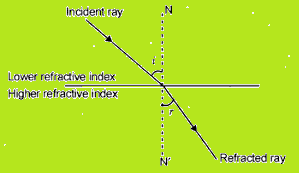
Note: When speed of light becomes less after refraction, light tilts towards the normal, and when speed becomes more after refraction then light bends away from the normal. It is the phenomenon of refraction that light always bends when it travels from one medium to another having different optical density.
Complete answer:
When a light travels from denser to rarer medium the angle of refraction is more than the angle of incidence. This is because the speed of light varies from medium to medium. Angle of incidence is the angle which light makes with normal while entering the medium whereas angle of incidence is the angle which light makes with the surface after refraction.
There are two types of medium namely optically rarer medium and optically denser medium. Speed of light is more in the rarer medium than in denser medium. So, whenever light travels from denser to rarer medium light tends to move away from the normal. And when light travels from rarer to denser medium light tends to move towards normal. Also the relative refractive index of the medium is equal to the ratio of speed of light in medium 1 to that of medium 2.
$$\mu = {{{v_1}} \over {{v_2}}}$$ where, $$\mu $$=refractive index of medium
The angle of incidence is only equal to the angle of refraction only when light enters perpendicular to the surface of the medium.
Note: When speed of light becomes less after refraction, light tilts towards the normal, and when speed becomes more after refraction then light bends away from the normal. It is the phenomenon of refraction that light always bends when it travels from one medium to another having different optical density.
Recently Updated Pages
Master Class 12 Economics: Engaging Questions & Answers for Success

Master Class 12 Physics: Engaging Questions & Answers for Success
Master Class 12 English: Engaging Questions & Answers for Success
Master Class 12 Social Science: Engaging Questions & Answers for Success
Master Class 12 Maths: Engaging Questions & Answers for Success
Master Class 12 Business Studies: Engaging Questions & Answers for Success
Trending doubts
Which are the Top 10 Largest Countries of the World?
What are the major means of transport Explain each class 12 social science CBSE
Draw a labelled sketch of the human eye class 12 physics CBSE
Why cannot DNA pass through cell membranes class 12 biology CBSE
Differentiate between insitu conservation and exsitu class 12 biology CBSE
Draw a neat and well labeled diagram of TS of ovary class 12 biology CBSE