




Male and female gametophytes are independent and free-living in
(a) Sphagnum
(b) Mustard
(c) Caster
(d) Pinus
Answer
 Verified
590.1k+ views
Hint: Gametophytes of bryophytes are haploid, independent, autotrophic and it represents sexual reproduction. It can store large quantities of water inside the cells.
Complete answer:
Sphagnum is a bryophyte with a regular and cyclic alternation of generation between gametophytic and sporophytic phases. They can be unisexual or bisexual in nature. In bryophytes, there are two distinct vegetative individuals, of whom one is haploid or gametophytic and the other is diploid or sporophytic in nature. Because of the presence of one haploid and one diploid individual, they are haplo-diplontic in nature. Mainly gametophytes undergo asexual reproduction by fragmentation.
In bryophytes, the haploid gametophyte is dominant and is represented by green thallus. The sporophytic generation is short-lived and is totally or partially dependent on the gametophytic thallus. In mustard, caster, and pinus main plant body is sporophytic unlike sphagnum and their gametophytic phase is completely dependent on sporophyte. Unlike bryophytes and pteridophytes, it is entirely different in gymnosperms. They do not have an independent free-living existence in the male and female gametophytes. They do not remain within sporangia retained on the sporophytes.
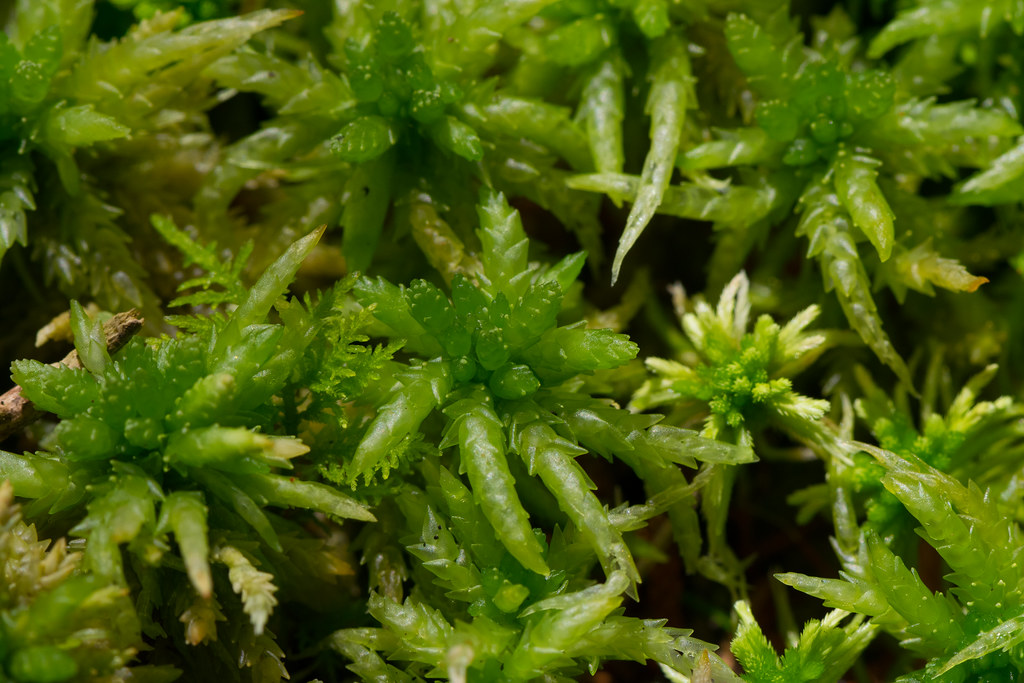
Figure: Sphagnum
So, the correct answer is ‘Sphagnum’.
Note: In Sphagnum moss, both living and dead plants retain a large quantity of water which is 16 to 26 times higher than its dry weight. When it grows, it slowly spreads into drier conditions forming bogs. This peat moss provides better habitat for peatland plants. Sphagnum moss has a variety of cells; such as photosynthesizing cells with chlorophyll and retort cells to soak up water like a sponge.
Complete answer:
Sphagnum is a bryophyte with a regular and cyclic alternation of generation between gametophytic and sporophytic phases. They can be unisexual or bisexual in nature. In bryophytes, there are two distinct vegetative individuals, of whom one is haploid or gametophytic and the other is diploid or sporophytic in nature. Because of the presence of one haploid and one diploid individual, they are haplo-diplontic in nature. Mainly gametophytes undergo asexual reproduction by fragmentation.
In bryophytes, the haploid gametophyte is dominant and is represented by green thallus. The sporophytic generation is short-lived and is totally or partially dependent on the gametophytic thallus. In mustard, caster, and pinus main plant body is sporophytic unlike sphagnum and their gametophytic phase is completely dependent on sporophyte. Unlike bryophytes and pteridophytes, it is entirely different in gymnosperms. They do not have an independent free-living existence in the male and female gametophytes. They do not remain within sporangia retained on the sporophytes.
Figure: Sphagnum
So, the correct answer is ‘Sphagnum’.
Note: In Sphagnum moss, both living and dead plants retain a large quantity of water which is 16 to 26 times higher than its dry weight. When it grows, it slowly spreads into drier conditions forming bogs. This peat moss provides better habitat for peatland plants. Sphagnum moss has a variety of cells; such as photosynthesizing cells with chlorophyll and retort cells to soak up water like a sponge.
Recently Updated Pages
Master Class 12 Economics: Engaging Questions & Answers for Success

Master Class 12 Physics: Engaging Questions & Answers for Success
Master Class 12 English: Engaging Questions & Answers for Success
Master Class 12 Social Science: Engaging Questions & Answers for Success
Master Class 12 Maths: Engaging Questions & Answers for Success
Master Class 12 Business Studies: Engaging Questions & Answers for Success
Trending doubts
Which are the Top 10 Largest Countries of the World?
What are the major means of transport Explain each class 12 social science CBSE
Draw a labelled sketch of the human eye class 12 physics CBSE
What is a transformer Explain the principle construction class 12 physics CBSE
Why cannot DNA pass through cell membranes class 12 biology CBSE
Differentiate between insitu conservation and exsitu class 12 biology CBSE