




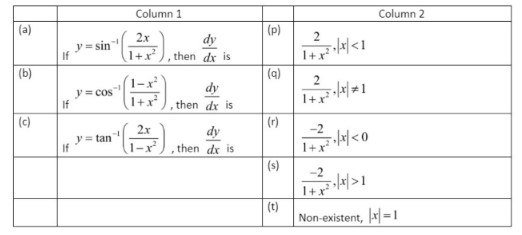
Match the following columns:
Answer
 Verified
618.9k+ views
Hint: To match the columns, simplify the functions given on the right hand side using the properties of inverse functions in the given range and domain and then differentiate them to get the exact values and then match them with the right hand side.
Complete step-by-step answer:
We have three different kinds of functions on the right side of the table. We want to find their derivative. We will begin by simplifying the given functions in their possible domain and range and then finding their first derivative.
We have the function \[y={{\sin }^{-1}}\left( \dfrac{2x}{1+{{x}^{2}}} \right)\]. We know that the domain of \[y={{\sin }^{-1}}x\] is \[\left[ -1,1 \right]\] and its range is \[\left[ -\dfrac{\pi }{2},\dfrac{\pi }{2} \right]\].
Thus, by substituting \[x=\tan \theta \] we get
\[y={{\sin }^{-1}}\left( \dfrac{2x}{1+{{x}^{2}}} \right)=2{{\tan }^{-1}}x\] if \[\left| x \right|\le 1\]
\[=\pi -2{{\tan }^{-1}}x\] if \[x>1\]
\[=-\left( \pi +2{{\tan }^{-1}}x \right)\] if \[x<-1\]
We know that the first derivative of \[y=a{{\tan }^{-1}}x+b\] is \[\dfrac{dy}{dx}=\dfrac{a}{1+{{x}^{2}}}\] .
If \[\left| x \right|<1\], we have \[y={{\sin }^{-1}}\left( \dfrac{2x}{1+{{x}^{2}}} \right)=2{{\tan }^{-1}}x\], thus \[\dfrac{dy}{dx}=\dfrac{2}{1+{{x}^{2}}}\].
If \[\left| x \right|>1\], we have \[y={{\sin }^{-1}}\left( \dfrac{2x}{1+{{x}^{2}}} \right)=\pm \pi -2{{\tan }^{-1}}x\], thus \[\dfrac{dy}{dx}=\dfrac{-2}{1+{{x}^{2}}}\].
Thus, for (a) the correct options are (p), (s).
We have the function \[y={{\cos }^{-1}}\left( \dfrac{1-{{x}^{2}}}{1+{{x}^{2}}} \right)\]. We know that the domain of \[y={{\cos }^{-1}}x\] is \[\left[ -1,1 \right]\] and its range is \[\left[ 0,\pi \right]\].
Thus, by substituting \[x=\tan \theta \] we get
\[y={{\cos }^{-1}}\left( \dfrac{1-{{x}^{2}}}{1+{{x}^{2}}} \right)=2{{\tan }^{-1}}x\] if \[x\ge 0\]
\[=-2{{\tan }^{-1}}x\] if \[x<0\]
We know that the first derivative of \[y=a{{\tan }^{-1}}x+b\] is \[\dfrac{dy}{dx}=\dfrac{a}{1+{{x}^{2}}}\] .
If \[x<0\], we have \[y={{\cos }^{-1}}\left( \dfrac{1-{{x}^{2}}}{1+{{x}^{2}}} \right)=-2{{\tan }^{-1}}x\], thus \[\dfrac{dy}{dx}=\dfrac{-2}{1+{{x}^{2}}}\].
If \[x\ge 0\], we have \[y={{\cos }^{-1}}\left( \dfrac{1-{{x}^{2}}}{1+{{x}^{2}}} \right)=2{{\tan }^{-1}}x\], thus \[\dfrac{dy}{dx}=\dfrac{2}{1+{{x}^{2}}}\].
Thus, for (b) the correct option is (r).
We have the function \[y={{\tan }^{-1}}\left( \dfrac{2x}{1-{{x}^{2}}} \right)\]. We know that the domain of \[y={{\tan }^{-1}}x\] is \[\mathbb{R}\] and its range is \[\left( \dfrac{-\pi }{2},\dfrac{\pi }{2} \right)\].
Thus, by substituting \[x=\tan \theta \] we get
\[y={{\tan }^{-1}}\left( \dfrac{2x}{1-{{x}^{2}}} \right)=2{{\tan }^{-1}}x\] if \[\left| x \right|<1\]
\[=-\pi +2{{\tan }^{-1}}x\] if \[x>1\]
\[=\pi +2{{\tan }^{-1}}x\] if \[x<-1\]
We know that the first derivative of \[y=a{{\tan }^{-1}}x+b\] is \[\dfrac{dy}{dx}=\dfrac{a}{1+{{x}^{2}}}\] .
If \[\left| x \right|<1\], we have \[y={{\tan }^{-1}}\left( \dfrac{2x}{1-{{x}^{2}}} \right)=2{{\tan }^{-1}}x\], thus \[\dfrac{dy}{dx}=\dfrac{2}{1+{{x}^{2}}}\].
If \[\left| x \right|>1\], we have \[y={{\tan }^{-1}}\left( \dfrac{2x}{1-{{x}^{2}}} \right)=\pm \pi +2{{\tan }^{-1}}x\], thus \[\dfrac{dy}{dx}=\dfrac{2}{1+{{x}^{2}}}\].
Also, the function \[y={{\tan }^{-1}}\left( \dfrac{2x}{1-{{x}^{2}}} \right)\] is non-existent for \[\left| x \right|=1\].
Thus, for (c) the correct options are (p), (q) and (t).
Note: It’s necessary to keep in mind the possible domain and range of the given inverse functions. The functions show different behaviour in different values of domain and range. If we don’t keep the domain and range in mind, we will get an incorrect answer.
Complete step-by-step answer:
We have three different kinds of functions on the right side of the table. We want to find their derivative. We will begin by simplifying the given functions in their possible domain and range and then finding their first derivative.
We have the function \[y={{\sin }^{-1}}\left( \dfrac{2x}{1+{{x}^{2}}} \right)\]. We know that the domain of \[y={{\sin }^{-1}}x\] is \[\left[ -1,1 \right]\] and its range is \[\left[ -\dfrac{\pi }{2},\dfrac{\pi }{2} \right]\].
Thus, by substituting \[x=\tan \theta \] we get
\[y={{\sin }^{-1}}\left( \dfrac{2x}{1+{{x}^{2}}} \right)=2{{\tan }^{-1}}x\] if \[\left| x \right|\le 1\]
\[=\pi -2{{\tan }^{-1}}x\] if \[x>1\]
\[=-\left( \pi +2{{\tan }^{-1}}x \right)\] if \[x<-1\]
We know that the first derivative of \[y=a{{\tan }^{-1}}x+b\] is \[\dfrac{dy}{dx}=\dfrac{a}{1+{{x}^{2}}}\] .
If \[\left| x \right|<1\], we have \[y={{\sin }^{-1}}\left( \dfrac{2x}{1+{{x}^{2}}} \right)=2{{\tan }^{-1}}x\], thus \[\dfrac{dy}{dx}=\dfrac{2}{1+{{x}^{2}}}\].
If \[\left| x \right|>1\], we have \[y={{\sin }^{-1}}\left( \dfrac{2x}{1+{{x}^{2}}} \right)=\pm \pi -2{{\tan }^{-1}}x\], thus \[\dfrac{dy}{dx}=\dfrac{-2}{1+{{x}^{2}}}\].
Thus, for (a) the correct options are (p), (s).
We have the function \[y={{\cos }^{-1}}\left( \dfrac{1-{{x}^{2}}}{1+{{x}^{2}}} \right)\]. We know that the domain of \[y={{\cos }^{-1}}x\] is \[\left[ -1,1 \right]\] and its range is \[\left[ 0,\pi \right]\].
Thus, by substituting \[x=\tan \theta \] we get
\[y={{\cos }^{-1}}\left( \dfrac{1-{{x}^{2}}}{1+{{x}^{2}}} \right)=2{{\tan }^{-1}}x\] if \[x\ge 0\]
\[=-2{{\tan }^{-1}}x\] if \[x<0\]
We know that the first derivative of \[y=a{{\tan }^{-1}}x+b\] is \[\dfrac{dy}{dx}=\dfrac{a}{1+{{x}^{2}}}\] .
If \[x<0\], we have \[y={{\cos }^{-1}}\left( \dfrac{1-{{x}^{2}}}{1+{{x}^{2}}} \right)=-2{{\tan }^{-1}}x\], thus \[\dfrac{dy}{dx}=\dfrac{-2}{1+{{x}^{2}}}\].
If \[x\ge 0\], we have \[y={{\cos }^{-1}}\left( \dfrac{1-{{x}^{2}}}{1+{{x}^{2}}} \right)=2{{\tan }^{-1}}x\], thus \[\dfrac{dy}{dx}=\dfrac{2}{1+{{x}^{2}}}\].
Thus, for (b) the correct option is (r).
We have the function \[y={{\tan }^{-1}}\left( \dfrac{2x}{1-{{x}^{2}}} \right)\]. We know that the domain of \[y={{\tan }^{-1}}x\] is \[\mathbb{R}\] and its range is \[\left( \dfrac{-\pi }{2},\dfrac{\pi }{2} \right)\].
Thus, by substituting \[x=\tan \theta \] we get
\[y={{\tan }^{-1}}\left( \dfrac{2x}{1-{{x}^{2}}} \right)=2{{\tan }^{-1}}x\] if \[\left| x \right|<1\]
\[=-\pi +2{{\tan }^{-1}}x\] if \[x>1\]
\[=\pi +2{{\tan }^{-1}}x\] if \[x<-1\]
We know that the first derivative of \[y=a{{\tan }^{-1}}x+b\] is \[\dfrac{dy}{dx}=\dfrac{a}{1+{{x}^{2}}}\] .
If \[\left| x \right|<1\], we have \[y={{\tan }^{-1}}\left( \dfrac{2x}{1-{{x}^{2}}} \right)=2{{\tan }^{-1}}x\], thus \[\dfrac{dy}{dx}=\dfrac{2}{1+{{x}^{2}}}\].
If \[\left| x \right|>1\], we have \[y={{\tan }^{-1}}\left( \dfrac{2x}{1-{{x}^{2}}} \right)=\pm \pi +2{{\tan }^{-1}}x\], thus \[\dfrac{dy}{dx}=\dfrac{2}{1+{{x}^{2}}}\].
Also, the function \[y={{\tan }^{-1}}\left( \dfrac{2x}{1-{{x}^{2}}} \right)\] is non-existent for \[\left| x \right|=1\].
Thus, for (c) the correct options are (p), (q) and (t).
Note: It’s necessary to keep in mind the possible domain and range of the given inverse functions. The functions show different behaviour in different values of domain and range. If we don’t keep the domain and range in mind, we will get an incorrect answer.
Recently Updated Pages
Master Class 12 Economics: Engaging Questions & Answers for Success

Master Class 12 Physics: Engaging Questions & Answers for Success
Master Class 12 English: Engaging Questions & Answers for Success
Master Class 12 Social Science: Engaging Questions & Answers for Success
Master Class 12 Maths: Engaging Questions & Answers for Success
Master Class 12 Business Studies: Engaging Questions & Answers for Success
Trending doubts
Which are the Top 10 Largest Countries of the World?
What are the major means of transport Explain each class 12 social science CBSE
Draw a labelled sketch of the human eye class 12 physics CBSE
Why cannot DNA pass through cell membranes class 12 biology CBSE
Differentiate between insitu conservation and exsitu class 12 biology CBSE
Draw a neat and well labeled diagram of TS of ovary class 12 biology CBSE