




What do you mean by filtration. Explain with a diagram.
Answer
 Verified
533.7k+ views
Hint: The concept of filtration is applied to separate or filter out a required substance from a heterogeneous mixture. Specifically, the solid substance is removed from a liquid with the help of a semi-permeable membrane.
Complete answer:
The drinking tea is made by adding tea leaves and sugar to water or milk but the tea leaves are removed from the mixture at the end with the help of a sieve or filter. This type of process which involves the separation of suspended solids from a liquid solvent by passing it through a fine porous membrane is known as filtration.
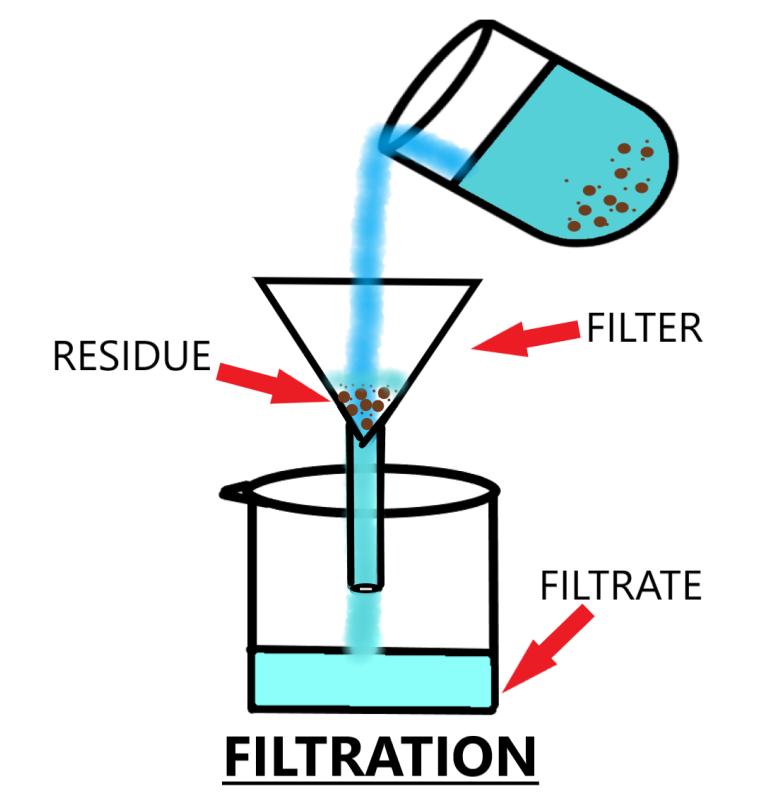
The membrane or filter used for filtration has pores small enough to allow liquid to pass through it and the larger solid particles remain on top of the membrane.
The liquid or any fluid that is obtained after passing through the filter is called filtrate and the solid particles which get separated out are called the residue.
Thus, filtration is a basic technique to filter out a liquid component from a heterogeneous mixture of solid and liquid.
Additional information:
The method of filtration is used in water treatment plants and there are many ways to perform filtration such as filtration by vacuum.
Note:
Filtration is different from sieving. Sieving involves a single perforated layer that allows liquid to pass through it while filtration involves a filter medium that has multiple layers through which liquid passes. Thus, sieving cannot be used to filter a liquid that has very fine solid particles as they can pass through the sieve and we cannot obtain a pure liquid.
Complete answer:
The drinking tea is made by adding tea leaves and sugar to water or milk but the tea leaves are removed from the mixture at the end with the help of a sieve or filter. This type of process which involves the separation of suspended solids from a liquid solvent by passing it through a fine porous membrane is known as filtration.
The membrane or filter used for filtration has pores small enough to allow liquid to pass through it and the larger solid particles remain on top of the membrane.
The liquid or any fluid that is obtained after passing through the filter is called filtrate and the solid particles which get separated out are called the residue.
Thus, filtration is a basic technique to filter out a liquid component from a heterogeneous mixture of solid and liquid.
Additional information:
The method of filtration is used in water treatment plants and there are many ways to perform filtration such as filtration by vacuum.
Note:
Filtration is different from sieving. Sieving involves a single perforated layer that allows liquid to pass through it while filtration involves a filter medium that has multiple layers through which liquid passes. Thus, sieving cannot be used to filter a liquid that has very fine solid particles as they can pass through the sieve and we cannot obtain a pure liquid.
Recently Updated Pages
Master Class 11 Computer Science: Engaging Questions & Answers for Success

Master Class 11 Business Studies: Engaging Questions & Answers for Success
Master Class 11 Economics: Engaging Questions & Answers for Success
Master Class 11 English: Engaging Questions & Answers for Success
Master Class 11 Maths: Engaging Questions & Answers for Success
Master Class 11 Biology: Engaging Questions & Answers for Success
Trending doubts
One Metric ton is equal to kg A 10000 B 1000 C 100 class 11 physics CBSE
There are 720 permutations of the digits 1 2 3 4 5 class 11 maths CBSE
Discuss the various forms of bacteria class 11 biology CBSE
Draw a diagram of a plant cell and label at least eight class 11 biology CBSE
State the laws of reflection of light
Explain zero factorial class 11 maths CBSE