




When npn transistor is used as an amplifier:
A. Electrons move from base to collector
B. Holes move from emitter to base
C. Electrons move from collector to base
D. Holes move from base to emitter
Answer
 Verified
574.8k+ views
Hint: Amplifier is an electronic circuit that controls a large output signal using a small input signal. The input of an amplifier can be a voltage or else current and the output will be an amplified input signal. The amplifier can have npn configuration as well as pnp configuration. The difference between these two configurations is the direction of flow of electrons and holes. Electrons and holes flow in opposite directions to each other.
Complete answer:
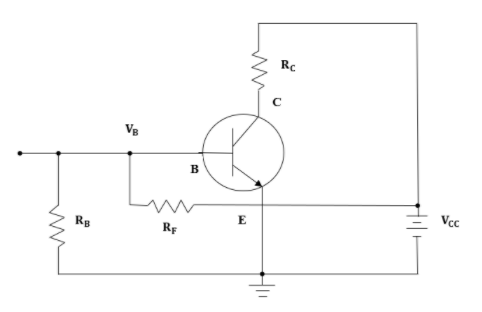
When the npn transistor is in forward bias, electrons flow from emitter to base. Electrons and holes always move in opposite directions. Thus, the holes move from base to emitter. When the pnp transistor is in forward bias, holes move from emitter to base and the electrons move from base to emitter.
For a npn transistor to be used as an amplifier, forward bias has to be applied on the transistor. Thus, when an npn transistor is used as an amplifier, holes move from base to emitter.
So, the correct answer is option D i.e. holes move from base to emitter.
Note:
Transistors as an amplifier have many applications. Transistor amplifier circuits are used in audio, radio, optical fiber communication, etc. Students must remember that a transistor can be used as an amplifier only if it is biased properly. There are various parameters for a transistor to be good which includes high gain, high bandwidth, high linearity, high efficiency, high stability, etc. The amplifiers generally have common emitter configuration.
Complete answer:
When the npn transistor is in forward bias, electrons flow from emitter to base. Electrons and holes always move in opposite directions. Thus, the holes move from base to emitter. When the pnp transistor is in forward bias, holes move from emitter to base and the electrons move from base to emitter.
For a npn transistor to be used as an amplifier, forward bias has to be applied on the transistor. Thus, when an npn transistor is used as an amplifier, holes move from base to emitter.
So, the correct answer is option D i.e. holes move from base to emitter.
Note:
Transistors as an amplifier have many applications. Transistor amplifier circuits are used in audio, radio, optical fiber communication, etc. Students must remember that a transistor can be used as an amplifier only if it is biased properly. There are various parameters for a transistor to be good which includes high gain, high bandwidth, high linearity, high efficiency, high stability, etc. The amplifiers generally have common emitter configuration.
Recently Updated Pages
Master Class 12 Economics: Engaging Questions & Answers for Success

Master Class 12 Physics: Engaging Questions & Answers for Success
Master Class 12 English: Engaging Questions & Answers for Success
Master Class 12 Social Science: Engaging Questions & Answers for Success
Master Class 12 Maths: Engaging Questions & Answers for Success
Master Class 12 Business Studies: Engaging Questions & Answers for Success
Trending doubts
Which are the Top 10 Largest Countries of the World?
What are the major means of transport Explain each class 12 social science CBSE
Draw a labelled sketch of the human eye class 12 physics CBSE
Why cannot DNA pass through cell membranes class 12 biology CBSE
Differentiate between insitu conservation and exsitu class 12 biology CBSE
Draw a neat and well labeled diagram of TS of ovary class 12 biology CBSE