




Prove that $\csc \left( {{\csc }^{-1}}x \right)=x,x\in \left( -\infty ,-1 \right]\bigcup \left[ 1,\infty \right)$
Answer
 Verified
606k+ views
Hint: Use the fact that if $y={{\csc }^{-1}}x$, then $x=\csc y$. Assume $y={{\csc }^{-1}}x$. Write $\csc \left( {{\csc }^{-1}}x \right)$ in terms of y and hence prove the above result.
Complete step-by-step answer:
Before dwelling into the proof of the above question, we must understand how ${{\csc }^{-1}}x$ is defined even when $\csc x$ is not one-one.
We know that cosecx is a periodic function.
Let us draw the graph of cosecx
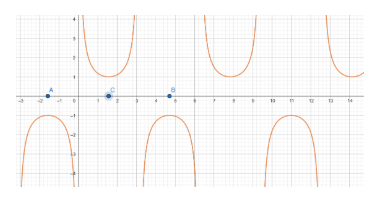
As is evident from the graph cosecx is a repeated chunk of the graph of cosecx within the interval $\left[ A,B \right]-\left\{ 0,\pi \right\}$ , and it attains all its possible values in the interval $\left[ A,C \right]-\left\{ 0 \right\}$, where $A=\dfrac{-\pi }{2},B=\dfrac{3\pi }{2}$ and $C=\dfrac{\pi }{2}$
Hence if we consider cosecx in the interval [A, C], we will lose no value attained by cosecx, and at the same time, cosecx will be one-one and onto.
Hence ${{\csc }^{-1}}x$ is defined over the Domain $\left( -\infty ,-1 \right]\bigcup \left[ 1,\infty \right)$, with codomain $\left[ \dfrac{-\pi }{2},\dfrac{\pi }{2} \right]-\left\{ 0 \right\}$ as in the Domain $\left[ \dfrac{-\pi }{2},\dfrac{\pi }{2} \right]-\left\{ 0 \right\}$, cosecx is one-one and ${{R}_{\csc x}}=\left( -\infty ,-1 \right]\bigcup \left[ 1,\infty \right)$.
Now since ${{\csc }^{-1}}x$ is the inverse of cosecx it satisfies the fact that if $y={{\csc }^{-1}}x$, then $\csc y=x$.
So let $y={{\csc }^{-1}}x$
Hence we have cosecy = x.
Now $\csc \left( {{\csc }^{-1}}x \right)=\csc y$
Hence we have $\csc \left( {{\csc }^{-1}}x \right)=x$.
Also as x is in the Domain of ${{\csc }^{-1}}x$, we have $x\in \left( -\infty ,-1 \right]\bigcup \left[ 1,\infty \right)$.
Hence $\csc \left( {{\csc }^{-1}}x \right)=x,x\in \left( -\infty ,-1 \right]\bigcup \left[ 1,\infty \right)$
Note: [1] The above-specified codomain for ${{\csc }^{-1}}x$ is called principal branch for ${{\csc }^{-1}}x$. We can select any branch as long as $\csc x$ is one-one and onto and Range $=\left( -\infty ,-1 \right]\bigcup \left[ 1,\infty \right)$. Like instead of $\left[ -\dfrac{\pi }{2},\dfrac{\pi }{2} \right]-\left\{ 0 \right\}$, we can select the interval $\left[ \dfrac{\pi }{2},\dfrac{3\pi }{2} \right]-\left\{ \pi \right\}$. The proof will remain the same as above.
Complete step-by-step answer:
Before dwelling into the proof of the above question, we must understand how ${{\csc }^{-1}}x$ is defined even when $\csc x$ is not one-one.
We know that cosecx is a periodic function.
Let us draw the graph of cosecx
As is evident from the graph cosecx is a repeated chunk of the graph of cosecx within the interval $\left[ A,B \right]-\left\{ 0,\pi \right\}$ , and it attains all its possible values in the interval $\left[ A,C \right]-\left\{ 0 \right\}$, where $A=\dfrac{-\pi }{2},B=\dfrac{3\pi }{2}$ and $C=\dfrac{\pi }{2}$
Hence if we consider cosecx in the interval [A, C], we will lose no value attained by cosecx, and at the same time, cosecx will be one-one and onto.
Hence ${{\csc }^{-1}}x$ is defined over the Domain $\left( -\infty ,-1 \right]\bigcup \left[ 1,\infty \right)$, with codomain $\left[ \dfrac{-\pi }{2},\dfrac{\pi }{2} \right]-\left\{ 0 \right\}$ as in the Domain $\left[ \dfrac{-\pi }{2},\dfrac{\pi }{2} \right]-\left\{ 0 \right\}$, cosecx is one-one and ${{R}_{\csc x}}=\left( -\infty ,-1 \right]\bigcup \left[ 1,\infty \right)$.
Now since ${{\csc }^{-1}}x$ is the inverse of cosecx it satisfies the fact that if $y={{\csc }^{-1}}x$, then $\csc y=x$.
So let $y={{\csc }^{-1}}x$
Hence we have cosecy = x.
Now $\csc \left( {{\csc }^{-1}}x \right)=\csc y$
Hence we have $\csc \left( {{\csc }^{-1}}x \right)=x$.
Also as x is in the Domain of ${{\csc }^{-1}}x$, we have $x\in \left( -\infty ,-1 \right]\bigcup \left[ 1,\infty \right)$.
Hence $\csc \left( {{\csc }^{-1}}x \right)=x,x\in \left( -\infty ,-1 \right]\bigcup \left[ 1,\infty \right)$
Note: [1] The above-specified codomain for ${{\csc }^{-1}}x$ is called principal branch for ${{\csc }^{-1}}x$. We can select any branch as long as $\csc x$ is one-one and onto and Range $=\left( -\infty ,-1 \right]\bigcup \left[ 1,\infty \right)$. Like instead of $\left[ -\dfrac{\pi }{2},\dfrac{\pi }{2} \right]-\left\{ 0 \right\}$, we can select the interval $\left[ \dfrac{\pi }{2},\dfrac{3\pi }{2} \right]-\left\{ \pi \right\}$. The proof will remain the same as above.
Recently Updated Pages
Master Class 12 Economics: Engaging Questions & Answers for Success

Master Class 12 Physics: Engaging Questions & Answers for Success
Master Class 12 English: Engaging Questions & Answers for Success
Master Class 12 Social Science: Engaging Questions & Answers for Success
Master Class 12 Maths: Engaging Questions & Answers for Success
Master Class 12 Business Studies: Engaging Questions & Answers for Success
Trending doubts
Which are the Top 10 Largest Countries of the World?
What are the major means of transport Explain each class 12 social science CBSE
Draw a labelled sketch of the human eye class 12 physics CBSE
Why cannot DNA pass through cell membranes class 12 biology CBSE
Differentiate between insitu conservation and exsitu class 12 biology CBSE
Draw a neat and well labeled diagram of TS of ovary class 12 biology CBSE