




How is the sex of the child determined in human punnet square?
Answer
 Verified
510.6k+ views
Hint: A sex-determination system is a biological system that controls the development of an organism's sexual characteristics. The majority of organisms that produce offspring through sexual reproduction have two sexes. Hermaphrodites exist in some species.
Complete answer:
The XY type is the sex-determining mechanism in humans. Humans have 23 chromosome pairs. Autosomes are 22 pairs of chromosomes that are identical in both males and females. The 23rd pair is unique to both sexes and is referred to as the sex chromosome. Males have X and Y chromosomes as sex chromosomes, while females have a pair of X chromosomes.
The type of male haploid gamete that fuses with the female egg determines a child's sex in humans.
Males produce two types of gametes during spermatogenesis: half of the sperms have an X chromosome and the other half have a Y chromosome.
The female egg has an X chromosome at all times.
If a male gamete with the X chromosome fuses with a female egg, the child will be female; if a male gamete with the Y chromosome fuses with a female egg, the child will be male.
In humans, the sex of the child is determined by genetics.
Women have a perfectly matched pair of sex chromosomes, XX, whereas men have a mismatched pair, XY. The X chromosome will be present in all eggs produced. Half of the sperms will have the Y chromosome, while the other half will have the X chromosome.
When an egg fuses with a sperm carrying the Y chromosome during fertilization, a boy is formed. When the egg fuses with a sperm carrying the X chromosome, the offspring will be a girl child.
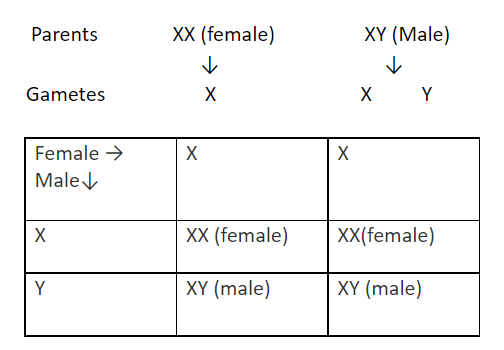
Thus, in this way, the sex of the child is determined in human punnet square.
Note:
Sex determination is genetic in many species: males and females have different alleles or even different genes that specify their sexual morphology. In animals, this is frequently accompanied by chromosomal differences, most commonly through XY, ZW, XO, ZO chromosome combinations, or haplodiploidy. A main gene (a "sex locus") is usually responsible for sexual differentiation.
Complete answer:
The XY type is the sex-determining mechanism in humans. Humans have 23 chromosome pairs. Autosomes are 22 pairs of chromosomes that are identical in both males and females. The 23rd pair is unique to both sexes and is referred to as the sex chromosome. Males have X and Y chromosomes as sex chromosomes, while females have a pair of X chromosomes.
The type of male haploid gamete that fuses with the female egg determines a child's sex in humans.
Males produce two types of gametes during spermatogenesis: half of the sperms have an X chromosome and the other half have a Y chromosome.
The female egg has an X chromosome at all times.
If a male gamete with the X chromosome fuses with a female egg, the child will be female; if a male gamete with the Y chromosome fuses with a female egg, the child will be male.
In humans, the sex of the child is determined by genetics.
Women have a perfectly matched pair of sex chromosomes, XX, whereas men have a mismatched pair, XY. The X chromosome will be present in all eggs produced. Half of the sperms will have the Y chromosome, while the other half will have the X chromosome.
When an egg fuses with a sperm carrying the Y chromosome during fertilization, a boy is formed. When the egg fuses with a sperm carrying the X chromosome, the offspring will be a girl child.
Thus, in this way, the sex of the child is determined in human punnet square.
Note:
Sex determination is genetic in many species: males and females have different alleles or even different genes that specify their sexual morphology. In animals, this is frequently accompanied by chromosomal differences, most commonly through XY, ZW, XO, ZO chromosome combinations, or haplodiploidy. A main gene (a "sex locus") is usually responsible for sexual differentiation.
Recently Updated Pages
Master Class 12 Economics: Engaging Questions & Answers for Success

Master Class 12 Physics: Engaging Questions & Answers for Success
Master Class 12 English: Engaging Questions & Answers for Success
Master Class 12 Social Science: Engaging Questions & Answers for Success
Master Class 12 Maths: Engaging Questions & Answers for Success
Master Class 12 Business Studies: Engaging Questions & Answers for Success
Trending doubts
Which are the Top 10 Largest Countries of the World?
What are the major means of transport Explain each class 12 social science CBSE
Draw a labelled sketch of the human eye class 12 physics CBSE
Why cannot DNA pass through cell membranes class 12 biology CBSE
Differentiate between insitu conservation and exsitu class 12 biology CBSE
Draw a neat and well labeled diagram of TS of ovary class 12 biology CBSE