




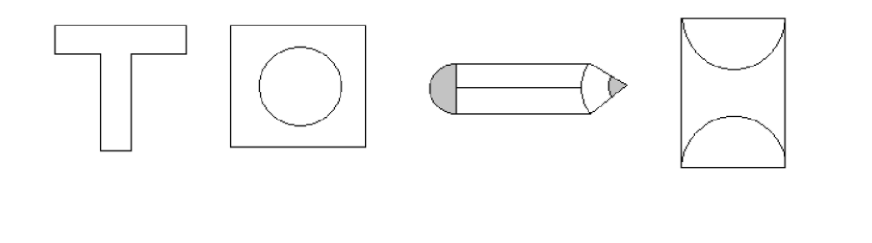
Shankar made the following picture also.
What shapes can they be broken into so that we can find the area easily?
Make some more pictures and think of the shapes they can be divided into different parts.
Answer
 Verified
559.2k+ views
Hint:We know the formula to find the areas of a rectangle/square, parallelogram, triangle, and circle.
Breaking a complicated shape into the shapes whose formulae we already know, can help us determine its area.
Look for the familiar shapes, like rectangle or a circle, in the given pictures.
Complete step by step solution:
The given shapes can be divided into rectangles, circles, semi-circles and triangles as illustrated below.
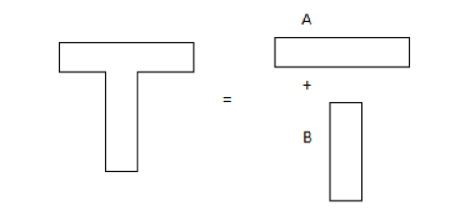
The T shape can be divided into two rectangles, as shown:
Total area = $A+B$ .
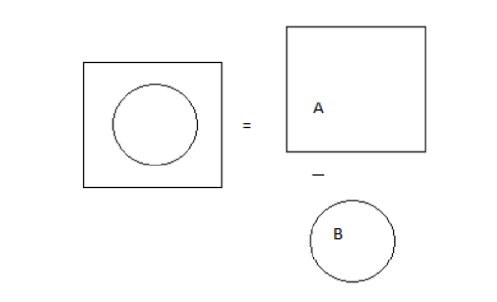
We can separate the square and the circle in the next shape.
Total area = $A-B$ .
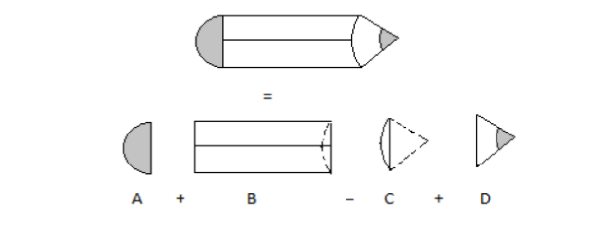
For the pencil, we can divide into a semi-circle, a rectangle, a segment of a circle and a triangle.
Total area = $A+B-C+D$ .
The next shape is made up of a rectangle and two semi-circles.
Total area = $A-B-C$ .
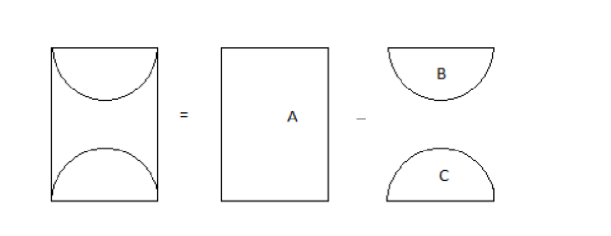
Note:Area is measured by counting the number of squares of a unit length present in a shape.There are $a\times a$ unit squares inside a square of side $a$ units.
Area of a parallelogram with base $b$ units and height $h$ units is $b\times h$ square units.
Area of a triangle with base $b$ units and height $h$ units will be $\dfrac{1}{2}\times b\times h$ square units.
Area of a circle of radius r units, is $\pi {{r}^{2}}$ sq. units.
3D figures are also made by combining basic figures such that squares, rectangles, circles etc. For example: Cube is a 3D figure containing six squares having area 2a if a is the length of the side of the square and thus, Total area of the cube is 26a as it contains six squares.
Breaking a complicated shape into the shapes whose formulae we already know, can help us determine its area.
Look for the familiar shapes, like rectangle or a circle, in the given pictures.
Complete step by step solution:
The given shapes can be divided into rectangles, circles, semi-circles and triangles as illustrated below.
The T shape can be divided into two rectangles, as shown:
Total area = $A+B$ .
We can separate the square and the circle in the next shape.
Total area = $A-B$ .
For the pencil, we can divide into a semi-circle, a rectangle, a segment of a circle and a triangle.
Total area = $A+B-C+D$ .
The next shape is made up of a rectangle and two semi-circles.
Total area = $A-B-C$ .
Note:Area is measured by counting the number of squares of a unit length present in a shape.There are $a\times a$ unit squares inside a square of side $a$ units.
Area of a parallelogram with base $b$ units and height $h$ units is $b\times h$ square units.
Area of a triangle with base $b$ units and height $h$ units will be $\dfrac{1}{2}\times b\times h$ square units.
Area of a circle of radius r units, is $\pi {{r}^{2}}$ sq. units.
3D figures are also made by combining basic figures such that squares, rectangles, circles etc. For example: Cube is a 3D figure containing six squares having area 2a if a is the length of the side of the square and thus, Total area of the cube is 26a as it contains six squares.
Recently Updated Pages
Master Class 11 Computer Science: Engaging Questions & Answers for Success

Master Class 11 Business Studies: Engaging Questions & Answers for Success
Master Class 11 Economics: Engaging Questions & Answers for Success
Master Class 11 English: Engaging Questions & Answers for Success
Master Class 11 Maths: Engaging Questions & Answers for Success
Master Class 11 Biology: Engaging Questions & Answers for Success
Trending doubts
One Metric ton is equal to kg A 10000 B 1000 C 100 class 11 physics CBSE
There are 720 permutations of the digits 1 2 3 4 5 class 11 maths CBSE
Discuss the various forms of bacteria class 11 biology CBSE
Draw a diagram of a plant cell and label at least eight class 11 biology CBSE
State the laws of reflection of light
Explain zero factorial class 11 maths CBSE