




Show that the values of $\sin 2{{\theta}} - \cos 2{{\theta}} - \sin {{\theta}} + \cos {{\theta}} = 0$.
Answer
 Verified
580.8k+ views
Hint: In this question we have to show that the given trigonometric expression equals zero. For this we are going to show that by using trigonometric identities in angle and ratio and also we are going to multiply and add the trigonometric identities in complete step by step solution.
Trigonometric is a function that deals with the relationship between the sides and angles of triangles.
Formula used: There are six function of an angle commonly used in trigonometry, they are \[{\text{sine, cosine, tangent, }}\] \[{\text{cosecant, secant, co - tangent}}\]. In this sum we are going to see about only \[{\text{sine}}\] and \[{\text{cosine}}\] angle and ratio formula. The formulas are
$\sin 2{{\theta}} - \cos 2{{\theta}} = \sqrt 2 \sin \left( {{{2\theta }} - \dfrac{{{\pi}}}{4}} \right)$
$\sin {{\theta}} - \cos {{\theta}} = - \sqrt 2 \sin \left( {{{\theta}} - \dfrac{{{\pi}}}{4}} \right)$
\[\sin {\text{a + }}\sin {\text{b}} = 2\sin \left( {\dfrac{{{\text{a}} + {\text{b}}}}{{\text{2}}}} \right).\cos \left( {\dfrac{{{\text{a}} - {\text{b}}}}{2}} \right)\]
Complete step-by-step answer:
Let consider the given equation as \[{\text{f}}\left( {\text{x}} \right) = {\text{sin}}2{{\theta}} - \cos 2{{\theta}} - \sin {{\theta}} + \cos {{\theta = 0}}\] .
Now, Rewrite the above equation as \[{\text{f}}\left( {\text{x}} \right) = \left( {{\text{sin}}2{{\theta}} - \cos 2{{\theta}}} \right) - \left( {\sin {{\theta}} - \cos {{\theta}}} \right){\text{ = 0}}\].
Here, we applying the trigonometric angles formulas on the expression, the \[{\text{sine}}\] and \[{\text{cosine}}\] angle are commonly known as $\sin $ and $\cos $.
$\sin {{\theta}} - \cos {{\theta}} = \sqrt 2 \sin \left( {{{\theta}} - \dfrac{{{\pi}}}{4}} \right)$
Now, we get
$\sin 2{{\theta}} - \cos 2{{\theta}} = \sqrt 2 \sin \left( {{{2\theta }} - \dfrac{{{\pi}}}{4}} \right)$ and
$\sin {{\theta}} - \cos {{\theta}} = - \sqrt 2 \sin \left( {{{\theta}} - \dfrac{{{\pi}}}{4}} \right)$
Substitute the two trigonometric identities into the \[{\text{f}}\left( {\text{x}} \right)\], we get
${\text{f(x)}} = \sqrt 2 \sin \left( {{{2\theta }} - \dfrac{{{\pi}}}{4}} \right) + \sqrt 2 \sin \left( {{{\theta}} - \dfrac{{{\pi}}}{4}} \right) = 0$
Taking $\sqrt 2 $ as a common term in the above both terms, then
\[ \Rightarrow \sqrt 2 \left( {\sin \left( {{{2\theta }} - \dfrac{{{\pi}}}{4}} \right) + \sin \left( {{{\theta}} - \dfrac{{{\pi}}}{4}} \right)} \right) = 0\]
Now, cross multiply the $\sqrt 2 $ into denominator of right hand side, we get
\[ \Rightarrow \sin \left( {{{2\theta }} - \dfrac{{{\pi}}}{4}} \right) + \sin \left( {{{\theta}} - \dfrac{{{\pi}}}{4}} \right) = \dfrac{0}{{\sqrt 2 }}\]
We know that any number divisible by zero is zero. Then,
\[ \Rightarrow \sin \left( {{{2\theta }} - \dfrac{{{\pi}}}{4}} \right) + \sin \left( {{{\theta}} - \dfrac{{{\pi}}}{4}} \right) = 0\]
Applying the trigonometry identity,
\[\sin {\text{a + }}\sin {\text{b}} = 2\sin \left( {\dfrac{{{\text{a}} + {\text{b}}}}{{\text{2}}}} \right).\cos \left( {\dfrac{{{\text{a}} - {\text{b}}}}{2}} \right)\]
Now, consider here, ${\text{a}} = 2{{\theta}} - \dfrac{{{\pi}}}{4}$ and ${\text{b}} = {{\theta}} - \dfrac{{{\pi}}}{4}$ . Then, we substitute in the above trigonometric identity, we get
\[ \Rightarrow \sin \left( {{{2\theta }} - \dfrac{{{\pi}}}{4}} \right) + \sin \left( {{{\theta}} - \dfrac{{{\pi}}}{4}} \right) = \sin \left( {2{{\theta}} - \dfrac{{{\pi}}}{4} + {{\theta}} - \dfrac{{{\pi}}}{4}} \right).\cos \left( {2{{\theta}} - \dfrac{{{\pi}}}{4} - {{\theta}} + \dfrac{{{\pi}}}{4}} \right)\]
After adding and subtracting the trigonometric identities, we get
\[ \Rightarrow \sin \left( {{{2\theta }} - \dfrac{{{\pi}}}{4}} \right) + \sin \left( {{{\theta}} - \dfrac{{{\pi}}}{4}} \right) = \sin \left( {3{{\theta}} - \dfrac{{2{{\pi}}}}{4}} \right).\cos \left( {{\theta}} \right)\]
\[ \Rightarrow \sin \left( {{{2\theta }} - \dfrac{{{\pi}}}{4}} \right) + \sin \left( {{{\theta}} - \dfrac{{{\pi}}}{4}} \right) = \sin \left( {3{{\theta}} - \dfrac{{{\pi}}}{2}} \right).\cos {{\theta}}\]
Since there are two solutions:
1. $\cos {{\theta}} = 0$ if and only if ${{\theta = }}\dfrac{{{\pi}}}{{\text{2}}}$ and ${{\theta = }}\dfrac{{{{3\pi }}}}{{\text{2}}}$ .
2. $\sin \left( {\dfrac{{3{{\theta}}}}{2} - \dfrac{{{\pi}}}{2}} \right) = 0$
Now, we have to find the angle where the sine term becomes zero.
$\dfrac{{{{3\theta }}}}{2} = {{\pi}} \Rightarrow {{3\theta = 2\pi }}$
$ \Rightarrow {{\theta = }}\dfrac{{2{{\pi}}}}{3}$ .
Also find another angle for sine term becomes zero.
$\dfrac{{{{3\theta }}}}{2} = 2{{\pi}} \Rightarrow {{3\theta = 4\pi }}$
$ \Rightarrow {{\theta = }}\dfrac{{{{4\pi }}}}{3}$ .
$\therefore \sin \left( {\dfrac{{3{{\theta}}}}{2} - \dfrac{{{\pi}}}{2}} \right) = 0$ if and only if ${{\theta = }}\dfrac{{2{{\pi}}}}{3}$ and ${{\theta = }}\dfrac{{{{4\pi }}}}{3}$.
Therefore, from the above angle which shows that the trigonometric identities become zero.
$\therefore \sin \left( {{{2\theta }} - \dfrac{{{\pi}}}{4}} \right) + \sin \left( {{{\theta}} - \dfrac{{{\pi}}}{4}} \right) = 0$
Hence proved.
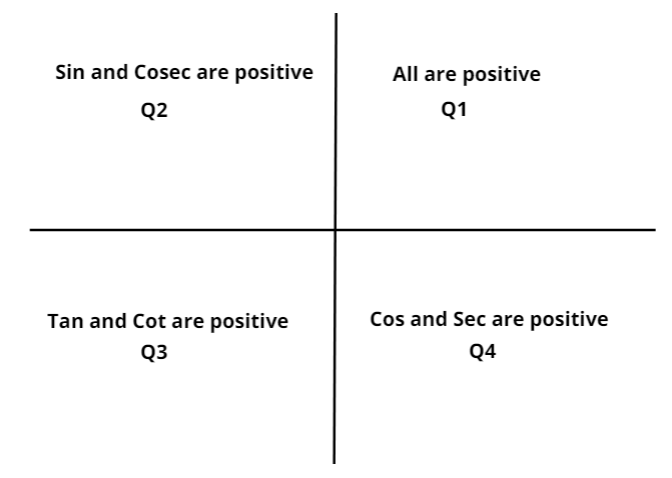
Note: All the trigonometric functions are positive in the first quadrant. SIn and Cosec are positive in the second quadrant. Tan and Cot are positive in the third quadrant. Cos and Sec are positive in the fourth quadrant.
Trigonometric is a function that deals with the relationship between the sides and angles of triangles.
Formula used: There are six function of an angle commonly used in trigonometry, they are \[{\text{sine, cosine, tangent, }}\] \[{\text{cosecant, secant, co - tangent}}\]. In this sum we are going to see about only \[{\text{sine}}\] and \[{\text{cosine}}\] angle and ratio formula. The formulas are
$\sin 2{{\theta}} - \cos 2{{\theta}} = \sqrt 2 \sin \left( {{{2\theta }} - \dfrac{{{\pi}}}{4}} \right)$
$\sin {{\theta}} - \cos {{\theta}} = - \sqrt 2 \sin \left( {{{\theta}} - \dfrac{{{\pi}}}{4}} \right)$
\[\sin {\text{a + }}\sin {\text{b}} = 2\sin \left( {\dfrac{{{\text{a}} + {\text{b}}}}{{\text{2}}}} \right).\cos \left( {\dfrac{{{\text{a}} - {\text{b}}}}{2}} \right)\]
Complete step-by-step answer:
Let consider the given equation as \[{\text{f}}\left( {\text{x}} \right) = {\text{sin}}2{{\theta}} - \cos 2{{\theta}} - \sin {{\theta}} + \cos {{\theta = 0}}\] .
Now, Rewrite the above equation as \[{\text{f}}\left( {\text{x}} \right) = \left( {{\text{sin}}2{{\theta}} - \cos 2{{\theta}}} \right) - \left( {\sin {{\theta}} - \cos {{\theta}}} \right){\text{ = 0}}\].
Here, we applying the trigonometric angles formulas on the expression, the \[{\text{sine}}\] and \[{\text{cosine}}\] angle are commonly known as $\sin $ and $\cos $.
$\sin {{\theta}} - \cos {{\theta}} = \sqrt 2 \sin \left( {{{\theta}} - \dfrac{{{\pi}}}{4}} \right)$
Now, we get
$\sin 2{{\theta}} - \cos 2{{\theta}} = \sqrt 2 \sin \left( {{{2\theta }} - \dfrac{{{\pi}}}{4}} \right)$ and
$\sin {{\theta}} - \cos {{\theta}} = - \sqrt 2 \sin \left( {{{\theta}} - \dfrac{{{\pi}}}{4}} \right)$
Substitute the two trigonometric identities into the \[{\text{f}}\left( {\text{x}} \right)\], we get
${\text{f(x)}} = \sqrt 2 \sin \left( {{{2\theta }} - \dfrac{{{\pi}}}{4}} \right) + \sqrt 2 \sin \left( {{{\theta}} - \dfrac{{{\pi}}}{4}} \right) = 0$
Taking $\sqrt 2 $ as a common term in the above both terms, then
\[ \Rightarrow \sqrt 2 \left( {\sin \left( {{{2\theta }} - \dfrac{{{\pi}}}{4}} \right) + \sin \left( {{{\theta}} - \dfrac{{{\pi}}}{4}} \right)} \right) = 0\]
Now, cross multiply the $\sqrt 2 $ into denominator of right hand side, we get
\[ \Rightarrow \sin \left( {{{2\theta }} - \dfrac{{{\pi}}}{4}} \right) + \sin \left( {{{\theta}} - \dfrac{{{\pi}}}{4}} \right) = \dfrac{0}{{\sqrt 2 }}\]
We know that any number divisible by zero is zero. Then,
\[ \Rightarrow \sin \left( {{{2\theta }} - \dfrac{{{\pi}}}{4}} \right) + \sin \left( {{{\theta}} - \dfrac{{{\pi}}}{4}} \right) = 0\]
Applying the trigonometry identity,
\[\sin {\text{a + }}\sin {\text{b}} = 2\sin \left( {\dfrac{{{\text{a}} + {\text{b}}}}{{\text{2}}}} \right).\cos \left( {\dfrac{{{\text{a}} - {\text{b}}}}{2}} \right)\]
Now, consider here, ${\text{a}} = 2{{\theta}} - \dfrac{{{\pi}}}{4}$ and ${\text{b}} = {{\theta}} - \dfrac{{{\pi}}}{4}$ . Then, we substitute in the above trigonometric identity, we get
\[ \Rightarrow \sin \left( {{{2\theta }} - \dfrac{{{\pi}}}{4}} \right) + \sin \left( {{{\theta}} - \dfrac{{{\pi}}}{4}} \right) = \sin \left( {2{{\theta}} - \dfrac{{{\pi}}}{4} + {{\theta}} - \dfrac{{{\pi}}}{4}} \right).\cos \left( {2{{\theta}} - \dfrac{{{\pi}}}{4} - {{\theta}} + \dfrac{{{\pi}}}{4}} \right)\]
After adding and subtracting the trigonometric identities, we get
\[ \Rightarrow \sin \left( {{{2\theta }} - \dfrac{{{\pi}}}{4}} \right) + \sin \left( {{{\theta}} - \dfrac{{{\pi}}}{4}} \right) = \sin \left( {3{{\theta}} - \dfrac{{2{{\pi}}}}{4}} \right).\cos \left( {{\theta}} \right)\]
\[ \Rightarrow \sin \left( {{{2\theta }} - \dfrac{{{\pi}}}{4}} \right) + \sin \left( {{{\theta}} - \dfrac{{{\pi}}}{4}} \right) = \sin \left( {3{{\theta}} - \dfrac{{{\pi}}}{2}} \right).\cos {{\theta}}\]
Since there are two solutions:
1. $\cos {{\theta}} = 0$ if and only if ${{\theta = }}\dfrac{{{\pi}}}{{\text{2}}}$ and ${{\theta = }}\dfrac{{{{3\pi }}}}{{\text{2}}}$ .
2. $\sin \left( {\dfrac{{3{{\theta}}}}{2} - \dfrac{{{\pi}}}{2}} \right) = 0$
Now, we have to find the angle where the sine term becomes zero.
$\dfrac{{{{3\theta }}}}{2} = {{\pi}} \Rightarrow {{3\theta = 2\pi }}$
$ \Rightarrow {{\theta = }}\dfrac{{2{{\pi}}}}{3}$ .
Also find another angle for sine term becomes zero.
$\dfrac{{{{3\theta }}}}{2} = 2{{\pi}} \Rightarrow {{3\theta = 4\pi }}$
$ \Rightarrow {{\theta = }}\dfrac{{{{4\pi }}}}{3}$ .
$\therefore \sin \left( {\dfrac{{3{{\theta}}}}{2} - \dfrac{{{\pi}}}{2}} \right) = 0$ if and only if ${{\theta = }}\dfrac{{2{{\pi}}}}{3}$ and ${{\theta = }}\dfrac{{{{4\pi }}}}{3}$.
Therefore, from the above angle which shows that the trigonometric identities become zero.
$\therefore \sin \left( {{{2\theta }} - \dfrac{{{\pi}}}{4}} \right) + \sin \left( {{{\theta}} - \dfrac{{{\pi}}}{4}} \right) = 0$
Hence proved.
Note: All the trigonometric functions are positive in the first quadrant. SIn and Cosec are positive in the second quadrant. Tan and Cot are positive in the third quadrant. Cos and Sec are positive in the fourth quadrant.
Recently Updated Pages
Master Class 12 Economics: Engaging Questions & Answers for Success

Master Class 12 Physics: Engaging Questions & Answers for Success
Master Class 12 English: Engaging Questions & Answers for Success
Master Class 12 Social Science: Engaging Questions & Answers for Success
Master Class 12 Maths: Engaging Questions & Answers for Success
Master Class 12 Business Studies: Engaging Questions & Answers for Success
Trending doubts
Which are the Top 10 Largest Countries of the World?
What are the major means of transport Explain each class 12 social science CBSE
Draw a labelled sketch of the human eye class 12 physics CBSE
Differentiate between insitu conservation and exsitu class 12 biology CBSE
Draw a neat and well labeled diagram of TS of ovary class 12 biology CBSE
Differentiate between homogeneous and heterogeneous class 12 chemistry CBSE