




Some foreign DNA fragments are attached to the Cla l site of pBR322. This recombinant vector is used to transition Escherichia coli host cells. The cells subjected to the transformation are plated on two different media one containing ampicillin and the other containing tetracycline. So what recombinant vector does the transformed cells contain?
(a) Will grow both on tetracycline containing and ampicillin containing media
(b) Will not grow on either tetracycline or ampicillin containing media
(c) Will grow on tetracycline but not on ampicillin containing media
(d) Will grow or ampicillin but not on tetracycline containing media.
Answer
 Verified
573.9k+ views
Hint: PBR322 is the first one of its kind to be used extensively. Cloning Vectors of E. coli. The resistance of plasmid pBR322 to ampicillin and tetracycline plasmid was one.
Complete answer:
PBR322 is a plasmid and was one of the first E to be used extensively. Cloning Vectors of E. coli. Created in 1977 at the University of California, San Francisco, in Herbert Boyer's laboratory, it was named after Francisco Bolivar Zapata, the postdoctoral researcher, and Raymond L. Rodriguez.
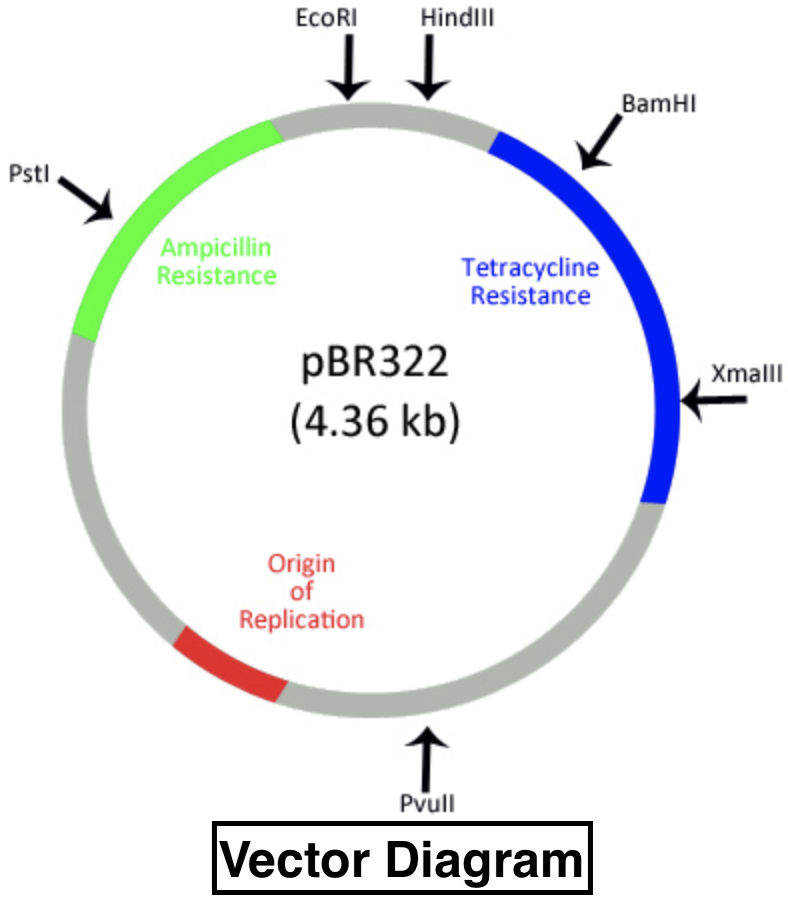
"To differentiate this vector from other vectors they produced in their laboratory, they called the plasmid with the number" 322.
Additional information: Both include the gene for ampicillin-resistance and the origin of replication from a plasmid of Haemophilus, pRSF0885. Both also contain the root of pBR322 and thus can be amplified in E. The plasmid pHCVS contains the pBR322 tetracycline resistance gene, and pHVTl contains the Tn10 transposon analog region. On pBR322, the antibiotic-resistant genes are not transposable. In addition to four distinct restriction sites, EcoRI, HindIII, BamHI, and SalI, the vector pBR322 was constructed to provide a plasmid with a single PstI site located in the ampicillin-resistant gene (Apr).
So, the correct answer is ‘will not grow on either tetracycline or ampicillin containing media’.
Note: In pBR322 - the p stands for plasmid, BR stands for Bolivar and Rodriguez, and 322 stands for the vector number. There are three restriction sites for the pBR322 plasmid: PstI, SalI, and EcoRI. The first two sites of restriction are found inside the gene that codes for resistance to ampicillin and tetracycline, respectively. Cleaving will inactivate their respective genes and antibiotic resistance at either restriction site.
Complete answer:
PBR322 is a plasmid and was one of the first E to be used extensively. Cloning Vectors of E. coli. Created in 1977 at the University of California, San Francisco, in Herbert Boyer's laboratory, it was named after Francisco Bolivar Zapata, the postdoctoral researcher, and Raymond L. Rodriguez.
"To differentiate this vector from other vectors they produced in their laboratory, they called the plasmid with the number" 322.
Additional information: Both include the gene for ampicillin-resistance and the origin of replication from a plasmid of Haemophilus, pRSF0885. Both also contain the root of pBR322 and thus can be amplified in E. The plasmid pHCVS contains the pBR322 tetracycline resistance gene, and pHVTl contains the Tn10 transposon analog region. On pBR322, the antibiotic-resistant genes are not transposable. In addition to four distinct restriction sites, EcoRI, HindIII, BamHI, and SalI, the vector pBR322 was constructed to provide a plasmid with a single PstI site located in the ampicillin-resistant gene (Apr).
So, the correct answer is ‘will not grow on either tetracycline or ampicillin containing media’.
Note: In pBR322 - the p stands for plasmid, BR stands for Bolivar and Rodriguez, and 322 stands for the vector number. There are three restriction sites for the pBR322 plasmid: PstI, SalI, and EcoRI. The first two sites of restriction are found inside the gene that codes for resistance to ampicillin and tetracycline, respectively. Cleaving will inactivate their respective genes and antibiotic resistance at either restriction site.
Recently Updated Pages
Master Class 12 Economics: Engaging Questions & Answers for Success

Master Class 12 Physics: Engaging Questions & Answers for Success
Master Class 12 English: Engaging Questions & Answers for Success
Master Class 12 Social Science: Engaging Questions & Answers for Success
Master Class 12 Maths: Engaging Questions & Answers for Success
Master Class 12 Business Studies: Engaging Questions & Answers for Success
Trending doubts
Which are the Top 10 Largest Countries of the World?
What are the major means of transport Explain each class 12 social science CBSE
Draw a labelled sketch of the human eye class 12 physics CBSE
Why cannot DNA pass through cell membranes class 12 biology CBSE
Differentiate between insitu conservation and exsitu class 12 biology CBSE
Draw a neat and well labeled diagram of TS of ovary class 12 biology CBSE