



State whether the following statement is true or false: A square has four right angles.
(a) True
(b) False
Answer
 Verified
531k+ views
Hint: Using the definition of a square, and the property of quadrilaterals, which tells us that the sum of all internal angles of a quadrilateral is 360 degrees, we can find the value of each internal angle of the square. We will see that each of its angles is a right angle.
Complete step by step answer:
We know that a square is quadrilateral in which all the four sides are equal, and all the four angles are equal. We can also define a square in terms of a rhombus. A rhombus is a parallelogram in which all four sides are equal to one another. A square is a rhombus in which the adjacent angles are equal, or we can say that all the angles are equal to one another.
Let us consider a square ABCD, as shown in the figure below.
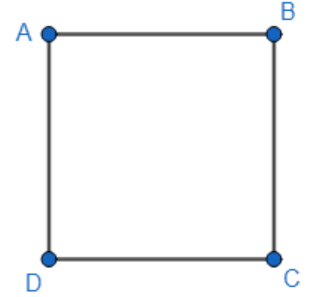
As per the definition of square, we have AB = BC = CD = DA and
Angle (ABC) = Angle (BCD) = Angle (CDA) = Angle (DAB).
But we know that ABCD is a quadrilateral and the sum of all internal angles of a quadrilateral is 360 degrees. Thus, we have
Angle (ABC) + Angle (BCD) + Angle (CDA) + Angle (DAB) = ${{360}^{\circ }}$
Hence, we can write
Angle (ABC) = Angle (BCD) = Angle (CDA) = Angle (DAB) = $\dfrac{{{360}^{\circ }}}{4}={{90}^{\circ }}$
Thus, we now know that all four angles of a square are equal to 90 degrees, or a right angle.
Hence, the statement that a square has four right angles is true.
So, the correct answer is “Option a”.
Note: There are many definitions for a square. We can define a square in terms of a quadrilateral, in terms of a parallelogram, in terms of a rhombus, or in terms of a rectangle. And we can get this end result through anyone of these definitions.
Complete step by step answer:
We know that a square is quadrilateral in which all the four sides are equal, and all the four angles are equal. We can also define a square in terms of a rhombus. A rhombus is a parallelogram in which all four sides are equal to one another. A square is a rhombus in which the adjacent angles are equal, or we can say that all the angles are equal to one another.
Let us consider a square ABCD, as shown in the figure below.
As per the definition of square, we have AB = BC = CD = DA and
Angle (ABC) = Angle (BCD) = Angle (CDA) = Angle (DAB).
But we know that ABCD is a quadrilateral and the sum of all internal angles of a quadrilateral is 360 degrees. Thus, we have
Angle (ABC) + Angle (BCD) + Angle (CDA) + Angle (DAB) = ${{360}^{\circ }}$
Hence, we can write
Angle (ABC) = Angle (BCD) = Angle (CDA) = Angle (DAB) = $\dfrac{{{360}^{\circ }}}{4}={{90}^{\circ }}$
Thus, we now know that all four angles of a square are equal to 90 degrees, or a right angle.
Hence, the statement that a square has four right angles is true.
So, the correct answer is “Option a”.
Note: There are many definitions for a square. We can define a square in terms of a quadrilateral, in terms of a parallelogram, in terms of a rhombus, or in terms of a rectangle. And we can get this end result through anyone of these definitions.
Recently Updated Pages
Master Class 8 Social Science: Engaging Questions & Answers for Success

Master Class 8 English: Engaging Questions & Answers for Success
Class 8 Question and Answer - Your Ultimate Solutions Guide
Master Class 8 Maths: Engaging Questions & Answers for Success
Master Class 8 Science: Engaging Questions & Answers for Success
Master Class 7 English: Engaging Questions & Answers for Success
Trending doubts
Which are the Top 10 Largest States of India?
What is the theme or message of the poem The road not class 9 english CBSE
What are the major achievements of the UNO class 9 social science CBSE
Explain the importance of pH in everyday life class 9 chemistry CBSE
Differentiate between parenchyma collenchyma and sclerenchyma class 9 biology CBSE
Give 5 examples of refraction of light in daily life