




Statement: In bcc lattice, the atoms at the corners of the unit cell are in contact with each other.
State whether the given statement is true or false.
A. True
B. False
Answer
 Verified
587.7k+ views
Hint: A unit cell which has lattice points at the body centre along with the lattice points on every corner is known as a Body centered cubic unit cell. The particles present on the diagonal of the unit cell touch the particle at the center.
Complete answer: or Complete step by step answer:
In the case of a BCC unit cell, along the diagonal of the cubic unit cell, all atoms touch each other and the length of the cube diagonal is equal to $a\sqrt 3 $, where, ‘a’ is the length of the side of the unit cell.
The structure of a BCC unit cell can be understood from the following diagram:
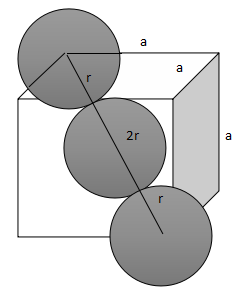
The three atoms are present on the body diagonal in such a way that they touch each other.
Thus, $a\sqrt 3 = 4r$
Now, the total number of atom present in the unit cell (z) will be:
Contributions of atoms on the corner of the unit cell = $\dfrac{1}{8}$
Total number of atoms present at the corners = $8$
Total contribution of the atom present at the center of the unit cell = $1$
Total number of atoms present at the center = $1$
Thus, the total number of atoms in the unit cell = $\left( {8 \times \dfrac{1}{8}} \right) + (1 \times 1) = 2$ atoms/unit cell
Now, from these calculations, it is clearly visible that the central atom is surrounded by eight equidistant atoms and hence, the coordination number is eight. This means that in the bcc lattice, the atoms at the corners of the unit cell are not in contact with each other but to the central atom.
Hence, the given statement is B. False.
Note:
The packing efficiency of the body centered cubic lattice is 68% the remaining space in the lattice is void space. This means that out of the total volume of a cubic unit cell, only 68% of the total volume is occupied by the atoms and the rest of the space remains vacant.
Complete answer: or Complete step by step answer:
In the case of a BCC unit cell, along the diagonal of the cubic unit cell, all atoms touch each other and the length of the cube diagonal is equal to $a\sqrt 3 $, where, ‘a’ is the length of the side of the unit cell.
The structure of a BCC unit cell can be understood from the following diagram:
The three atoms are present on the body diagonal in such a way that they touch each other.
Thus, $a\sqrt 3 = 4r$
Now, the total number of atom present in the unit cell (z) will be:
Contributions of atoms on the corner of the unit cell = $\dfrac{1}{8}$
Total number of atoms present at the corners = $8$
Total contribution of the atom present at the center of the unit cell = $1$
Total number of atoms present at the center = $1$
Thus, the total number of atoms in the unit cell = $\left( {8 \times \dfrac{1}{8}} \right) + (1 \times 1) = 2$ atoms/unit cell
Now, from these calculations, it is clearly visible that the central atom is surrounded by eight equidistant atoms and hence, the coordination number is eight. This means that in the bcc lattice, the atoms at the corners of the unit cell are not in contact with each other but to the central atom.
Hence, the given statement is B. False.
Note:
The packing efficiency of the body centered cubic lattice is 68% the remaining space in the lattice is void space. This means that out of the total volume of a cubic unit cell, only 68% of the total volume is occupied by the atoms and the rest of the space remains vacant.
Recently Updated Pages
Master Class 12 Economics: Engaging Questions & Answers for Success

Master Class 12 Physics: Engaging Questions & Answers for Success
Master Class 12 English: Engaging Questions & Answers for Success
Master Class 12 Social Science: Engaging Questions & Answers for Success
Master Class 12 Maths: Engaging Questions & Answers for Success
Master Class 12 Business Studies: Engaging Questions & Answers for Success
Trending doubts
Which are the Top 10 Largest Countries of the World?
What are the major means of transport Explain each class 12 social science CBSE
Draw a labelled sketch of the human eye class 12 physics CBSE
Why cannot DNA pass through cell membranes class 12 biology CBSE
Differentiate between insitu conservation and exsitu class 12 biology CBSE
Draw a neat and well labeled diagram of TS of ovary class 12 biology CBSE