




The angle between the two diagonals of a rhombus is:-
a) 60°
b) 45°
c) 90°
d) 180°
Answer
 Verified
609.3k+ views
HINT:- Before solving this question, let us firstly know about Polygon, Quadrilateral and Rhombus.
POLYGON: A polygon is a 2 – dimensional shape that is formed with straight lines. Triangles, quadrilaterals, pentagons, hexagons, etc. are some examples of polygons.
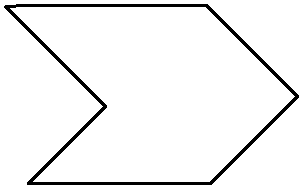
Above given is the figure of a polygon. We can see that this figure is completely made of straight lines, and according to the definition provided above, a polygon is a 2 – dimensional shape made of straight lines. Hence, this is a polygon.
QUADRILATERAL: A quadrilateral is a closed, two – dimensional shape which has four straight sides. As it is made of straight lines, therefore, it is a polygon. These polygons have four vertices or corners.
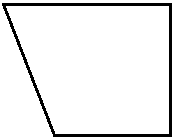
Above given is the figure of a quadrilateral. We can see that this figure is made of four straight lines, and according to the definition provided above, a quadrilateral is a 2 – dimensional shape made of four straight lines. Hence, this is a quadrilateral.
RHOMBUS: A rhombus is a quadrilateral whose all four sides have the same length.
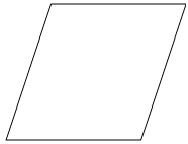
Above given is the figure of a rhombus. We can see that this figure is a quadrilateral, made with four straight lines, and according to the definition provided above, a rhombus is a quadrilateral whose all four sides have the same length. Hence, this is a rhombus.
Another name for a rhombus is Equilateral Quadrilateral, because equilateral means that all of its sides are equal in length and all the four sides are equal in a rhombus.
Complete step-by-step answer:
Let us now solve this question.
The angle between the two diagonals of a rhombus is 90° as they are perpendicular to each other.
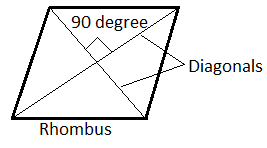
Therefore, the answer to this question is 90°.
Hence, the correct option is (c) 90°.
NOTE:- Let us now learn about some of the properties of a rhombus.
1) All sides of a rhombus are equal.
2) The opposite sides of a rhombus are parallel.
3) Opposite angles of a rhombus are equal.
4) In a rhombus, diagonals bisect each other at right angles.
5) Diagonals bisect the angles of a rhombus.
6) The sum of two adjacent angles is equal to 180 degrees.
7) The two diagonals of a rhombus form four right-angled triangles which are congruent to each other
POLYGON: A polygon is a 2 – dimensional shape that is formed with straight lines. Triangles, quadrilaterals, pentagons, hexagons, etc. are some examples of polygons.
Above given is the figure of a polygon. We can see that this figure is completely made of straight lines, and according to the definition provided above, a polygon is a 2 – dimensional shape made of straight lines. Hence, this is a polygon.
QUADRILATERAL: A quadrilateral is a closed, two – dimensional shape which has four straight sides. As it is made of straight lines, therefore, it is a polygon. These polygons have four vertices or corners.
Above given is the figure of a quadrilateral. We can see that this figure is made of four straight lines, and according to the definition provided above, a quadrilateral is a 2 – dimensional shape made of four straight lines. Hence, this is a quadrilateral.
RHOMBUS: A rhombus is a quadrilateral whose all four sides have the same length.
Above given is the figure of a rhombus. We can see that this figure is a quadrilateral, made with four straight lines, and according to the definition provided above, a rhombus is a quadrilateral whose all four sides have the same length. Hence, this is a rhombus.
Another name for a rhombus is Equilateral Quadrilateral, because equilateral means that all of its sides are equal in length and all the four sides are equal in a rhombus.
Complete step-by-step answer:
Let us now solve this question.
The angle between the two diagonals of a rhombus is 90° as they are perpendicular to each other.
Therefore, the answer to this question is 90°.
Hence, the correct option is (c) 90°.
NOTE:- Let us now learn about some of the properties of a rhombus.
1) All sides of a rhombus are equal.
2) The opposite sides of a rhombus are parallel.
3) Opposite angles of a rhombus are equal.
4) In a rhombus, diagonals bisect each other at right angles.
5) Diagonals bisect the angles of a rhombus.
6) The sum of two adjacent angles is equal to 180 degrees.
7) The two diagonals of a rhombus form four right-angled triangles which are congruent to each other
Recently Updated Pages
Master Class 9 General Knowledge: Engaging Questions & Answers for Success

Master Class 9 Social Science: Engaging Questions & Answers for Success
Master Class 9 English: Engaging Questions & Answers for Success
Master Class 9 Maths: Engaging Questions & Answers for Success
Master Class 9 Science: Engaging Questions & Answers for Success
Class 9 Question and Answer - Your Ultimate Solutions Guide
Trending doubts
Difference Between Plant Cell and Animal Cell
Fill the blanks with the suitable prepositions 1 The class 9 english CBSE
Who is eligible for RTE class 9 social science CBSE
Which places in India experience sunrise first and class 9 social science CBSE
What is pollution? How many types of pollution? Define it
Name 10 Living and Non living things class 9 biology CBSE