




The broad wavelength range of visible spectrum is:
(A) $ 4000 - 8000{A^\circ } $
(B) $ 2000 - 4000{A^\circ } $
(C) $ 10000 - 20000{A^\circ } $
(D) None of the above
Answer
 Verified
539.7k+ views
Hint :Human eyes can only sense the visible spectrum of the whole electromagnetic spectrum whereas few animals can detect infrared, radio, etc waves. The broad wavelength range of the visible spectrum refers to the range of electromagnetic radiation which causes the maximum sensation of colours in the human eyes.
Complete Step By Step Answer:
Electromagnetic radiation or EM waves refer to the fluctuation of mutually perpendicular electric and magnetic fields which propagate throughout the universe. These radiations are produced mainly in the stars where the excited atoms when returning to their ground state eject these waves in forms of photons.
The range of these EM waves is quite vast. Their wavelength ranges from $ {10^{ - 18}}m $ to $ {10^6}m $ . These include waves in increasing order of their wavelengths as Gamma rays>X-rays>Ultraviolet rays>Visible light>Infrared rays>Microwave rays>Radio waves. The figure below depicts the range of different waves:
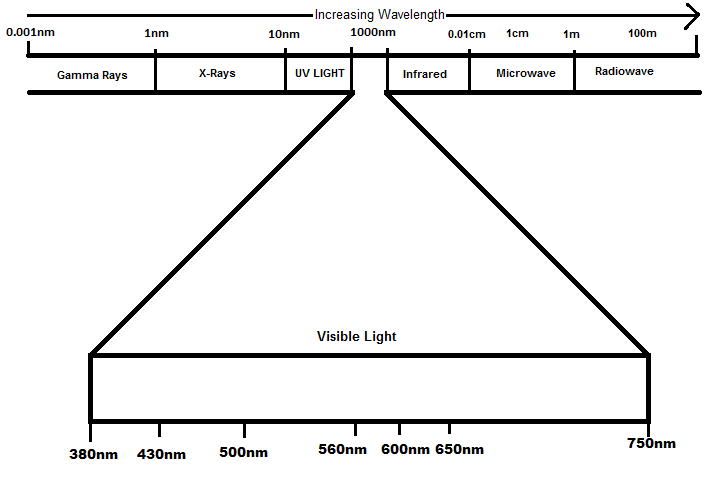
For visible light the accurate range is $ 3800 - 8000{A^\circ } $ . Hence the broad range of electromagnetic radiation for visible spectrum is $ 4000 - 8000{A^\circ } $ .
The correct answer is option A.
Note :
Be careful about the units of the wavelengths. Generally, the wavelengths are expressed in Armstrong but sometimes to confuse the students it is given in nano-meters. In a nano-meter the range would be 400-800 nm.
Complete Step By Step Answer:
Electromagnetic radiation or EM waves refer to the fluctuation of mutually perpendicular electric and magnetic fields which propagate throughout the universe. These radiations are produced mainly in the stars where the excited atoms when returning to their ground state eject these waves in forms of photons.
The range of these EM waves is quite vast. Their wavelength ranges from $ {10^{ - 18}}m $ to $ {10^6}m $ . These include waves in increasing order of their wavelengths as Gamma rays>X-rays>Ultraviolet rays>Visible light>Infrared rays>Microwave rays>Radio waves. The figure below depicts the range of different waves:
For visible light the accurate range is $ 3800 - 8000{A^\circ } $ . Hence the broad range of electromagnetic radiation for visible spectrum is $ 4000 - 8000{A^\circ } $ .
The correct answer is option A.
Note :
Be careful about the units of the wavelengths. Generally, the wavelengths are expressed in Armstrong but sometimes to confuse the students it is given in nano-meters. In a nano-meter the range would be 400-800 nm.
Recently Updated Pages
Master Class 12 Economics: Engaging Questions & Answers for Success

Master Class 12 Physics: Engaging Questions & Answers for Success
Master Class 12 English: Engaging Questions & Answers for Success
Master Class 12 Social Science: Engaging Questions & Answers for Success
Master Class 12 Maths: Engaging Questions & Answers for Success
Master Class 12 Business Studies: Engaging Questions & Answers for Success
Trending doubts
Which are the Top 10 Largest Countries of the World?
What are the major means of transport Explain each class 12 social science CBSE
Draw a labelled sketch of the human eye class 12 physics CBSE
Why cannot DNA pass through cell membranes class 12 biology CBSE
Differentiate between insitu conservation and exsitu class 12 biology CBSE
Draw a neat and well labeled diagram of TS of ovary class 12 biology CBSE