




The electric field intensity at the centre of a uniformly charged hemispherical shell is $E_{0}$. Now two portions of the hemisphere are cut from either side, and the remaining portion is shown in figure. If $\alpha=\beta=\dfrac{\pi}{3}$, then the electric field intensity at the centre due to the remaining portion is :
\[\begin{align}
& A.\dfrac{{{E}_{0}}}{3} \\
& B.\dfrac{{{E}_{0}}}{6} \\
& C.\dfrac{{{E}_{0}}}{2} \\
& D.\text{information insufficient} \\
\end{align}\]
Answer
 Verified
560.7k+ views
Hint: Electric field is the electric force due to a unit positive charge which is at rest would exert on its surrounding. We also know that the electric potential due to a charge, is defined as the amount of energy needed to move a unit positive charge to infinity. Using the relation between the two we can solve this sum.
Formula used: $E=\dfrac{V}{r}$ and $E=-\nabla V$
Complete step by step answer:
We know that the electric force due to a pair of charges is given by Coulomb's law. An electric field can be produced by a time-varying electric field or an electrical charge. These can be either attracting or repelling in nature.
An electric field E is defined as the electric force F per unit positive charge q, which is infinitesimally small and at rest, and is given as $E=\dfrac{F}{q}$. Then $E=\dfrac{kq}{r^{2}}$, where $k=\dfrac{1}{4\pi\epsilon_{0}}$ which is a constant and $r$ is the distance between the unit charges. Since the electric field is a vector quantity, it acts along the direction of the distance $r$, then we can denote it as $\vec E=\dfrac{kq\vec r}{r^{3}}$.
Given that the electric field of the hemispherical shell as shown below is $E_{0}$. If it is cut as below, let the new electric field be $E_{1}$
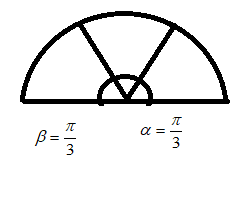
Since the electric field is a vector quantity, we can say that the vertical component of the side parts add as $2E_{1}sin(30)$ with the middle electric field $E_{1}$.
Then we can say $E_{0}=\dfrac{2E_{1}}{2}+E_{1}=2E_{1}$
$\implies E_{1}=\dfrac{E_{0}}{2}$
So, the correct answer is “Option C”.
Note: Electric field is the electric force due to a unit positive charge which is at rest would exert on its surrounding. We also know that the electric potential due to a charge is defined as the amount of energy needed to move a unit positive charge to infinity. Using the relation between the two we can solve this sum.
Formula used: $E=\dfrac{V}{r}$ and $E=-\nabla V$
Complete step by step answer:
We know that the electric force due to a pair of charges is given by Coulomb's law. An electric field can be produced by a time-varying electric field or an electrical charge. These can be either attracting or repelling in nature.
An electric field E is defined as the electric force F per unit positive charge q, which is infinitesimally small and at rest, and is given as $E=\dfrac{F}{q}$. Then $E=\dfrac{kq}{r^{2}}$, where $k=\dfrac{1}{4\pi\epsilon_{0}}$ which is a constant and $r$ is the distance between the unit charges. Since the electric field is a vector quantity, it acts along the direction of the distance $r$, then we can denote it as $\vec E=\dfrac{kq\vec r}{r^{3}}$.
Given that the electric field of the hemispherical shell as shown below is $E_{0}$. If it is cut as below, let the new electric field be $E_{1}$
Since the electric field is a vector quantity, we can say that the vertical component of the side parts add as $2E_{1}sin(30)$ with the middle electric field $E_{1}$.
Then we can say $E_{0}=\dfrac{2E_{1}}{2}+E_{1}=2E_{1}$
$\implies E_{1}=\dfrac{E_{0}}{2}$
So, the correct answer is “Option C”.
Note: Electric field is the electric force due to a unit positive charge which is at rest would exert on its surrounding. We also know that the electric potential due to a charge is defined as the amount of energy needed to move a unit positive charge to infinity. Using the relation between the two we can solve this sum.
Recently Updated Pages
A man running at a speed 5 ms is viewed in the side class 12 physics CBSE

State and explain Hardy Weinbergs Principle class 12 biology CBSE
Which of the following statements is wrong a Amnion class 12 biology CBSE
Two Planoconcave lenses 1 and 2 of glass of refractive class 12 physics CBSE
The compound 2 methyl 2 butene on reaction with NaIO4 class 12 chemistry CBSE
Bacterial cell wall is made up of A Cellulose B Hemicellulose class 12 biology CBSE
Trending doubts
What are the major means of transport Explain each class 12 social science CBSE
Which are the Top 10 Largest Countries of the World?
Draw a labelled sketch of the human eye class 12 physics CBSE
Explain sex determination in humans with line diag class 12 biology CBSE
Give 10 examples of unisexual and bisexual flowers
State the principle of an ac generator and explain class 12 physics CBSE