




The electric potential due to infinite uniformly charge of linear charge density $\lambda $ at a distance r from is given by is the reference point ${{r}_{o}}$
$\begin{align}
& a)\dfrac{\text{2 }\!\!\lambda\!\!\text{ }}{\text{4 }\!\!\pi\!\!\text{ }{{\in }_{\text{o}}}r} \\
& b)\dfrac{\text{2 }\!\!\lambda\!\!\text{ }}{\text{4 }\!\!\pi\!\!\text{ }{{\in }_{\text{o}}}{{r}_{0}}} \\
& c)\dfrac{\text{2 }\!\!\lambda\!\!\text{ }\left[ \ln {{r}_{o}}-\ln r \right]}{\text{4 }\!\!\pi\!\!\text{ }{{\in }_{\text{o}}}} \\
& d)\dfrac{\text{2 }\!\!\lambda\!\!\text{ (lnr)}}{\text{4 }\!\!\pi\!\!\text{ }{{\in }_{\text{o}}}r} \\
\end{align}$
Answer
 Verified
585.3k+ views
Hint: The electric field due to an infinitely charge distribution is given by, $\dfrac{\lambda }{2\pi {{\in }_{\circ }}r}$ where $\lambda $ is the linear charge density, ${{\in }_{\circ }}$ is the permittivity of free space and r is the perpendicular distance from the charge distribution. Hence taking ${{r}_{o}}$ as the reference point, the potential at the point which is at a distance r from the charge distribution from the expression i.e. $\dfrac{dV}{dr}=\dfrac{{{V}_{r}}-{{V}_{{{r}_{o}}}}}{dr}=-E...(1)$ where ${{V}_{r}}$ is the potential at point r, ${{V}_{{{r}_{o}}}}$ is the potential at the reference point and E is the electric field at point r.
Complete step-by-step answer:
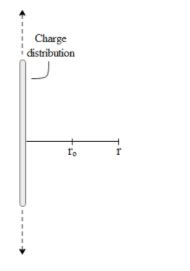
In the above figure we can see a charge distribution of linear charge density $\lambda $. Now we wish to calculate the potential at point r from the linear charge distribution. For that let us use equation 1 to determine the potential at point r with respect to the reference point ${{r}_{o}}$. Let us assume the distance between them is very small i.e. dr.
$\begin{align}
& \dfrac{{{V}_{r}}-{{V}_{{{r}_{o}}}}}{dr}=-E,\text{since }E=\dfrac{\lambda }{2\pi {{\in }_{\circ }}r} \\
& {{V}_{r}}-{{V}_{{{r}_{o}}}}=-\dfrac{\lambda }{2\pi {{\in }_{\circ }}r}dr \\
\end{align}$
Now let us integrate the above equation to find the potential at point r with respect to ${{r}_{o}}$.
$\begin{align}
& {{V}_{r}}-{{V}_{{{r}_{o}}}}=-\int\limits_{{{r}_{o}}}^{r}{\dfrac{\lambda }{2\pi {{\in }_{\circ }}r}dr} \\
& {{V}_{r}}-{{V}_{{{r}_{o}}}}=-\dfrac{\lambda }{2\pi {{\in }_{\circ }}}\int\limits_{{{r}_{o}}}^{r}{\dfrac{1}{_{\circ }r}dr} \\
& {{V}_{r}}-{{V}_{{{r}_{o}}}}=-\dfrac{\lambda }{2\pi {{\in }_{\circ }}}\left[ \ln r \right]_{{{r}_{o}}}^{r} \\
& {{V}_{r}}-{{V}_{{{r}_{o}}}}=-\dfrac{\lambda }{2\pi {{\in }_{\circ }}}\left[ \ln r-\ln {{r}_{o}} \right] \\
& {{V}_{r}}-{{V}_{{{r}_{o}}}}=\dfrac{\lambda }{2\pi {{\in }_{\circ }}}\left[ \ln {{r}_{o}}-\ln r \right] \\
\end{align}$
Hence from the above obtained result we can conclude that the potential at point r with respect to the reference point is given by,$\dfrac{\lambda }{2\pi {{\in }_{\circ }}}\left[ \ln {{r}_{o}}-\ln r \right]$ .
So, the correct answer is “Option C”.
Note: If we consider the above equation the potential keeps on decreasing as we move away from the reference point ${{r}_{o}}$. Hence we always take the electric field as a negative gradient of potential between the two points. The potential at a point always varies inversely with the distance.
Complete step-by-step answer:
In the above figure we can see a charge distribution of linear charge density $\lambda $. Now we wish to calculate the potential at point r from the linear charge distribution. For that let us use equation 1 to determine the potential at point r with respect to the reference point ${{r}_{o}}$. Let us assume the distance between them is very small i.e. dr.
$\begin{align}
& \dfrac{{{V}_{r}}-{{V}_{{{r}_{o}}}}}{dr}=-E,\text{since }E=\dfrac{\lambda }{2\pi {{\in }_{\circ }}r} \\
& {{V}_{r}}-{{V}_{{{r}_{o}}}}=-\dfrac{\lambda }{2\pi {{\in }_{\circ }}r}dr \\
\end{align}$
Now let us integrate the above equation to find the potential at point r with respect to ${{r}_{o}}$.
$\begin{align}
& {{V}_{r}}-{{V}_{{{r}_{o}}}}=-\int\limits_{{{r}_{o}}}^{r}{\dfrac{\lambda }{2\pi {{\in }_{\circ }}r}dr} \\
& {{V}_{r}}-{{V}_{{{r}_{o}}}}=-\dfrac{\lambda }{2\pi {{\in }_{\circ }}}\int\limits_{{{r}_{o}}}^{r}{\dfrac{1}{_{\circ }r}dr} \\
& {{V}_{r}}-{{V}_{{{r}_{o}}}}=-\dfrac{\lambda }{2\pi {{\in }_{\circ }}}\left[ \ln r \right]_{{{r}_{o}}}^{r} \\
& {{V}_{r}}-{{V}_{{{r}_{o}}}}=-\dfrac{\lambda }{2\pi {{\in }_{\circ }}}\left[ \ln r-\ln {{r}_{o}} \right] \\
& {{V}_{r}}-{{V}_{{{r}_{o}}}}=\dfrac{\lambda }{2\pi {{\in }_{\circ }}}\left[ \ln {{r}_{o}}-\ln r \right] \\
\end{align}$
Hence from the above obtained result we can conclude that the potential at point r with respect to the reference point is given by,$\dfrac{\lambda }{2\pi {{\in }_{\circ }}}\left[ \ln {{r}_{o}}-\ln r \right]$ .
So, the correct answer is “Option C”.
Note: If we consider the above equation the potential keeps on decreasing as we move away from the reference point ${{r}_{o}}$. Hence we always take the electric field as a negative gradient of potential between the two points. The potential at a point always varies inversely with the distance.
Recently Updated Pages
Master Class 12 Economics: Engaging Questions & Answers for Success

Master Class 12 Physics: Engaging Questions & Answers for Success
Master Class 12 English: Engaging Questions & Answers for Success
Master Class 12 Social Science: Engaging Questions & Answers for Success
Master Class 12 Maths: Engaging Questions & Answers for Success
Master Class 12 Business Studies: Engaging Questions & Answers for Success
Trending doubts
Why cannot DNA pass through cell membranes class 12 biology CBSE
Draw a neat and well labeled diagram of TS of ovary class 12 biology CBSE
In a human foetus the limbs and digits develop after class 12 biology CBSE
AABbCc genotype forms how many types of gametes a 4 class 12 biology CBSE
Differentiate between homogeneous and heterogeneous class 12 chemistry CBSE
The correct structure of ethylenediaminetetraacetic class 12 chemistry CBSE