




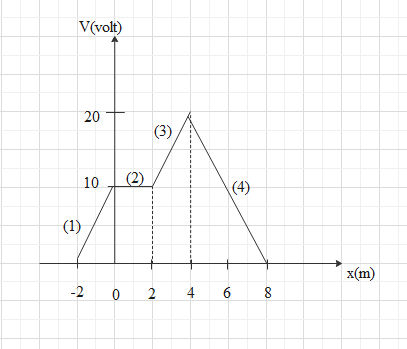
The electric potential function for an electric field directed parallel to the X-axis is shown in figure. The intervals in which the magnitude of the electric field in the X-axis direction is maximum are,
(A) \[-2\le x\le 0,4\le x\le 8,and0\le x\le 2\]
(B) \[-2\le x\le 0,and0\le x\le 2\]
(C) \[-2\le x\le 0,2\le x\le 4and4\le x\le 8\]
(D) \[0\le x\le 2,and4\le x\le 8\]
Answer
 Verified
590.1k+ views
Hint: The graph of electric potential function for an electric field directed parallel to the X-axis is given and the graph of the magnitude of the electric field in the X-axis direction has to be found. The graph of the magnitude of the electric field in the X-axis direction has positive and negative values of the electric field, so the maximum magnitude of the electric field is the maximum electric field.
Formula used:
\[E=-\dfrac{dv}{dx}\]
Complete answer:
In the question the graph of the electric potential function for an electric field directed parallel to the X-axis is given. From the relation between electric field and electric potential the graph of the intervals in which the magnitude of the electric field in the X-axis direction can be converted. The slope of the above graph is an electric field parallel to the X-axis.
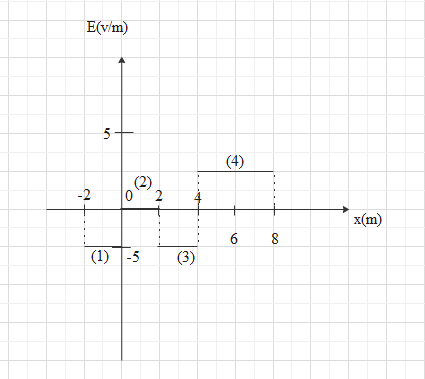
So, for the part\[(1)\]: \[E=-\dfrac{10-0}{0-(-2)}=-5\]
\[\therefore E=\left| -5 \right|=5\]
For the part\[(2)\]: \[E=-\dfrac{0}{2-0}=0\]
\[\therefore E=\left| 0 \right|=0\]
For the part\[(3)\]: \[E=-\dfrac{20-10}{4-2}=-5\]
\[\therefore E=\left| -5 \right|=5\]
For the part\[(4)\]: \[E=-\dfrac{20-0}{4-8}=5\]
\[\therefore E=\left| 5 \right|=5\]
So the range of the intervals in which the magnitude of the electric field in the X-axis direction is maximum are:
\[-2\le x\le 0\]
\[2\le x\le 4\]
\[4\le x\le 8\].
So, the correct answer is “Option C”.
Additional Information:
The line integral of the eclectic field between point P and Q is the voltage difference between that two points and vice versa if the distance between two point is very small then \[\overset{\to }{\mathop{dv}}\,=-\overset{\to }{\mathop{E}}\,\cdot \overset{\to }{\mathop{dl}}\,\]. So, \[E=-\dfrac{dv}{dx}\].
Note:
If the electric field is negative it only says that the direction of the field is convergent and if the field is positive it only says that the field is divergent. In both the case if the magnitude of the electric field is the same, the intensities of both are the same.
Formula used:
\[E=-\dfrac{dv}{dx}\]
Complete answer:
In the question the graph of the electric potential function for an electric field directed parallel to the X-axis is given. From the relation between electric field and electric potential the graph of the intervals in which the magnitude of the electric field in the X-axis direction can be converted. The slope of the above graph is an electric field parallel to the X-axis.
So, for the part\[(1)\]: \[E=-\dfrac{10-0}{0-(-2)}=-5\]
\[\therefore E=\left| -5 \right|=5\]
For the part\[(2)\]: \[E=-\dfrac{0}{2-0}=0\]
\[\therefore E=\left| 0 \right|=0\]
For the part\[(3)\]: \[E=-\dfrac{20-10}{4-2}=-5\]
\[\therefore E=\left| -5 \right|=5\]
For the part\[(4)\]: \[E=-\dfrac{20-0}{4-8}=5\]
\[\therefore E=\left| 5 \right|=5\]
So the range of the intervals in which the magnitude of the electric field in the X-axis direction is maximum are:
\[-2\le x\le 0\]
\[2\le x\le 4\]
\[4\le x\le 8\].
So, the correct answer is “Option C”.
Additional Information:
The line integral of the eclectic field between point P and Q is the voltage difference between that two points and vice versa if the distance between two point is very small then \[\overset{\to }{\mathop{dv}}\,=-\overset{\to }{\mathop{E}}\,\cdot \overset{\to }{\mathop{dl}}\,\]. So, \[E=-\dfrac{dv}{dx}\].
Note:
If the electric field is negative it only says that the direction of the field is convergent and if the field is positive it only says that the field is divergent. In both the case if the magnitude of the electric field is the same, the intensities of both are the same.
Recently Updated Pages
Master Class 12 Economics: Engaging Questions & Answers for Success

Master Class 12 Physics: Engaging Questions & Answers for Success
Master Class 12 English: Engaging Questions & Answers for Success
Master Class 12 Social Science: Engaging Questions & Answers for Success
Master Class 12 Maths: Engaging Questions & Answers for Success
Master Class 12 Business Studies: Engaging Questions & Answers for Success
Trending doubts
Which are the Top 10 Largest Countries of the World?
What are the major means of transport Explain each class 12 social science CBSE
Draw a labelled sketch of the human eye class 12 physics CBSE
Why cannot DNA pass through cell membranes class 12 biology CBSE
Differentiate between insitu conservation and exsitu class 12 biology CBSE
Draw a neat and well labeled diagram of TS of ovary class 12 biology CBSE