




The electron in a hydrogen atom first jumps from the third excited state to the second excited state and subsequently to the first excited state. The ratio of the respective wavelengths, $\dfrac{{{\lambda }_{1}}}{{{\lambda }_{2}}}$ of the photons emitted in this process is
$\left( a \right)\dfrac{9}{7}$
$\left( b \right)\dfrac{7}{5}$
$\left( c \right)\dfrac{27}{5}$
$\left( d \right)\dfrac{20}{7}$
Answer
 Verified
590.7k+ views
Hint: We will solve the question by using the Rydberg equation for both changes in the states of the electron in the hydrogen atom. By this formula we will find the wavelength of the given excited states in the series of hydrogen atoms. After that we will divide the two equations and get the required ratio.
Formula used:
$\dfrac{1}{\lambda }={{R}_{H}}\left( \dfrac{1}{{{n}_{f}}^{2}}-\dfrac{1}{{{n}_{i}}^{2}} \right)$. Here, ${{n}_{f}}$ is known as the initial excited state and ${{n}_{i}}$ is called the initial one. Here ${{R}_{H}}$ is the Rydberg constant whose value is equal to $1.097\times {{10}^{7}}{{m}^{-1}}$ and $\lambda $ is the wavelength.
Complete answer:
Excited state: The excited state arises when an electron by chance occupies the state which is basically higher than its own ground state. This chance is given to the electron when an extra energy is given to it in the form of photon, light or it somehow, gets in touch with a particle or atom present near it.
The diagram of movement of the electron from the ground state to excited state is given below.
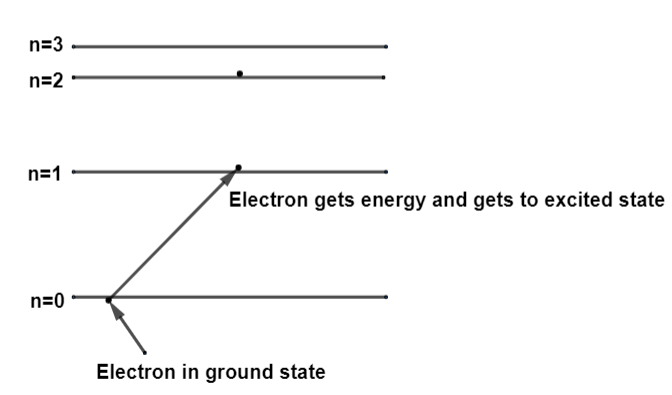
Since, the electron is jumping from third to second excited state resulting into the electron going from ${{n}_{i}}=4$ and ${{n}_{f}}=3$ as the third excited state means n=4 and so on so, by formula $\dfrac{1}{\lambda }={{R}_{H}}\left( \dfrac{1}{{{n}_{f}}^{2}}-\dfrac{1}{{{n}_{i}}^{2}} \right)$ we get,
$\begin{align}
& \dfrac{1}{{{\lambda }_{1}}}={{R}_{H}}\left( \dfrac{1}{{{\left( 3 \right)}^{2}}}-\dfrac{1}{{{\left( 4 \right)}^{2}}} \right) \\
& \Rightarrow \dfrac{1}{{{\lambda }_{1}}}={{R}_{H}}\left( \dfrac{1}{9}-\dfrac{1}{16} \right) \\
& \dfrac{1}{{{\lambda }_{1}}}={{R}_{H}}\left( \dfrac{16-9}{16\times 9} \right) \\
& \dfrac{1}{{{\lambda }_{1}}}={{R}_{H}}\left( \dfrac{7}{16\times 9} \right) \\
\end{align}$
Similarly for ${{n}_{i}}=3$ and ${{n}_{f}}=2$ we get,
$\begin{align}
& \dfrac{1}{{{\lambda }_{2}}}={{R}_{H}}\left( \dfrac{1}{{{\left( 2 \right)}^{2}}}-\dfrac{1}{{{\left( 3 \right)}^{2}}} \right) \\
& \Rightarrow \dfrac{1}{{{\lambda }_{2}}}={{R}_{H}}\left( \dfrac{1}{4}-\dfrac{1}{9} \right) \\
& \Rightarrow \dfrac{1}{{{\lambda }_{2}}}={{R}_{H}}\left( \dfrac{9-4}{4\times 9} \right) \\
& \Rightarrow \dfrac{1}{{{\lambda }_{2}}}={{R}_{H}}\left( \dfrac{5}{4\times 9} \right) \\
\end{align}$
So, ratio of
$\begin{align}
& \dfrac{\dfrac{1}{{{\lambda }_{1}}}}{\dfrac{1}{{{\lambda }_{2}}}}=\dfrac{{{R}_{H}}\left( \dfrac{7}{16\times 9} \right)}{{{R}_{H}}\left( \dfrac{5}{4\times 9} \right)} \\
& \Rightarrow \dfrac{{{\lambda }_{1}}}{{{\lambda }_{2}}}=\dfrac{7}{16\times 9}\times \dfrac{4\times 9}{5} \\
& \Rightarrow \dfrac{{{\lambda }_{1}}}{{{\lambda }_{2}}}=\dfrac{7}{4}\times \dfrac{1}{5} \\
& \Rightarrow \dfrac{{{\lambda }_{2}}}{{{\lambda }_{1}}}=\dfrac{20}{7} \\
\end{align}$
So, the correct answer is “Option D”.
Note:
One should remember the Rydberg equation, $\dfrac{1}{\lambda }={{R}_{H}}\left( \dfrac{1}{{{n}_{f}}^{2}}-\dfrac{1}{{{n}_{i}}^{2}} \right)$ to solve the question. Since, the electron jumps from the third excited state to the second excited state, this means that initially it was in the third excited state and then it went to the final excited state which is second one. Most importantly, one might take the initial third state as 3, but this is considered wrong due to that fact that the n substitution of energy states is done as n = 0 for ground state or first state and after that if the electron gets excited then it moves to second excited state which is numbered as n = 1. So, this is why we will consider initial third excited as 4 and not 3.
Formula used:
$\dfrac{1}{\lambda }={{R}_{H}}\left( \dfrac{1}{{{n}_{f}}^{2}}-\dfrac{1}{{{n}_{i}}^{2}} \right)$. Here, ${{n}_{f}}$ is known as the initial excited state and ${{n}_{i}}$ is called the initial one. Here ${{R}_{H}}$ is the Rydberg constant whose value is equal to $1.097\times {{10}^{7}}{{m}^{-1}}$ and $\lambda $ is the wavelength.
Complete answer:
Excited state: The excited state arises when an electron by chance occupies the state which is basically higher than its own ground state. This chance is given to the electron when an extra energy is given to it in the form of photon, light or it somehow, gets in touch with a particle or atom present near it.
The diagram of movement of the electron from the ground state to excited state is given below.
Since, the electron is jumping from third to second excited state resulting into the electron going from ${{n}_{i}}=4$ and ${{n}_{f}}=3$ as the third excited state means n=4 and so on so, by formula $\dfrac{1}{\lambda }={{R}_{H}}\left( \dfrac{1}{{{n}_{f}}^{2}}-\dfrac{1}{{{n}_{i}}^{2}} \right)$ we get,
$\begin{align}
& \dfrac{1}{{{\lambda }_{1}}}={{R}_{H}}\left( \dfrac{1}{{{\left( 3 \right)}^{2}}}-\dfrac{1}{{{\left( 4 \right)}^{2}}} \right) \\
& \Rightarrow \dfrac{1}{{{\lambda }_{1}}}={{R}_{H}}\left( \dfrac{1}{9}-\dfrac{1}{16} \right) \\
& \dfrac{1}{{{\lambda }_{1}}}={{R}_{H}}\left( \dfrac{16-9}{16\times 9} \right) \\
& \dfrac{1}{{{\lambda }_{1}}}={{R}_{H}}\left( \dfrac{7}{16\times 9} \right) \\
\end{align}$
Similarly for ${{n}_{i}}=3$ and ${{n}_{f}}=2$ we get,
$\begin{align}
& \dfrac{1}{{{\lambda }_{2}}}={{R}_{H}}\left( \dfrac{1}{{{\left( 2 \right)}^{2}}}-\dfrac{1}{{{\left( 3 \right)}^{2}}} \right) \\
& \Rightarrow \dfrac{1}{{{\lambda }_{2}}}={{R}_{H}}\left( \dfrac{1}{4}-\dfrac{1}{9} \right) \\
& \Rightarrow \dfrac{1}{{{\lambda }_{2}}}={{R}_{H}}\left( \dfrac{9-4}{4\times 9} \right) \\
& \Rightarrow \dfrac{1}{{{\lambda }_{2}}}={{R}_{H}}\left( \dfrac{5}{4\times 9} \right) \\
\end{align}$
So, ratio of
$\begin{align}
& \dfrac{\dfrac{1}{{{\lambda }_{1}}}}{\dfrac{1}{{{\lambda }_{2}}}}=\dfrac{{{R}_{H}}\left( \dfrac{7}{16\times 9} \right)}{{{R}_{H}}\left( \dfrac{5}{4\times 9} \right)} \\
& \Rightarrow \dfrac{{{\lambda }_{1}}}{{{\lambda }_{2}}}=\dfrac{7}{16\times 9}\times \dfrac{4\times 9}{5} \\
& \Rightarrow \dfrac{{{\lambda }_{1}}}{{{\lambda }_{2}}}=\dfrac{7}{4}\times \dfrac{1}{5} \\
& \Rightarrow \dfrac{{{\lambda }_{2}}}{{{\lambda }_{1}}}=\dfrac{20}{7} \\
\end{align}$
So, the correct answer is “Option D”.
Note:
One should remember the Rydberg equation, $\dfrac{1}{\lambda }={{R}_{H}}\left( \dfrac{1}{{{n}_{f}}^{2}}-\dfrac{1}{{{n}_{i}}^{2}} \right)$ to solve the question. Since, the electron jumps from the third excited state to the second excited state, this means that initially it was in the third excited state and then it went to the final excited state which is second one. Most importantly, one might take the initial third state as 3, but this is considered wrong due to that fact that the n substitution of energy states is done as n = 0 for ground state or first state and after that if the electron gets excited then it moves to second excited state which is numbered as n = 1. So, this is why we will consider initial third excited as 4 and not 3.
Recently Updated Pages
Master Class 12 Economics: Engaging Questions & Answers for Success

Master Class 12 Physics: Engaging Questions & Answers for Success
Master Class 12 English: Engaging Questions & Answers for Success
Master Class 12 Social Science: Engaging Questions & Answers for Success
Master Class 12 Maths: Engaging Questions & Answers for Success
Master Class 12 Business Studies: Engaging Questions & Answers for Success
Trending doubts
Which are the Top 10 Largest Countries of the World?
What are the major means of transport Explain each class 12 social science CBSE
Draw a labelled sketch of the human eye class 12 physics CBSE
Why cannot DNA pass through cell membranes class 12 biology CBSE
Differentiate between insitu conservation and exsitu class 12 biology CBSE
Draw a neat and well labeled diagram of TS of ovary class 12 biology CBSE