




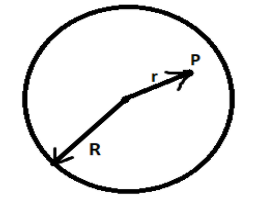
The figure shows a sphere of radius r that carries a total charge Q uniformly distributed throughout its volume.
Which of the following expressions gives the electric field strength at point P, a point that lies inside the sphere and is a distance r from the center of the sphere?
A) $E = \dfrac{{Qr}}{{4\pi {\varepsilon _0}{R^3}}}$
B) $E = \dfrac{Q}{{4\pi {\varepsilon _0}{r^2}}}$
C) $E = 0$ (Point P is inside of conductor)
D) $E = \dfrac{{3Qr}}{{4\pi {\varepsilon _0}{R^3}}}$
Answer
 Verified
575.1k+ views
Hint: We can consider a Gaussian surface for point P and distance from center become radius for this surface. We can use the following relationship to calculate electric strength at point P.
$\phi = E\iint {da}$ where $\phi $ and E is electric flux and field respectively and $\iint {da}$ is surface integral or area of the body.
$\phi = \dfrac{q}{{{\varepsilon _0}}}$ where q is the charge.
Volume charge density of a Gaussian surface is :
\[\dfrac{{Charge{\text{ }}in{\text{ }}body}}{{Volume{\text{ }}of{\text{ }}body}} \times Volume{\text{ }}of{\text{ }}Gaussian{\text{ }}surface{\text{ }}\].
Formula used:
Area of sphere = $4\pi {r^2}$
Volume of sphere = $\dfrac{4}{3}\pi {r^2}$
Complete step by step answer:
Drawing a Gaussian surface around point P to get the electric flux:
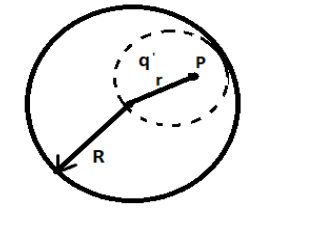
Let charge be enclosed in this Gaussian surface. Then according to Gaussian theorem, the flux inside this surface is given as:
$\phi = E\iint {da}$
For a square, the area will be $4\pi {r^2}$ so:
$\iint {da} = 4\pi {r^2}$ [r being distance from center for P]
$ \Rightarrow \phi = E \times 4\pi {r^2}$ ……… (1)
According to Gauss’ s law, the electric flux is equal to $\dfrac{1}{{{\varepsilon _0}}}$ times the charge contained.
The charge contained in the Gaussian surface is, so:
$\phi = \dfrac{{q'}}{{{\varepsilon _0}}}$ ………….. (2)
As both (1) and (2) represent electric fields for the Gaussian surface, they will be equal.
$\Rightarrow E \times 4\pi {r^2} = \dfrac{{q'}}{{{\varepsilon _0}}} \\$
$ \implies E = \dfrac{{q'}}{{4\pi {r^2}{\varepsilon _0}}}......(3) \\ $
Now, the charge enclosed by this Gaussian surface is the volume charge density of the sphere.
Volume of sphere is $\dfrac{4}{3}\pi {r^3}$ and the charge contained in the sphere is Q, so:
$q' = \dfrac{Q}{{\dfrac{4}{3}\pi {R^3}}} \times \dfrac{4}{3}\pi {r^3} \\$
$ q' = Q\dfrac{{{r^3}}}{{{R^3}}} \\ $ [r is radius of Gaussian surface and R is radius of the sphere]
Substituting this value in (3), we get:
$ E = \dfrac{1}{{4\pi {\varepsilon _0}{r^2}}} \times Q\dfrac{{{r^3}}}{{{R^3}}} \\$
$E = \dfrac{{Qr}}{{4\pi {\varepsilon _0}{R^3}}} \\ $
Therefore, the electric field strength at point P, that lies inside the sphere at distance r from the center of the sphere is \[E = \dfrac{{Qr}}{{4\pi {\varepsilon _0}{R^3}}}\] and the correct option is A).
So, the correct answer is “Option A”.
Note:
The Gaussian surface is basically a 3-D space to calculate flux of electric fields.
Electric field in general terms is the rate of flow of electric field lines flowing in/out the given surface.
Flux can be produced on the spherical Gaussian surface due to a point charge, or shell with uniform charge distribution or symmetrical charge distribution.
$\phi = E\iint {da}$ where $\phi $ and E is electric flux and field respectively and $\iint {da}$ is surface integral or area of the body.
$\phi = \dfrac{q}{{{\varepsilon _0}}}$ where q is the charge.
Volume charge density of a Gaussian surface is :
\[\dfrac{{Charge{\text{ }}in{\text{ }}body}}{{Volume{\text{ }}of{\text{ }}body}} \times Volume{\text{ }}of{\text{ }}Gaussian{\text{ }}surface{\text{ }}\].
Formula used:
Area of sphere = $4\pi {r^2}$
Volume of sphere = $\dfrac{4}{3}\pi {r^2}$
Complete step by step answer:
Drawing a Gaussian surface around point P to get the electric flux:
Let charge be enclosed in this Gaussian surface. Then according to Gaussian theorem, the flux inside this surface is given as:
$\phi = E\iint {da}$
For a square, the area will be $4\pi {r^2}$ so:
$\iint {da} = 4\pi {r^2}$ [r being distance from center for P]
$ \Rightarrow \phi = E \times 4\pi {r^2}$ ……… (1)
According to Gauss’ s law, the electric flux is equal to $\dfrac{1}{{{\varepsilon _0}}}$ times the charge contained.
The charge contained in the Gaussian surface is, so:
$\phi = \dfrac{{q'}}{{{\varepsilon _0}}}$ ………….. (2)
As both (1) and (2) represent electric fields for the Gaussian surface, they will be equal.
$\Rightarrow E \times 4\pi {r^2} = \dfrac{{q'}}{{{\varepsilon _0}}} \\$
$ \implies E = \dfrac{{q'}}{{4\pi {r^2}{\varepsilon _0}}}......(3) \\ $
Now, the charge enclosed by this Gaussian surface is the volume charge density of the sphere.
Volume of sphere is $\dfrac{4}{3}\pi {r^3}$ and the charge contained in the sphere is Q, so:
$q' = \dfrac{Q}{{\dfrac{4}{3}\pi {R^3}}} \times \dfrac{4}{3}\pi {r^3} \\$
$ q' = Q\dfrac{{{r^3}}}{{{R^3}}} \\ $ [r is radius of Gaussian surface and R is radius of the sphere]
Substituting this value in (3), we get:
$ E = \dfrac{1}{{4\pi {\varepsilon _0}{r^2}}} \times Q\dfrac{{{r^3}}}{{{R^3}}} \\$
$E = \dfrac{{Qr}}{{4\pi {\varepsilon _0}{R^3}}} \\ $
Therefore, the electric field strength at point P, that lies inside the sphere at distance r from the center of the sphere is \[E = \dfrac{{Qr}}{{4\pi {\varepsilon _0}{R^3}}}\] and the correct option is A).
So, the correct answer is “Option A”.
Note:
The Gaussian surface is basically a 3-D space to calculate flux of electric fields.
Electric field in general terms is the rate of flow of electric field lines flowing in/out the given surface.
Flux can be produced on the spherical Gaussian surface due to a point charge, or shell with uniform charge distribution or symmetrical charge distribution.
Recently Updated Pages
Master Class 12 Economics: Engaging Questions & Answers for Success

Master Class 12 Physics: Engaging Questions & Answers for Success
Master Class 12 English: Engaging Questions & Answers for Success
Master Class 12 Social Science: Engaging Questions & Answers for Success
Master Class 12 Maths: Engaging Questions & Answers for Success
Master Class 12 Business Studies: Engaging Questions & Answers for Success
Trending doubts
Which are the Top 10 Largest Countries of the World?
What are the major means of transport Explain each class 12 social science CBSE
Draw a labelled sketch of the human eye class 12 physics CBSE
Why cannot DNA pass through cell membranes class 12 biology CBSE
Differentiate between insitu conservation and exsitu class 12 biology CBSE
Draw a neat and well labeled diagram of TS of ovary class 12 biology CBSE