




The fleshy, flat, leaf-like green structures in cactus plants are
(a) Modified leaves with thorns
(b) Modified flowers which perform photosynthesis
(c) Stems modified to thorns
(d) Stems modified to synthesize food by photosynthesis
Answer
 Verified
580.2k+ views
Hint: The cactus plants are desert dwellers that grow and survive in the desert conditions. These plants adapt themselves to prevent water loss from their surface area.
Complete answer:
Cladophylls are the modified stems which are usually flattened having leaf-like appearance and are green in colour, specialized for photosynthesis.
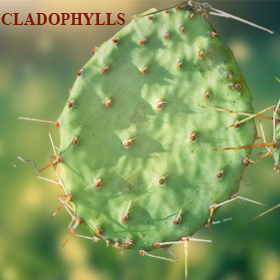
Anatomically, a cladophyll is a branch (it consists of nodes from which new stems, leaves, flowers, and even roots can arise) but it functions as a leaf.
Cacti have a thick, hard-walled, succulent stem to store water, when it rains. Generally, the stem is either spongy or hollow towards the inside. The water loss from the stem is null due to a thick, waxy coating. It keeps the water inside the cactus thus preventing evaporation.
Additional Information:
The cacti plants have lost true leaves. The leaves of the cactus are also modified to spines and help in reducing transpiration. Spines also defend cacti from herbivores and provide some shade. These specialized structures are produced from areoles (highly reduced branches). The presence of Areoles serves as an identifying feature of cacti plants. They also give rise to tubular and multi-petaled flowers.
So, the correct answer is ‘Stems modified to synthesize food by photosynthesis’.
Note:
- Many succulents consist of cladophylls.
- Cladophylls are also known as cladodes or prickly pear pads.
- Cacti produces flowers of different plants that are showy, usually delicate, and very attractive.
- Genus Opuntia is a large genus having the pad cacti or prickly pear cacti since the cladophylls are pad-shaped. The fruit are the edible prickly pears.
Complete answer:
Cladophylls are the modified stems which are usually flattened having leaf-like appearance and are green in colour, specialized for photosynthesis.
Anatomically, a cladophyll is a branch (it consists of nodes from which new stems, leaves, flowers, and even roots can arise) but it functions as a leaf.
Cacti have a thick, hard-walled, succulent stem to store water, when it rains. Generally, the stem is either spongy or hollow towards the inside. The water loss from the stem is null due to a thick, waxy coating. It keeps the water inside the cactus thus preventing evaporation.
Additional Information:
The cacti plants have lost true leaves. The leaves of the cactus are also modified to spines and help in reducing transpiration. Spines also defend cacti from herbivores and provide some shade. These specialized structures are produced from areoles (highly reduced branches). The presence of Areoles serves as an identifying feature of cacti plants. They also give rise to tubular and multi-petaled flowers.
So, the correct answer is ‘Stems modified to synthesize food by photosynthesis’.
Note:
- Many succulents consist of cladophylls.
- Cladophylls are also known as cladodes or prickly pear pads.
- Cacti produces flowers of different plants that are showy, usually delicate, and very attractive.
- Genus Opuntia is a large genus having the pad cacti or prickly pear cacti since the cladophylls are pad-shaped. The fruit are the edible prickly pears.
Recently Updated Pages
Master Class 11 Computer Science: Engaging Questions & Answers for Success

Master Class 11 Business Studies: Engaging Questions & Answers for Success
Master Class 11 Economics: Engaging Questions & Answers for Success
Master Class 11 English: Engaging Questions & Answers for Success
Master Class 11 Maths: Engaging Questions & Answers for Success
Master Class 11 Biology: Engaging Questions & Answers for Success
Trending doubts
There are 720 permutations of the digits 1 2 3 4 5 class 11 maths CBSE
Discuss the various forms of bacteria class 11 biology CBSE
Explain zero factorial class 11 maths CBSE
What organs are located on the left side of your body class 11 biology CBSE
Draw a diagram of nephron and explain its structur class 11 biology CBSE
How do I convert ms to kmh Give an example class 11 physics CBSE