




The food chain in which microbes split energy-rich compounds of the producer community is
(a)Parasitic food chain
(b)Detritus food chain
(c)Predators food chain
(d)Producer food chain
Answer
 Verified
572.7k+ views
Hint: This is the kind of food chain that begins with organic materials that are dead. Microorganisms decompose dead organic compounds. Organisms are known as decomposers, which feed on dead organic matter. Such decomposers are eaten by predators later.
Complete answer:
The food chain is the sequence of populations of organisms in which food and its contained energy move through an ecosystem with members being the food of the sequence's later phase at one point.
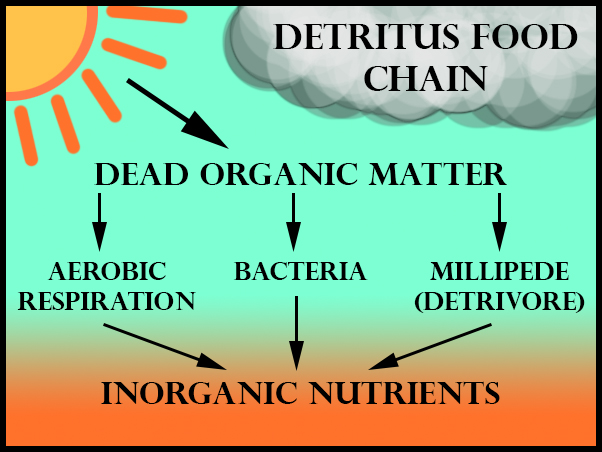
The predator or grazing food chain, the detritus food chain, are common food chains. The food chain of detritus (DFC) starts with organic matter that is dead. It is made up of decomposers, primarily fungi, and bacteria, which are heterotrophic organisms. By decaying dead organic matter or detritus, they satisfy their energy and nutrient demands. Saprotrophs (sapro: to decompose) are also known as these.
Decomposers secrete digestive enzymes into basic, inorganic materials, which are subsequently absorbed by dead and waste materials.
Additional Information: The parasitic food chain is a type of food chain that begins with herbivores, but in the case of a predator, food energy is transferred from larger organisms to smaller organisms without killing. The food is then passed to smaller living species.
Producers sometimes referred to as autotrophs, produce food on their own. They make up every food chain's first stage. Typically, autotrophs are plants or one-celled species. To produce "food" (a nutrient called glucose) from sunlight, carbon dioxide, and water, almost all autotrophs use a method called photosynthesis.
An animal that kills and consumes other animals is a predator, and the prey is the animal that the predator consumes. In the food chain above, the frog is a predator and its prey is the grasshopper. The hawk is a hunter and his prey is a frog.
So, the correct answer is ‘detritus food chain’.
Note: The rule of 10 percent does not refer to the food chain of detritus. In certain habitats, more energy moves through the food chain of detritus than through the food chain of grazing. The energy flow remains a continuous passage in the detritus food chain rather than a stepwise flow between distinct entities.
Complete answer:
The food chain is the sequence of populations of organisms in which food and its contained energy move through an ecosystem with members being the food of the sequence's later phase at one point.
The predator or grazing food chain, the detritus food chain, are common food chains. The food chain of detritus (DFC) starts with organic matter that is dead. It is made up of decomposers, primarily fungi, and bacteria, which are heterotrophic organisms. By decaying dead organic matter or detritus, they satisfy their energy and nutrient demands. Saprotrophs (sapro: to decompose) are also known as these.
Decomposers secrete digestive enzymes into basic, inorganic materials, which are subsequently absorbed by dead and waste materials.
Additional Information: The parasitic food chain is a type of food chain that begins with herbivores, but in the case of a predator, food energy is transferred from larger organisms to smaller organisms without killing. The food is then passed to smaller living species.
Producers sometimes referred to as autotrophs, produce food on their own. They make up every food chain's first stage. Typically, autotrophs are plants or one-celled species. To produce "food" (a nutrient called glucose) from sunlight, carbon dioxide, and water, almost all autotrophs use a method called photosynthesis.
An animal that kills and consumes other animals is a predator, and the prey is the animal that the predator consumes. In the food chain above, the frog is a predator and its prey is the grasshopper. The hawk is a hunter and his prey is a frog.
So, the correct answer is ‘detritus food chain’.
Note: The rule of 10 percent does not refer to the food chain of detritus. In certain habitats, more energy moves through the food chain of detritus than through the food chain of grazing. The energy flow remains a continuous passage in the detritus food chain rather than a stepwise flow between distinct entities.
Recently Updated Pages
Master Class 12 Economics: Engaging Questions & Answers for Success

Master Class 12 Physics: Engaging Questions & Answers for Success
Master Class 12 English: Engaging Questions & Answers for Success
Master Class 12 Social Science: Engaging Questions & Answers for Success
Master Class 12 Maths: Engaging Questions & Answers for Success
Master Class 12 Business Studies: Engaging Questions & Answers for Success
Trending doubts
Which are the Top 10 Largest Countries of the World?
What are the major means of transport Explain each class 12 social science CBSE
Draw a labelled sketch of the human eye class 12 physics CBSE
Why cannot DNA pass through cell membranes class 12 biology CBSE
Differentiate between insitu conservation and exsitu class 12 biology CBSE
Draw a neat and well labeled diagram of TS of ovary class 12 biology CBSE