




The force of attraction between two bodies(A,B) depends upon
a) mass of A
b) mass of B
c) distance between them
d) All of these
Answer
 Verified
593.4k+ views
Hint: To draw a conclusion first we need to know how the force of attraction is defined and on what does it depend upon. We will use Newton's Law of gravitation to define the force of attraction between any two bodies. After we obtain a result from the law of gravitation, we will compare the result and see on what quantities mentioned in the options does it depend on.
Complete step-by-step answer:
Now let us see what the law of gravitation describes. For that let us consider two bodies at a distance r from each other and having mass M and m as shown in the figure below.
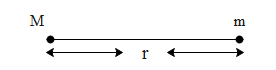
By Newton’s law of gravitation it states that the force between any two bodies in space is directly proportional to the product of their masses and inversely proportional to the square of the distance between them.
Hence mathematically this law can be written as, $\text{F}= -\dfrac{\text{GMm}}{{{\text{r}}^{\text{2}}}}\text{N}$.
G in the adjacent expression is the gravitational constant and minus sign indicates that this force is attractive in nature.
From the results obtained above we can conclude that the correct answer is option d.
Note:
The value of G in space is $\text{6}\text{.67 }\!\!\times\!\!\text{ 1}{{\text{0}}^{\text{-11}}}\text{ N}{{\text{m}}^{\text{2}}}\text{ k}{{\text{g}}^{\text{-2}}}$. From this itself we can conclude that the gravitational force is very weak in nature and even if the force exists between any two bodies having mass there will be no net motion of the body. This force will only result in motion between two bodies if the mass of either one or both the bodies is of the order greater than $\text{1}{{\text{0}}^{\text{-11}}}$.
Complete step-by-step answer:
Now let us see what the law of gravitation describes. For that let us consider two bodies at a distance r from each other and having mass M and m as shown in the figure below.
By Newton’s law of gravitation it states that the force between any two bodies in space is directly proportional to the product of their masses and inversely proportional to the square of the distance between them.
Hence mathematically this law can be written as, $\text{F}= -\dfrac{\text{GMm}}{{{\text{r}}^{\text{2}}}}\text{N}$.
G in the adjacent expression is the gravitational constant and minus sign indicates that this force is attractive in nature.
From the results obtained above we can conclude that the correct answer is option d.
Note:
The value of G in space is $\text{6}\text{.67 }\!\!\times\!\!\text{ 1}{{\text{0}}^{\text{-11}}}\text{ N}{{\text{m}}^{\text{2}}}\text{ k}{{\text{g}}^{\text{-2}}}$. From this itself we can conclude that the gravitational force is very weak in nature and even if the force exists between any two bodies having mass there will be no net motion of the body. This force will only result in motion between two bodies if the mass of either one or both the bodies is of the order greater than $\text{1}{{\text{0}}^{\text{-11}}}$.
Recently Updated Pages
Master Class 11 Computer Science: Engaging Questions & Answers for Success

Master Class 11 Business Studies: Engaging Questions & Answers for Success
Master Class 11 Economics: Engaging Questions & Answers for Success
Master Class 11 English: Engaging Questions & Answers for Success
Master Class 11 Maths: Engaging Questions & Answers for Success
Master Class 11 Biology: Engaging Questions & Answers for Success
Trending doubts
One Metric ton is equal to kg A 10000 B 1000 C 100 class 11 physics CBSE
There are 720 permutations of the digits 1 2 3 4 5 class 11 maths CBSE
Discuss the various forms of bacteria class 11 biology CBSE
Draw a diagram of a plant cell and label at least eight class 11 biology CBSE
State the laws of reflection of light
Explain zero factorial class 11 maths CBSE