




The mechanical advantage of a broom stick is always greater than 1
(A) True
(B) False
Answer
 Verified
233.1k+ views
Hint: The sweeping action of a broom stick is a lever of class 3 whose mechanical advantage is always less than 1.
Complete step by step solution
Firstly, let us understand what a lever is, a lever is a rigid rod that rotates around one point to move a load by applying a force at a third point.
The mechanical advantage of a lever is the ratio of length of the lever on the applied effort side of the fulcrum to the length of the lever on the load side of the fulcrum.
There are three classes of levers as explained below :
1. First Class Lever : In a first class lever, the fulcrum is located somewhere in between the input effort and the output load. This can be observed from the following diagram:
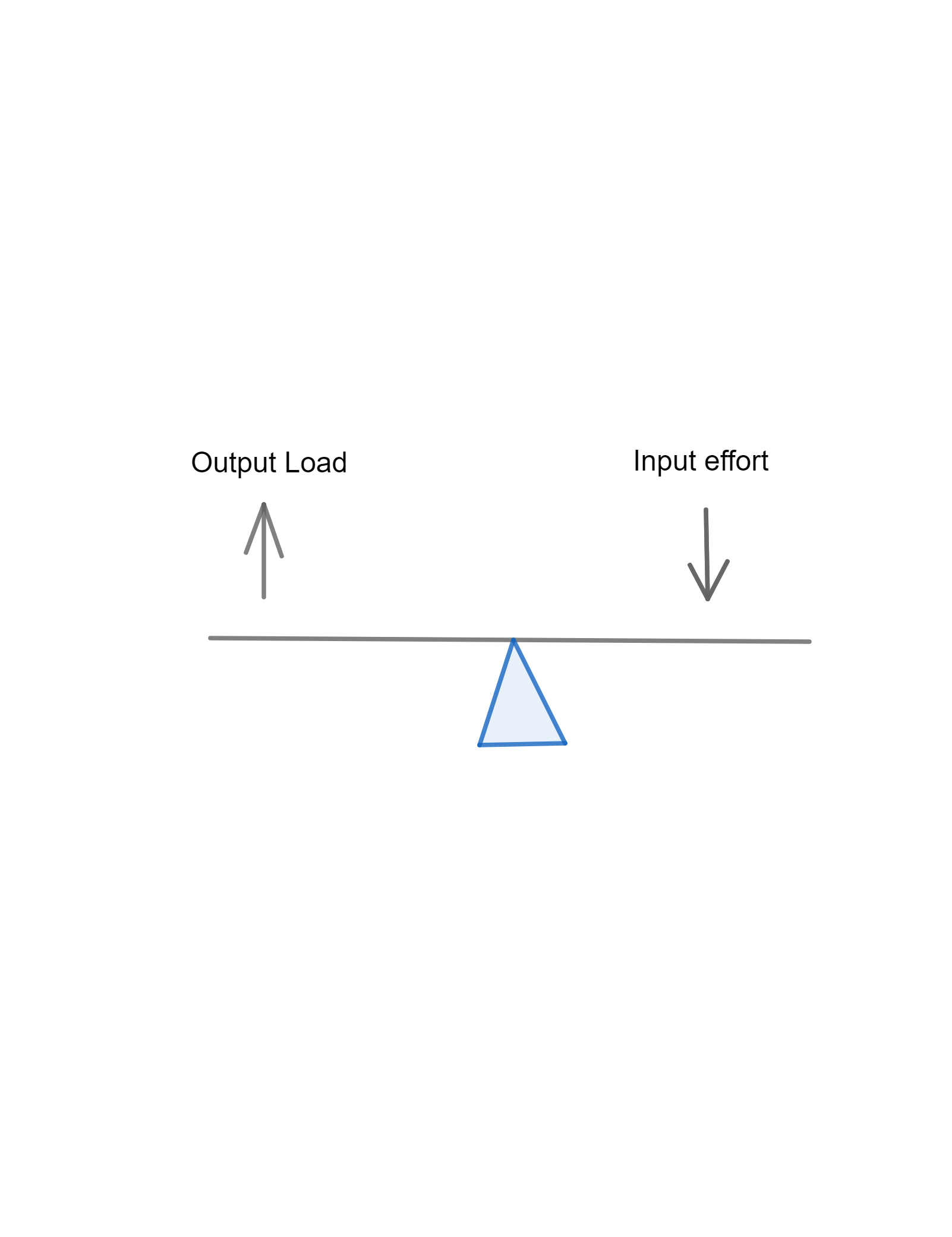
For this, the mechanical advantage can be greater or less than 1, either of them is possible.
Examples: crowbars, see saws and scissors.
2. Second Class Lever: In a second class lever, the load is between fulcrum and effort. This can be understood from the following diagram:
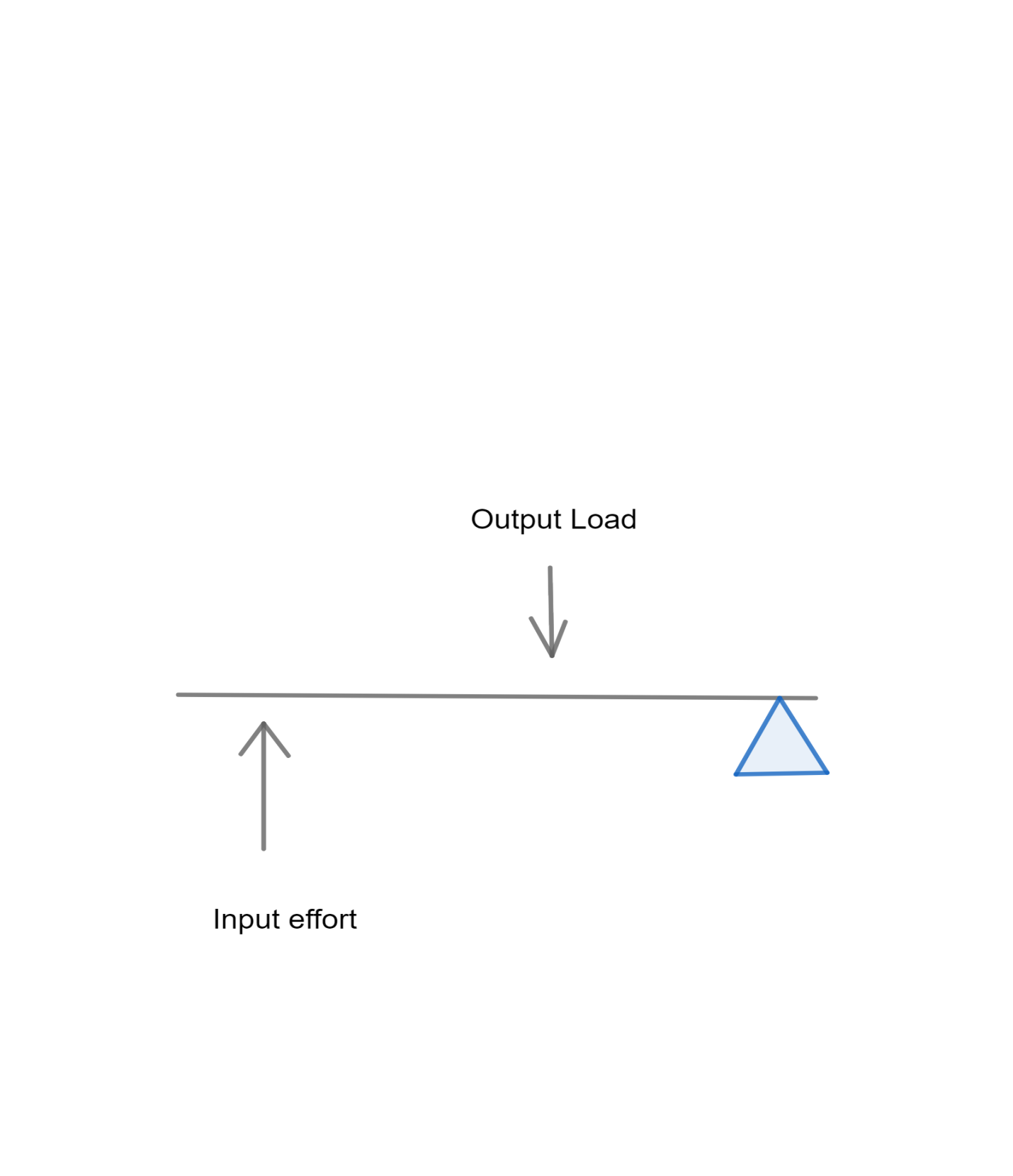
As we can observe from the diagram, length between input effort and the fulcrum is always greater than the length between output load and fulcrum, therefore, the mechanical advantage of a second class lever is always greater than 1.
Examples : Wheelbarrow, doors and bottle openers
3. Third Class Lever: In a second class lever, the effort is between fulcrum and load. This can be observed from the following diagram:
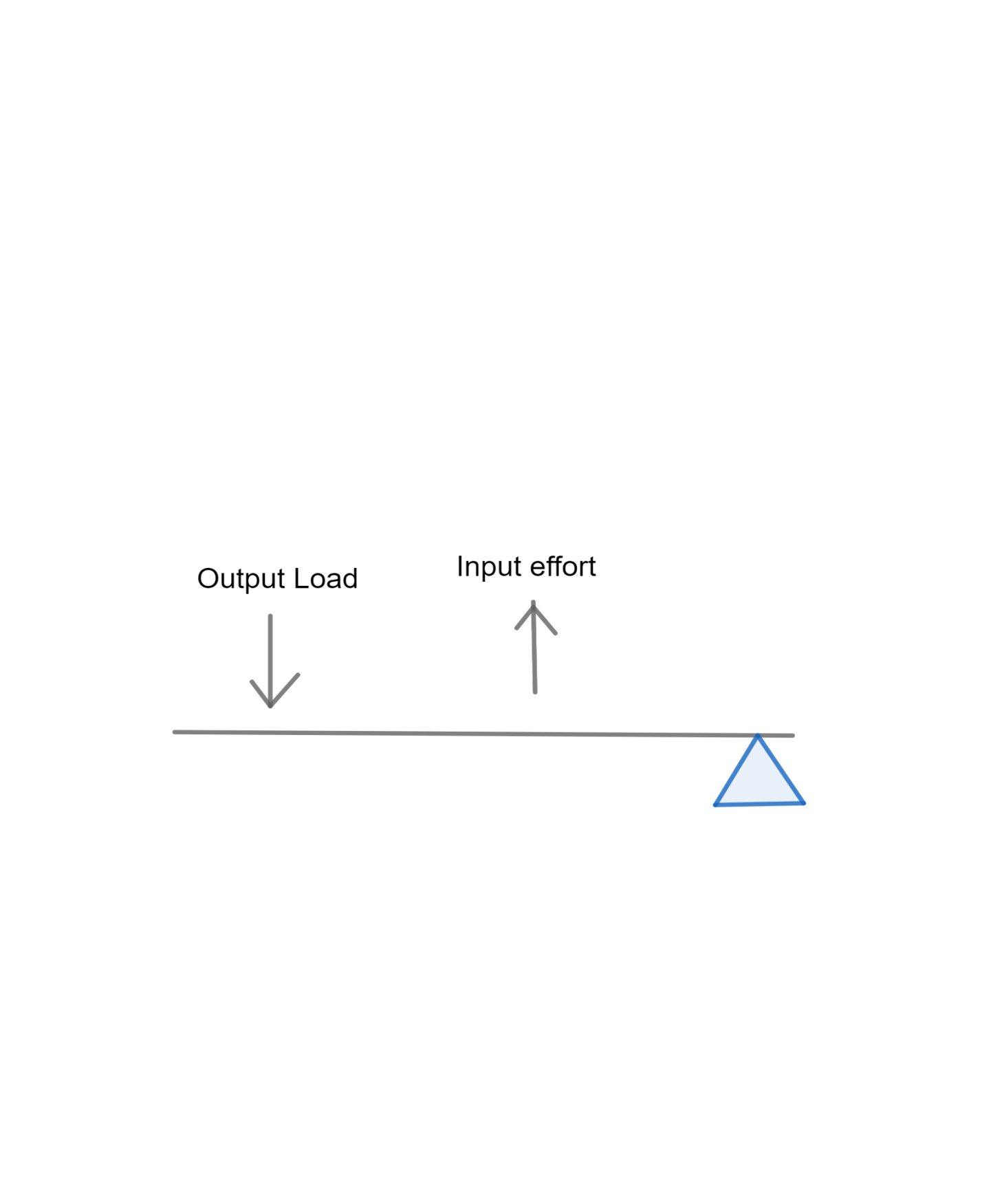
As we can observe from the diagram, length between input effort and the fulcrum is always less than the length between output load and fulcrum, therefore, the mechanical advantage of a second class lever is always less than 1.
Examples: Tweezers, arm hammer and shovel
In a broom stick, the handle of the broom at the top is the fulcrum, we push the handle from somewhere in the middle, that is the input effort and the bristles at the end of the broomstick sweep dust from the floor, that is the output load. Therefore, a broomstick is a lever of class 3. Hence, its mechanical load is always less than 1. So, the given statement in the question is False.
Option (B) is correct.
Note: We can learn the following for a quick answer:
1. Mechanical Advantage of a class 1 lever can be greater or less than 1.
2. Mechanical Advantage of a class 2 lever is always greater than 1.
3. Mechanical Advantage of a class 3 lever is always less than 1.
Complete step by step solution
Firstly, let us understand what a lever is, a lever is a rigid rod that rotates around one point to move a load by applying a force at a third point.
The mechanical advantage of a lever is the ratio of length of the lever on the applied effort side of the fulcrum to the length of the lever on the load side of the fulcrum.
There are three classes of levers as explained below :
1. First Class Lever : In a first class lever, the fulcrum is located somewhere in between the input effort and the output load. This can be observed from the following diagram:
For this, the mechanical advantage can be greater or less than 1, either of them is possible.
Examples: crowbars, see saws and scissors.
2. Second Class Lever: In a second class lever, the load is between fulcrum and effort. This can be understood from the following diagram:
As we can observe from the diagram, length between input effort and the fulcrum is always greater than the length between output load and fulcrum, therefore, the mechanical advantage of a second class lever is always greater than 1.
Examples : Wheelbarrow, doors and bottle openers
3. Third Class Lever: In a second class lever, the effort is between fulcrum and load. This can be observed from the following diagram:
As we can observe from the diagram, length between input effort and the fulcrum is always less than the length between output load and fulcrum, therefore, the mechanical advantage of a second class lever is always less than 1.
Examples: Tweezers, arm hammer and shovel
In a broom stick, the handle of the broom at the top is the fulcrum, we push the handle from somewhere in the middle, that is the input effort and the bristles at the end of the broomstick sweep dust from the floor, that is the output load. Therefore, a broomstick is a lever of class 3. Hence, its mechanical load is always less than 1. So, the given statement in the question is False.
Option (B) is correct.
Note: We can learn the following for a quick answer:
1. Mechanical Advantage of a class 1 lever can be greater or less than 1.
2. Mechanical Advantage of a class 2 lever is always greater than 1.
3. Mechanical Advantage of a class 3 lever is always less than 1.
Recently Updated Pages
JEE Main 2023 April 6 Shift 1 Question Paper with Answer Key

JEE Main 2023 April 6 Shift 2 Question Paper with Answer Key
JEE Main 2023 (January 31 Evening Shift) Question Paper with Solutions [PDF]
JEE Main 2023 January 30 Shift 2 Question Paper with Answer Key
JEE Main 2023 January 25 Shift 1 Question Paper with Answer Key
JEE Main 2023 January 24 Shift 2 Question Paper with Answer Key
Trending doubts
JEE Main 2026: Session 2 Registration Open, City Intimation Slip, Exam Dates, Syllabus & Eligibility
JEE Main 2026 Application Login: Direct Link, Registration, Form Fill, and Steps
Understanding the Angle of Deviation in a Prism
Hybridisation in Chemistry – Concept, Types & Applications
How to Convert a Galvanometer into an Ammeter or Voltmeter
Understanding Uniform Acceleration in Physics
Other Pages
JEE Advanced Marks vs Ranks 2025: Understanding Category-wise Qualifying Marks and Previous Year Cut-offs
Laws of Motion Class 11 Physics Chapter 4 CBSE Notes - 2025-26
Waves Class 11 Physics Chapter 14 CBSE Notes - 2025-26
Mechanical Properties of Fluids Class 11 Physics Chapter 9 CBSE Notes - 2025-26
Thermodynamics Class 11 Physics Chapter 11 CBSE Notes - 2025-26
Units And Measurements Class 11 Physics Chapter 1 CBSE Notes - 2025-26