




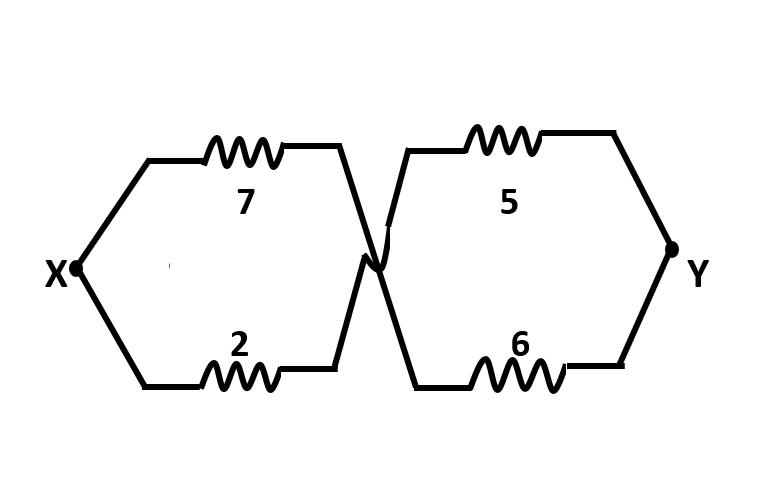
The net resistance between X and Y is: (all resistances are in ohm)
$\begin{align}
& (A)4\Omega \\
& (B)4.55\Omega \\
& (C)2\Omega \\
& (D)20\Omega \\
\end{align}$
Answer
 Verified
533.1k+ views
Hint: The trick to this question lies in its figure only. The wire coming from 7ohm resistance is connected with 6ohm resistance and not 2ohm resistance. Also, the wire coming from 2ohm resistance is connected with the 5ohm resistance and not the 7ohm resistance. We shall use this fact to first simplify our circuit and then solve it to get the net resistance between X and Y.
Complete step-by-step solution:
Let us first simplify our circuit based on the above analysis. The simplified circuit is shown below (all resistances being in ohm):
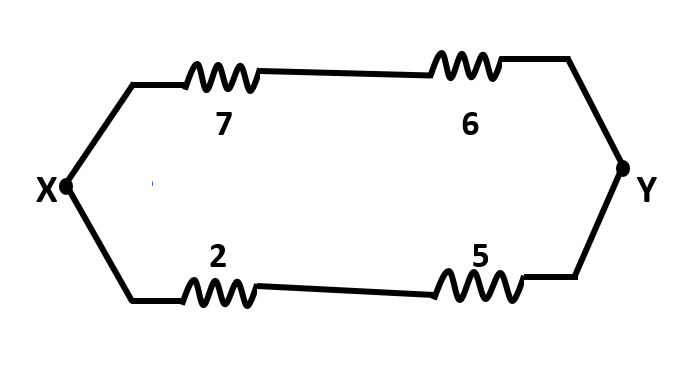
Now, the resultant resistance between X and Y can be calculated easily.
Let the net resistance in the upper branch be ${{R}_{1}}$ , then it is equal to:
$\begin{align}
& \Rightarrow {{R}_{1}}=(7+6)\Omega \\
& \Rightarrow {{R}_{1}}=13\Omega \\
\end{align}$
Now, let the resistance in the lower branch be given by ${{R}_{2}}$, then it is equal to:
$\begin{align}
& \Rightarrow {{R}_{2}}=(5+2)\Omega \\
& \Rightarrow {{R}_{2}}=7\Omega \\
\end{align}$
Now, these two branches are connected across the same potential difference, this means they are connected in parallel. Hence, their net resistance could be calculated using the following formula:
$\Rightarrow {{R}_{net}}=\dfrac{{{R}_{1}}\times {{R}_{2}}}{{{R}_{1}}+{{R}_{2}}}$
Putting the values of the two resistances, we get the equivalent resistance as:
$\begin{align}
& \Rightarrow {{R}_{net}}=\dfrac{13\times 7}{13+7}\Omega \\
& \Rightarrow {{R}_{net}}=\dfrac{91}{20}\Omega \\
& \therefore {{R}_{net}}=4.55\Omega \\
\end{align}$
Hence, the net resistance between the points X and Y comes out to be $4.55\Omega $ .
Hence, option (B) is the correct option.
Note: If we solve it ordinarily, then we will see that the 7 and 2, 5 and 6ohm resistances are in common. Now, this is where the problem lies. The wire through the 7ohm resistance trips below the wire coming from 2ohm resistance. We need to analyze these diagrams carefully and make sure to simplify our circuits if there are any complications.
Complete step-by-step solution:
Let us first simplify our circuit based on the above analysis. The simplified circuit is shown below (all resistances being in ohm):
Now, the resultant resistance between X and Y can be calculated easily.
Let the net resistance in the upper branch be ${{R}_{1}}$ , then it is equal to:
$\begin{align}
& \Rightarrow {{R}_{1}}=(7+6)\Omega \\
& \Rightarrow {{R}_{1}}=13\Omega \\
\end{align}$
Now, let the resistance in the lower branch be given by ${{R}_{2}}$, then it is equal to:
$\begin{align}
& \Rightarrow {{R}_{2}}=(5+2)\Omega \\
& \Rightarrow {{R}_{2}}=7\Omega \\
\end{align}$
Now, these two branches are connected across the same potential difference, this means they are connected in parallel. Hence, their net resistance could be calculated using the following formula:
$\Rightarrow {{R}_{net}}=\dfrac{{{R}_{1}}\times {{R}_{2}}}{{{R}_{1}}+{{R}_{2}}}$
Putting the values of the two resistances, we get the equivalent resistance as:
$\begin{align}
& \Rightarrow {{R}_{net}}=\dfrac{13\times 7}{13+7}\Omega \\
& \Rightarrow {{R}_{net}}=\dfrac{91}{20}\Omega \\
& \therefore {{R}_{net}}=4.55\Omega \\
\end{align}$
Hence, the net resistance between the points X and Y comes out to be $4.55\Omega $ .
Hence, option (B) is the correct option.
Note: If we solve it ordinarily, then we will see that the 7 and 2, 5 and 6ohm resistances are in common. Now, this is where the problem lies. The wire through the 7ohm resistance trips below the wire coming from 2ohm resistance. We need to analyze these diagrams carefully and make sure to simplify our circuits if there are any complications.
Recently Updated Pages
Master Class 12 Economics: Engaging Questions & Answers for Success

Master Class 12 Physics: Engaging Questions & Answers for Success
Master Class 12 English: Engaging Questions & Answers for Success
Master Class 12 Social Science: Engaging Questions & Answers for Success
Master Class 12 Maths: Engaging Questions & Answers for Success
Master Class 12 Business Studies: Engaging Questions & Answers for Success
Trending doubts
Which are the Top 10 Largest Countries of the World?
What are the major means of transport Explain each class 12 social science CBSE
Draw a labelled sketch of the human eye class 12 physics CBSE
Why cannot DNA pass through cell membranes class 12 biology CBSE
Differentiate between insitu conservation and exsitu class 12 biology CBSE
Draw a neat and well labeled diagram of TS of ovary class 12 biology CBSE