




The plane of a mirror makes an angle $ {30^ \circ } $ with the horizontal. If any vertical ray is incident on a mirror then the angle made by the reflected ray on the plane mirror will be.
Answer
 Verified
538.2k+ views
Hint :To solve this question, construct the ray diagram for the reflection of the incident vertical ray on the mirror, then find the angle that this ray makes with the mirror by using the angle of the normal and angle of the mirror with the horizontal, then , by laws of reflection, the problem is solved.
The angle that the normal ray makes with the mirror is $ {90^ \circ } $ .
The angle of incidence is equal to equal to the angle of reflection, i.e.
$ \angle i = \angle r $
Complete Step By Step Answer:
Consider the plane mirror as given in the question that is making an angle of $ {30^ \circ } $ with the horizontal, construct a vertical ray incident on the mirror and the corresponding reflected ray,
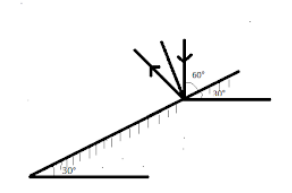
Here, the angle that the vertical incident ray makes with the mirror is:
$ {90^ \circ } - {30^ \circ } = {60^ \circ } $
Thus, the angle that the incident ray makes with the normal is
$ {90^ \circ } - {60^ \circ } = {30^ \circ } $
Now as according to the laws of reflection, the angle of incidence is equal to the angle of reflection, that means the angle that the reflected ray makes with the normal is equal to $ {30^ \circ } $
Therefore, the angle that the reflected ray makes with the mirror surface is
$ {90^ \circ } - {30^ \circ } = {60^ \circ } $
Hence, the answer is $ {60^ \circ } $ .
Note :
It is important to note that the incident vertical ray has to be perpendicular to the horizontal with which the angle of the mirror is already given, with this basic start, it gets very easier to solve this question, you might think of solving it the other way round by letting a variable for the value of angle that reflected ray makes with horizontal, but that makes it lengthy and tough.
The angle that the normal ray makes with the mirror is $ {90^ \circ } $ .
The angle of incidence is equal to equal to the angle of reflection, i.e.
$ \angle i = \angle r $
Complete Step By Step Answer:
Consider the plane mirror as given in the question that is making an angle of $ {30^ \circ } $ with the horizontal, construct a vertical ray incident on the mirror and the corresponding reflected ray,
Here, the angle that the vertical incident ray makes with the mirror is:
$ {90^ \circ } - {30^ \circ } = {60^ \circ } $
Thus, the angle that the incident ray makes with the normal is
$ {90^ \circ } - {60^ \circ } = {30^ \circ } $
Now as according to the laws of reflection, the angle of incidence is equal to the angle of reflection, that means the angle that the reflected ray makes with the normal is equal to $ {30^ \circ } $
Therefore, the angle that the reflected ray makes with the mirror surface is
$ {90^ \circ } - {30^ \circ } = {60^ \circ } $
Hence, the answer is $ {60^ \circ } $ .
Note :
It is important to note that the incident vertical ray has to be perpendicular to the horizontal with which the angle of the mirror is already given, with this basic start, it gets very easier to solve this question, you might think of solving it the other way round by letting a variable for the value of angle that reflected ray makes with horizontal, but that makes it lengthy and tough.
Recently Updated Pages
Master Class 12 Economics: Engaging Questions & Answers for Success

Master Class 12 Physics: Engaging Questions & Answers for Success
Master Class 12 English: Engaging Questions & Answers for Success
Master Class 12 Social Science: Engaging Questions & Answers for Success
Master Class 12 Maths: Engaging Questions & Answers for Success
Master Class 12 Business Studies: Engaging Questions & Answers for Success
Trending doubts
Which are the Top 10 Largest Countries of the World?
What are the major means of transport Explain each class 12 social science CBSE
Draw a labelled sketch of the human eye class 12 physics CBSE
Why cannot DNA pass through cell membranes class 12 biology CBSE
Differentiate between insitu conservation and exsitu class 12 biology CBSE
Draw a neat and well labeled diagram of TS of ovary class 12 biology CBSE