




The vector 3-4i is turned anticlockwise through an angle of ${{180}^{\circ }}$ and stretched 2.5 times. The complex number corresponding to the newly obtained vector is ..
\[\begin{align}
& A.\dfrac{-15}{2}+10i \\
& B.\dfrac{15}{2}+10i \\
& C.\dfrac{-15}{2}-10i \\
& D.\dfrac{15}{2}-10i \\
\end{align}\]
Answer
 Verified
571.8k+ views
Hint: For solving this question, we first need to understand the signs in the complex plane. Since every complex plane is of the form x+iy. So a complex plane is the same as an argand plane where x is x and y is y axis. First we will find the quadrant in which the current vector is lying. Then we will find the quadrant if the vector is rotated through an angle ${{180}^{\circ }}$. Using the quadrant, we will change the sign of the vector and at last we will multiply obtained vector by 2.5 to get the required vector.
Complete step-by-step answer:
Let us understand the complex plane first. In the complex plane the horizontal axis is the x axis and vertical axis is y axis. It looks like this:
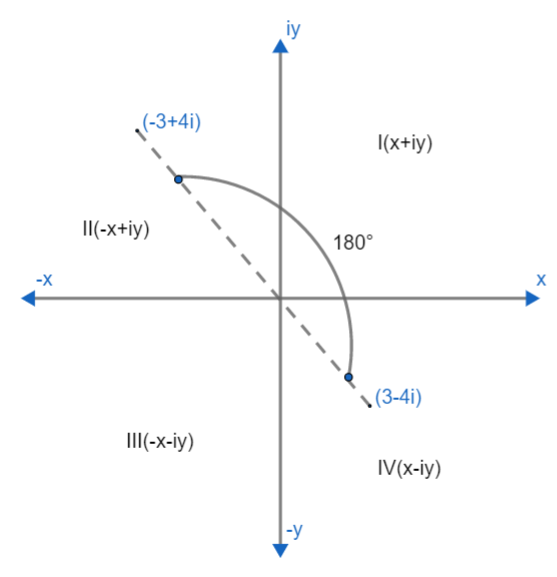
Complex numbers of the form x+iy lie in I quadrant, -x+iy lie in II quadrant, -x-iy lies in III quadrant and x-iy lies in IV quadrant.
Here we are given complex numbers as 3-4i. It is of the form x-iy. So it lies in the IV quadrant. If we turn the vector anticlockwise to ${{180}^{\circ }}$ our new vector will lie in II quadrant where vectors are of form -x+iy. So our vector becomes -3+4i.
Now, we have to stretch it 2.5 times, so our new vector becomes 2.5 times the original vector. So required complex number will be,
\[\begin{align}
& \Rightarrow 2.5\left( -3+4i \right) \\
& \Rightarrow \left( -2.5\times 3 \right)+\left( 2.5\times 4 \right)i \\
& \Rightarrow \left( \dfrac{-25\times 3}{10} \right)+\left( \dfrac{25\times 4}{10} \right)i \\
& \Rightarrow \dfrac{-15}{2}+10i \\
\end{align}\]
Hence, $\dfrac{-15}{2}+10i$ is our required vector.
So, the correct answer is “Option A”.
Note: Here students can make mistakes in positive and negative signs in quadrant. While changing quadrants, make sure that numbers remain the same and only sign changes. While selecting a vector, make sure 2.5 is multiplied with both -3 and 4. Complex plane is just like argand plane.
Complete step-by-step answer:
Let us understand the complex plane first. In the complex plane the horizontal axis is the x axis and vertical axis is y axis. It looks like this:
Complex numbers of the form x+iy lie in I quadrant, -x+iy lie in II quadrant, -x-iy lies in III quadrant and x-iy lies in IV quadrant.
Here we are given complex numbers as 3-4i. It is of the form x-iy. So it lies in the IV quadrant. If we turn the vector anticlockwise to ${{180}^{\circ }}$ our new vector will lie in II quadrant where vectors are of form -x+iy. So our vector becomes -3+4i.
Now, we have to stretch it 2.5 times, so our new vector becomes 2.5 times the original vector. So required complex number will be,
\[\begin{align}
& \Rightarrow 2.5\left( -3+4i \right) \\
& \Rightarrow \left( -2.5\times 3 \right)+\left( 2.5\times 4 \right)i \\
& \Rightarrow \left( \dfrac{-25\times 3}{10} \right)+\left( \dfrac{25\times 4}{10} \right)i \\
& \Rightarrow \dfrac{-15}{2}+10i \\
\end{align}\]
Hence, $\dfrac{-15}{2}+10i$ is our required vector.
So, the correct answer is “Option A”.
Note: Here students can make mistakes in positive and negative signs in quadrant. While changing quadrants, make sure that numbers remain the same and only sign changes. While selecting a vector, make sure 2.5 is multiplied with both -3 and 4. Complex plane is just like argand plane.
Recently Updated Pages
Master Class 12 Economics: Engaging Questions & Answers for Success

Master Class 12 Physics: Engaging Questions & Answers for Success
Master Class 12 English: Engaging Questions & Answers for Success
Master Class 12 Social Science: Engaging Questions & Answers for Success
Master Class 12 Maths: Engaging Questions & Answers for Success
Master Class 12 Business Studies: Engaging Questions & Answers for Success
Trending doubts
Which are the Top 10 Largest Countries of the World?
What are the major means of transport Explain each class 12 social science CBSE
Draw a labelled sketch of the human eye class 12 physics CBSE
Why cannot DNA pass through cell membranes class 12 biology CBSE
Differentiate between insitu conservation and exsitu class 12 biology CBSE
Draw a neat and well labeled diagram of TS of ovary class 12 biology CBSE