




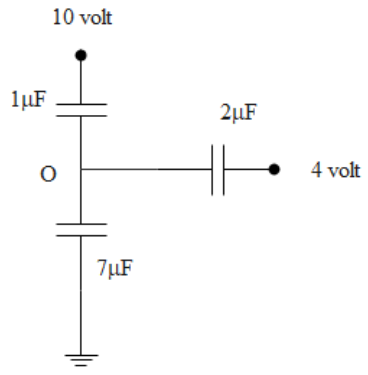
Three capacitors are connected as shown in the figure. The potential at point 0 is equal to
A. 1.4 volt
B. 4.7 volt
C. Zero
D. 1.8 volt
Answer
 Verified
603.3k+ views
Hint: To solve this question we need to have an idea about the concept of nodal analysis. With the help of the nodal analysis concept we will be able to find the potential at O for the three capacitors. The diagram plays a very important role for this question. It gives us an idea about the position of the capacitors placed in the circuit.
Complete step-by-step answer:
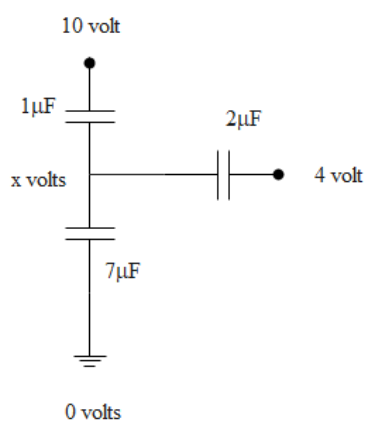
Nodal analysis is a method which is used to analyse the circuits on the basis of defining node voltages as the variables. The technique of nodal analysis can be used to analyse the circuits on the basis of the reactive components. With reference to the above diagram, we can determine that there are a total of 3 capacitors from the node point O. We can consider the voltage at the node point to be x as is shown in the figure below.
We can see the net charge to be the product of capacitance and voltage.
$\text{Q=CV}$
Where, Q = charge
C = capacitance
V = voltage
Therefore, the summation of the charges flowing through the transmission lines is zero. Hence, we get an equation,
$7(\text{x}-0)\text{ + 1(x}-\text{10) + 2(x}-\text{4) = 0}$
$\Rightarrow \text{ 10x = 18}$
$\Rightarrow \text{ x = 1}\text{.8V}$
Therefore, the correct option is Option D.
Note: No doubt that nodal analysis is a very used method. However, it has got some limitations as well. Some of the limitations include the inability to work with voltage sources and the current dependent elements of the circuits in a simple and efficient manner.
Complete step-by-step answer:
Nodal analysis is a method which is used to analyse the circuits on the basis of defining node voltages as the variables. The technique of nodal analysis can be used to analyse the circuits on the basis of the reactive components. With reference to the above diagram, we can determine that there are a total of 3 capacitors from the node point O. We can consider the voltage at the node point to be x as is shown in the figure below.
We can see the net charge to be the product of capacitance and voltage.
$\text{Q=CV}$
Where, Q = charge
C = capacitance
V = voltage
Therefore, the summation of the charges flowing through the transmission lines is zero. Hence, we get an equation,
$7(\text{x}-0)\text{ + 1(x}-\text{10) + 2(x}-\text{4) = 0}$
$\Rightarrow \text{ 10x = 18}$
$\Rightarrow \text{ x = 1}\text{.8V}$
Therefore, the correct option is Option D.
Note: No doubt that nodal analysis is a very used method. However, it has got some limitations as well. Some of the limitations include the inability to work with voltage sources and the current dependent elements of the circuits in a simple and efficient manner.
Recently Updated Pages
Master Class 12 Economics: Engaging Questions & Answers for Success

Master Class 12 Physics: Engaging Questions & Answers for Success
Master Class 12 English: Engaging Questions & Answers for Success
Master Class 12 Social Science: Engaging Questions & Answers for Success
Master Class 12 Maths: Engaging Questions & Answers for Success
Master Class 12 Business Studies: Engaging Questions & Answers for Success
Trending doubts
Which are the Top 10 Largest Countries of the World?
What are the major means of transport Explain each class 12 social science CBSE
Draw a labelled sketch of the human eye class 12 physics CBSE
Why cannot DNA pass through cell membranes class 12 biology CBSE
Differentiate between insitu conservation and exsitu class 12 biology CBSE
Draw a neat and well labeled diagram of TS of ovary class 12 biology CBSE