




Two cells of 1.25V and 0.75V are connected in parallel. The effective voltage will be?
Answer
 Verified
524.4k+ views
Hint: We have to use the Kirchhoff’s rule for finding the effective voltage when two cells are connected in parallel. In parallel grouping of cells, all anodes are connected at one point and all cathodes are connected together at other points. If n identical cells are connected in parallel then effective voltage of parallel combination is equal to the e.m.f. of one cell.
Complete step by step answer:
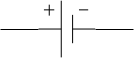
This figure represents a cell. Cell always contains two terminals one is a positive terminal and one is a negative terminal. Cell is always the source from where the voltage is produced. A cell converts chemical energy into electric energy. Combination of cells gives a battery. When one negative terminal of a cell is connected to the next positive terminal of a cell then it is called a series combination of cells while when all positive terminals and negative terminals of many cells are connected together then such combination is called parallel combination.
Cells always provide a Direct Current. Current flow in circuits only when charge carriers travel around the circuit. Current is defined as the rate at which this charge passes any point in the circuit.
There is basically two Kirchhoff’s Law: -
Junction rule: - The sum of incoming current towards the junction is always equal to sum of outgoing current away from junction.
Loop Rule: - This rule is applicable only for Closed loop, according to this law algebraic sum of all the potential difference of all the components used in a closed loop is always equal to zero.
Here in this question we have given two cells. Each of different voltages are connected in parallel combination.
Let us assume the voltage of the 1st cell as \[{{V}_{1}}\]and the 2nd voltage as\[{{V}_{2}}\].
So according of the question values of both the cells can be written as:-
\[\begin{align}
& {{V}_{1}}=1.25Volt \\
& {{V}_{2}}=0.75Volt \\
\end{align}\]
So at the junction, we will use Kirchhoff law for finding the effective voltage.
Let us assume the effective voltage will be V
So it can be represented as:-
\[V={{V}_{1}}-{{V}_{2}}\]
\[V=1.25-0.75\]
\[V=0.5Volt\]
Hence, the effective voltage of this parallel combination will be 0.5V.
Note: It is important to note the uses of signs while applying the Kirchhoff’s law - a positive sign of current means that the currents are flowing in the directions indicated on the circuit diagram and negative sign means that the currents are flowing in the direction opposite to indicated in the circuit diagram.
Complete step by step answer:
This figure represents a cell. Cell always contains two terminals one is a positive terminal and one is a negative terminal. Cell is always the source from where the voltage is produced. A cell converts chemical energy into electric energy. Combination of cells gives a battery. When one negative terminal of a cell is connected to the next positive terminal of a cell then it is called a series combination of cells while when all positive terminals and negative terminals of many cells are connected together then such combination is called parallel combination.
Cells always provide a Direct Current. Current flow in circuits only when charge carriers travel around the circuit. Current is defined as the rate at which this charge passes any point in the circuit.
There is basically two Kirchhoff’s Law: -
Junction rule: - The sum of incoming current towards the junction is always equal to sum of outgoing current away from junction.
Loop Rule: - This rule is applicable only for Closed loop, according to this law algebraic sum of all the potential difference of all the components used in a closed loop is always equal to zero.
Here in this question we have given two cells. Each of different voltages are connected in parallel combination.
Let us assume the voltage of the 1st cell as \[{{V}_{1}}\]and the 2nd voltage as\[{{V}_{2}}\].
So according of the question values of both the cells can be written as:-
\[\begin{align}
& {{V}_{1}}=1.25Volt \\
& {{V}_{2}}=0.75Volt \\
\end{align}\]
So at the junction, we will use Kirchhoff law for finding the effective voltage.
Let us assume the effective voltage will be V
So it can be represented as:-
\[V={{V}_{1}}-{{V}_{2}}\]
\[V=1.25-0.75\]
\[V=0.5Volt\]
Hence, the effective voltage of this parallel combination will be 0.5V.
Note: It is important to note the uses of signs while applying the Kirchhoff’s law - a positive sign of current means that the currents are flowing in the directions indicated on the circuit diagram and negative sign means that the currents are flowing in the direction opposite to indicated in the circuit diagram.
Recently Updated Pages
Master Class 12 Economics: Engaging Questions & Answers for Success

Master Class 12 Physics: Engaging Questions & Answers for Success
Master Class 12 English: Engaging Questions & Answers for Success
Master Class 12 Social Science: Engaging Questions & Answers for Success
Master Class 12 Maths: Engaging Questions & Answers for Success
Master Class 12 Business Studies: Engaging Questions & Answers for Success
Trending doubts
Which are the Top 10 Largest Countries of the World?
What are the major means of transport Explain each class 12 social science CBSE
Draw a labelled sketch of the human eye class 12 physics CBSE
Why cannot DNA pass through cell membranes class 12 biology CBSE
Differentiate between insitu conservation and exsitu class 12 biology CBSE
Draw a neat and well labeled diagram of TS of ovary class 12 biology CBSE