




Two circles of radii 5cm and 3cm intersect at two points and the distance between their centres is 4cm. Find the length of the common chord.
Answer
 Verified
580.2k+ views
Hint:
we will first prove that the line joining the centers of the two circles and the common chord are perpendicular to each other and also prove that the line joining the centers of the two circles bisect the common chord by using congruent triangle and then we will apply the Pythagorean Theorem to find the length of common chord.
Complete step by step solution:
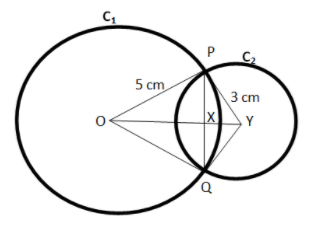
Let the two circles be C1 with centre O and C2 with centre Y. PQ is the required common chord which intersects OY at X.
Given that:
$\begin{align}
&\Rightarrow OP\text{ }=\text{ }5cm \\
&\Rightarrow YP\text{ }=\text{ }3cm \\
\end{align}$
In $\vartriangle OPY\text{ } and \text{ }\vartriangle OQY$
$\Rightarrow OP\text{ }=\text{ }OQ$ (radius of circle C1)
$\Rightarrow PY\text{ }=\text{ }QY$ (radius of circle C2)
$\Rightarrow OY\text{ }=\text{ }OY$ (common)
$\therefore \vartriangle OPY\cong OQY$ (SSS congruence rule)
$\Rightarrow \angle POY=\angle QOY$ (C.P.C.T) …………………..
Now,
In $\vartriangle POX\text{ }and\text{ }\vartriangle QOX$
$\Rightarrow OP\text{ }=\text{ }OQ$ (radius of circle C1)
$\Rightarrow \angle POX=\angle QOX$( from (1) )
$\Rightarrow OX\text{ }=\text{ }OX$ (common)
$\therefore \vartriangle POX\cong QOX$(SAS congruence rule)
$\Rightarrow \angle PXO\text{ }=\text{ }\angle QXO$ (C.P.C.T) ……………………
$\left( 2 \right)$
$\And \text{ }PX\text{ }=\text{ }QX$ (C.P.C.T) ……………………………. $\left( 3 \right)$
Since PQ is a straight line. So,
$\Rightarrow \angle PXO\text{ }+\text{ }\angle QXO\text{ }=\text{ }{{180}^{o}}$
$\Rightarrow \angle PXO\text{ }+\text{ }\angle PXO\text{ }=\text{ }{{180}^{o}}$ ( From)
$\Rightarrow 2\angle PXO\text{ }=\text{ }{{180}^{o}}$
$\Rightarrow \angle PXO\text{ }=\text{ }{{90}^{o}}$
$\Rightarrow \therefore \angle PXO\text{ }=\text{ }\angle QXO\text{ }=\text{ }{{90}^{o}}$
Therefore,
$\vartriangle PXO\text{ and }\vartriangle PXY$ is a right angled triangle.
Let $OX\text{ }=\text{ }x\text{ }so\text{ }XY\text{ }=\text{ }4\text{ }-\text{ }x$
Using Pythagoras Theorem in ;
$\begin{align}
&\Rightarrow \text{In }\vartriangle PXO \\
&\Rightarrow O{{P}^{2}}\text{ }=\text{ }O{{X}^{2}}\text{ }+\text{ }P{{X}^{2}} \\
&\Rightarrow {{5}^{2}}\text{ }=\text{ }{{x}^{2}}\text{ }+\text{ }P{{X}^{2}} \\
&\Rightarrow {{5}^{2}}\text{ }-\text{ }{{x}^{2}}\text{ }=\text{ }P{{X}^{2}} \\
\end{align}$ ………………$\left( 4 \right)$
$\begin{align}
&\Rightarrow \text{In }\vartriangle PXY \\
&\Rightarrow P{{Y}^{2}}\text{ }=\text{ }X{{Y}^{2}}\text{ }+\text{ }P{{X}^{2}} \\
&\Rightarrow {{3}^{2}}\text{ }=\text{ }{{(4\text{ }-\text{ }x)}^{2}}\text{ }+\text{ }P{{X}^{2}} \\
&\Rightarrow {{3}^{2}}\text{ }-\text{ }{{(4\text{ }-\text{ }x)}^{2}}\text{ }=\text{ }P{{X}^{2}} \\
\end{align}$ ………………$\left( 5 \right)$
Equating $\left( 4 \right)$and$\left( 5 \right)$, we get;
$\begin{align}
& {{3}^{2}}\text{ }-\text{ }{{(4\text{ }-\text{ }x)}^{2}}\text{ }=\text{ }{{5}^{2}}-{{x}^{2}} \\
& 9\text{ }-\text{ }(16\text{ }+\text{ }{{x}^{2}}\text{ }-\text{ }8x\text{ })\text{ }=\text{ }25-{{x}^{2}} \\
\end{align}$
$\Rightarrow 8\text{ }x\text{ }=\text{ }32$
$\Rightarrow x\text{ }=\text{ }\dfrac{32}{8}$
$\Rightarrow x\text{ }=\text{ }4$
Putting value of x in equation $\left( 4 \right)$, we get;
$\Rightarrow P{{X}^{2}}=\text{ }{{5}^{2}}-\text{ }{{4}^{2}}$
$\begin{align}
&\Rightarrow PX\text{ }=\text{ }\sqrt{25\text{ }-\text{ }16} \\
&\Rightarrow PX\text{ }=\text{ }\sqrt{9} \\
\end{align}$
$\therefore \text{ }PX\text{ }=\text{ }3cm$
So required length of common chord
$\Rightarrow \text{ }=\text{ }PX\text{ }+\text{ }QX$
$=PX+PX$ (From equation )
$\begin{align}
&\Rightarrow \text{ }2PX \\
&\Rightarrow \text{ }2\text{ }\times \text{ }3cm
\end{align}$
$=\text{ }6cm$
Note:
A chord of a circle is defined as the straight line segment whose endpoints lie on a circle. Also, a chord that passes through the centre of a circle is called a diameter and it is the longest chord of a circle.
we will first prove that the line joining the centers of the two circles and the common chord are perpendicular to each other and also prove that the line joining the centers of the two circles bisect the common chord by using congruent triangle and then we will apply the Pythagorean Theorem to find the length of common chord.
Complete step by step solution:
Let the two circles be C1 with centre O and C2 with centre Y. PQ is the required common chord which intersects OY at X.
Given that:
$\begin{align}
&\Rightarrow OP\text{ }=\text{ }5cm \\
&\Rightarrow YP\text{ }=\text{ }3cm \\
\end{align}$
In $\vartriangle OPY\text{ } and \text{ }\vartriangle OQY$
$\Rightarrow OP\text{ }=\text{ }OQ$ (radius of circle C1)
$\Rightarrow PY\text{ }=\text{ }QY$ (radius of circle C2)
$\Rightarrow OY\text{ }=\text{ }OY$ (common)
$\therefore \vartriangle OPY\cong OQY$ (SSS congruence rule)
$\Rightarrow \angle POY=\angle QOY$ (C.P.C.T) …………………..
Now,
In $\vartriangle POX\text{ }and\text{ }\vartriangle QOX$
$\Rightarrow OP\text{ }=\text{ }OQ$ (radius of circle C1)
$\Rightarrow \angle POX=\angle QOX$( from (1) )
$\Rightarrow OX\text{ }=\text{ }OX$ (common)
$\therefore \vartriangle POX\cong QOX$(SAS congruence rule)
$\Rightarrow \angle PXO\text{ }=\text{ }\angle QXO$ (C.P.C.T) ……………………
$\left( 2 \right)$
$\And \text{ }PX\text{ }=\text{ }QX$ (C.P.C.T) ……………………………. $\left( 3 \right)$
Since PQ is a straight line. So,
$\Rightarrow \angle PXO\text{ }+\text{ }\angle QXO\text{ }=\text{ }{{180}^{o}}$
$\Rightarrow \angle PXO\text{ }+\text{ }\angle PXO\text{ }=\text{ }{{180}^{o}}$ ( From)
$\Rightarrow 2\angle PXO\text{ }=\text{ }{{180}^{o}}$
$\Rightarrow \angle PXO\text{ }=\text{ }{{90}^{o}}$
$\Rightarrow \therefore \angle PXO\text{ }=\text{ }\angle QXO\text{ }=\text{ }{{90}^{o}}$
Therefore,
$\vartriangle PXO\text{ and }\vartriangle PXY$ is a right angled triangle.
Let $OX\text{ }=\text{ }x\text{ }so\text{ }XY\text{ }=\text{ }4\text{ }-\text{ }x$
Using Pythagoras Theorem in ;
$\begin{align}
&\Rightarrow \text{In }\vartriangle PXO \\
&\Rightarrow O{{P}^{2}}\text{ }=\text{ }O{{X}^{2}}\text{ }+\text{ }P{{X}^{2}} \\
&\Rightarrow {{5}^{2}}\text{ }=\text{ }{{x}^{2}}\text{ }+\text{ }P{{X}^{2}} \\
&\Rightarrow {{5}^{2}}\text{ }-\text{ }{{x}^{2}}\text{ }=\text{ }P{{X}^{2}} \\
\end{align}$ ………………$\left( 4 \right)$
$\begin{align}
&\Rightarrow \text{In }\vartriangle PXY \\
&\Rightarrow P{{Y}^{2}}\text{ }=\text{ }X{{Y}^{2}}\text{ }+\text{ }P{{X}^{2}} \\
&\Rightarrow {{3}^{2}}\text{ }=\text{ }{{(4\text{ }-\text{ }x)}^{2}}\text{ }+\text{ }P{{X}^{2}} \\
&\Rightarrow {{3}^{2}}\text{ }-\text{ }{{(4\text{ }-\text{ }x)}^{2}}\text{ }=\text{ }P{{X}^{2}} \\
\end{align}$ ………………$\left( 5 \right)$
Equating $\left( 4 \right)$and$\left( 5 \right)$, we get;
$\begin{align}
& {{3}^{2}}\text{ }-\text{ }{{(4\text{ }-\text{ }x)}^{2}}\text{ }=\text{ }{{5}^{2}}-{{x}^{2}} \\
& 9\text{ }-\text{ }(16\text{ }+\text{ }{{x}^{2}}\text{ }-\text{ }8x\text{ })\text{ }=\text{ }25-{{x}^{2}} \\
\end{align}$
$\Rightarrow 8\text{ }x\text{ }=\text{ }32$
$\Rightarrow x\text{ }=\text{ }\dfrac{32}{8}$
$\Rightarrow x\text{ }=\text{ }4$
Putting value of x in equation $\left( 4 \right)$, we get;
$\Rightarrow P{{X}^{2}}=\text{ }{{5}^{2}}-\text{ }{{4}^{2}}$
$\begin{align}
&\Rightarrow PX\text{ }=\text{ }\sqrt{25\text{ }-\text{ }16} \\
&\Rightarrow PX\text{ }=\text{ }\sqrt{9} \\
\end{align}$
$\therefore \text{ }PX\text{ }=\text{ }3cm$
So required length of common chord
$\Rightarrow \text{ }=\text{ }PX\text{ }+\text{ }QX$
$=PX+PX$ (From equation )
$\begin{align}
&\Rightarrow \text{ }2PX \\
&\Rightarrow \text{ }2\text{ }\times \text{ }3cm
\end{align}$
$=\text{ }6cm$
Note:
A chord of a circle is defined as the straight line segment whose endpoints lie on a circle. Also, a chord that passes through the centre of a circle is called a diameter and it is the longest chord of a circle.
Recently Updated Pages
Master Class 10 Computer Science: Engaging Questions & Answers for Success

Master Class 10 General Knowledge: Engaging Questions & Answers for Success
Master Class 10 English: Engaging Questions & Answers for Success
Master Class 10 Social Science: Engaging Questions & Answers for Success
Master Class 10 Maths: Engaging Questions & Answers for Success
Master Class 10 Science: Engaging Questions & Answers for Success
Trending doubts
What is the median of the first 10 natural numbers class 10 maths CBSE
Which women's tennis player has 24 Grand Slam singles titles?
Who is the Brand Ambassador of Incredible India?
Why is there a time difference of about 5 hours between class 10 social science CBSE
Write a letter to the principal requesting him to grant class 10 english CBSE
A moving boat is observed from the top of a 150 m high class 10 maths CBSE