




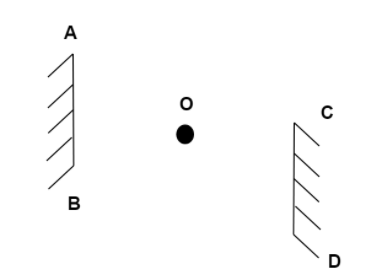
Two mirrors $AB$ and $CD$ are arranged along two parallel lines. The maximum number of images of objects that can be seen by any observer $O$ is:
a. One
b. Two
c. Four
d. Infinite
Answer
 Verified
557.1k+ views
Hint: We know that when the angle between the mirror decreases the number of images formed by the plane mirror increases. When two mirrors are parallel to each other, the angle is zero, and hence a maximum number of images is formed.
Complete step by step answer:
From the diagram, we know that the mirror $AB$ and $CD$ are parallel to each other.
We know that multiple images can be formed by using more than one plane mirror and keeping them at a certain angle.
As the angle between the two mirrors increases the number of images formed by the mirror increases.
Similarly, to decrease the number of images formed, the angle between the mirrors must be increased.
The number of images formed by the combination of two plane mirrors is given by the formula:
$n = \dfrac{{{{360}^ \circ }}}{\theta } - 1$
$n$ is the number of images formed
$\theta$ is the angle between the mirrors
Now, we know the angle between two parallel lines is zero degrees.
Since the mirrors are parallel to each other, the angle between them is ${0^ \circ }$
Putting the values in the formula above:
$n = \dfrac{{{{360}^ \circ }}}{{{0^ \circ }}} - 1$
$\Rightarrow n = \infty - 1$
This gives us $n = \infty$
Hence, the correct answer is option (D).
Note: The nature of the image formed by the plane mirrors is virtual, which means the light rays meet behind the mirror. The image formed is laterally inverted. The size of the image is always the same as the size of the object and always erect. Another point that is to be noted is the refractive index of the plane mirror is infinite.
Complete step by step answer:
From the diagram, we know that the mirror $AB$ and $CD$ are parallel to each other.
We know that multiple images can be formed by using more than one plane mirror and keeping them at a certain angle.
As the angle between the two mirrors increases the number of images formed by the mirror increases.
Similarly, to decrease the number of images formed, the angle between the mirrors must be increased.
The number of images formed by the combination of two plane mirrors is given by the formula:
$n = \dfrac{{{{360}^ \circ }}}{\theta } - 1$
$n$ is the number of images formed
$\theta$ is the angle between the mirrors
Now, we know the angle between two parallel lines is zero degrees.
Since the mirrors are parallel to each other, the angle between them is ${0^ \circ }$
Putting the values in the formula above:
$n = \dfrac{{{{360}^ \circ }}}{{{0^ \circ }}} - 1$
$\Rightarrow n = \infty - 1$
This gives us $n = \infty$
Hence, the correct answer is option (D).
Note: The nature of the image formed by the plane mirrors is virtual, which means the light rays meet behind the mirror. The image formed is laterally inverted. The size of the image is always the same as the size of the object and always erect. Another point that is to be noted is the refractive index of the plane mirror is infinite.
Recently Updated Pages
Master Class 12 Economics: Engaging Questions & Answers for Success

Master Class 12 Physics: Engaging Questions & Answers for Success
Master Class 12 English: Engaging Questions & Answers for Success
Master Class 12 Social Science: Engaging Questions & Answers for Success
Master Class 12 Maths: Engaging Questions & Answers for Success
Master Class 12 Business Studies: Engaging Questions & Answers for Success
Trending doubts
Which are the Top 10 Largest Countries of the World?
What are the major means of transport Explain each class 12 social science CBSE
Draw a labelled sketch of the human eye class 12 physics CBSE
Why cannot DNA pass through cell membranes class 12 biology CBSE
Differentiate between insitu conservation and exsitu class 12 biology CBSE
Draw a neat and well labeled diagram of TS of ovary class 12 biology CBSE