




What is a non-recording rain-gauge ?
Answer
 Verified
516.9k+ views
Hint:Here we will learn how many types of rain-gauges are they which are they and among that we will learn about what is non-recording rain- gauge and the principle of non-recording rain-gauge.
Complete answer:
There are two types of rain-gauges:
(1) recording rain-gauge
(2) non-recording rain-gauge.
We shall study about the non-recording rain-gauge. Non-recording rain gauges only display total rainfall over a specific time period. Hourly rainfall is measured using a rain gauge of the recording kind. One of the most popular non-recording rain-gauges is the Symon's rain-gauge. This form is defined further down. It is the most basic in terms of design and operation.
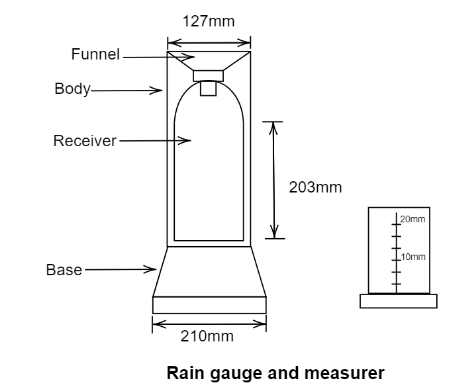
Principle of non-recording rain-gauge: It is obvious from the concept of unit rainfall that it is not affected by the size of the region. When it comes to only measuring rainfall, the region under consideration may be big or small.
Taking the smallest possible area, if the water that falls as rain is absorbed until it is lost or runs off, then the depth of this water over the small area can be accurately calculated to include the amount of rainfall that occurred in the appropriate units (centimeters). The small area should be chosen so that it has meteorological characteristics that are close to the wide area it reflects.
Note:There are two reasons for keeping the funnel's rim 30 cm above the natural surface:
-It reduces the amount of water splashing into the funnel to almost nothing.
-If the gauge's height is held above 30 cm, the amount of rain water collected decreases due to wind eddies generated by the gauge.
Complete answer:
There are two types of rain-gauges:
(1) recording rain-gauge
(2) non-recording rain-gauge.
We shall study about the non-recording rain-gauge. Non-recording rain gauges only display total rainfall over a specific time period. Hourly rainfall is measured using a rain gauge of the recording kind. One of the most popular non-recording rain-gauges is the Symon's rain-gauge. This form is defined further down. It is the most basic in terms of design and operation.
Principle of non-recording rain-gauge: It is obvious from the concept of unit rainfall that it is not affected by the size of the region. When it comes to only measuring rainfall, the region under consideration may be big or small.
Taking the smallest possible area, if the water that falls as rain is absorbed until it is lost or runs off, then the depth of this water over the small area can be accurately calculated to include the amount of rainfall that occurred in the appropriate units (centimeters). The small area should be chosen so that it has meteorological characteristics that are close to the wide area it reflects.
Note:There are two reasons for keeping the funnel's rim 30 cm above the natural surface:
-It reduces the amount of water splashing into the funnel to almost nothing.
-If the gauge's height is held above 30 cm, the amount of rain water collected decreases due to wind eddies generated by the gauge.
Recently Updated Pages
Master Class 9 General Knowledge: Engaging Questions & Answers for Success

Master Class 9 Social Science: Engaging Questions & Answers for Success
Master Class 9 English: Engaging Questions & Answers for Success
Master Class 9 Maths: Engaging Questions & Answers for Success
Master Class 9 Science: Engaging Questions & Answers for Success
Class 9 Question and Answer - Your Ultimate Solutions Guide
Trending doubts
Difference Between Plant Cell and Animal Cell
Fill the blanks with the suitable prepositions 1 The class 9 english CBSE
Who is eligible for RTE class 9 social science CBSE
Which places in India experience sunrise first and class 9 social science CBSE
What is pollution? How many types of pollution? Define it
Name 10 Living and Non living things class 9 biology CBSE