




Which of the following is an acidic amino acid?
A. Glycine
B. Valine
C. Leucine
D. Glutamic acid
Answer
 Verified
563.4k+ views
Hint:To answer this question we should talk about amino acids. The amino acids are made mainly of carbon, hydrogen, nitrogen and oxygen. The amino acids have amine group, carboxylic acid and alkyl chain. In water, the carboxylic acid loses proton and amine gains proton so amino acids behave as acid and base. We will draw the structure of all given amino acids to determine the acidic amino acid.
Complete solution:
In all amino acids two functional groups are present. One is carboxylic and the second is an amine group. The carboxylic acid donate proton so it behaves as acid and amine has lone pairs, so it can accept the proton so it behaves as base.
As both acidic part and basic part are present in amino acid so, amino acid behaves as an acid as well as a base in water. It’s carboxylic part donates proton in water simultaneously the basic part gains the proton so, all over the amino acid having one carboxylic group and one amine group behaves as neutral.
In some amino acids the amine group is one but carboxylic acids are more than one that amino acid donate one proton but gain more than one proton so they behave as acidic.
The structure of the given amino acids are as follows:
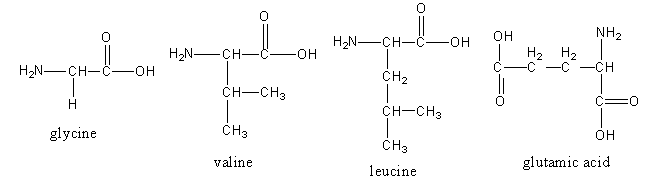
In all the given amino acids, only the glutamic acid is one which has two carboxylic groups and one amine group, so it is the acidic amino acid.
Therefore, option (D) is correct.
Note: One side of amino acid (having carboxylic acid) gains negative charge after losing proton and another side of amino acid (having amine group) gains positive charge after accepting proton. So, all over charge is zero. This structure of amino acid having oppositely charged sides is known as Zwitterion. Glycine, valine and leucine all have one-one carboxylic and amine groups, so they are neutral amino acids. The name of acidic amino acid itself includes the word ‘acidic’.
Complete solution:
In all amino acids two functional groups are present. One is carboxylic and the second is an amine group. The carboxylic acid donate proton so it behaves as acid and amine has lone pairs, so it can accept the proton so it behaves as base.
As both acidic part and basic part are present in amino acid so, amino acid behaves as an acid as well as a base in water. It’s carboxylic part donates proton in water simultaneously the basic part gains the proton so, all over the amino acid having one carboxylic group and one amine group behaves as neutral.
In some amino acids the amine group is one but carboxylic acids are more than one that amino acid donate one proton but gain more than one proton so they behave as acidic.
The structure of the given amino acids are as follows:
In all the given amino acids, only the glutamic acid is one which has two carboxylic groups and one amine group, so it is the acidic amino acid.
Therefore, option (D) is correct.
Note: One side of amino acid (having carboxylic acid) gains negative charge after losing proton and another side of amino acid (having amine group) gains positive charge after accepting proton. So, all over charge is zero. This structure of amino acid having oppositely charged sides is known as Zwitterion. Glycine, valine and leucine all have one-one carboxylic and amine groups, so they are neutral amino acids. The name of acidic amino acid itself includes the word ‘acidic’.
Recently Updated Pages
Master Class 12 Economics: Engaging Questions & Answers for Success

Master Class 12 Physics: Engaging Questions & Answers for Success
Master Class 12 English: Engaging Questions & Answers for Success
Master Class 12 Social Science: Engaging Questions & Answers for Success
Master Class 12 Maths: Engaging Questions & Answers for Success
Master Class 12 Business Studies: Engaging Questions & Answers for Success
Trending doubts
Why cannot DNA pass through cell membranes class 12 biology CBSE
Differentiate between insitu conservation and exsitu class 12 biology CBSE
Draw a neat and well labeled diagram of TS of ovary class 12 biology CBSE
In a human foetus the limbs and digits develop after class 12 biology CBSE
AABbCc genotype forms how many types of gametes a 4 class 12 biology CBSE
The correct structure of ethylenediaminetetraacetic class 12 chemistry CBSE