




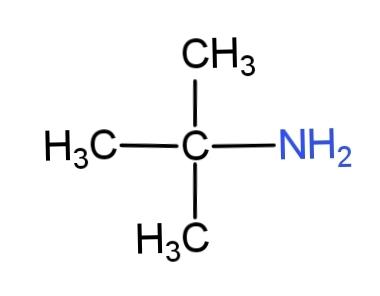
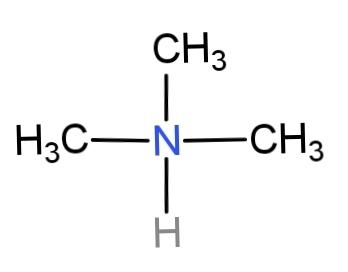
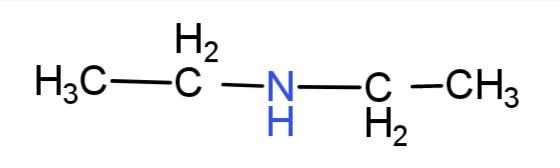
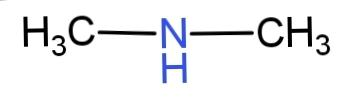
Which of the following undergo carbylamine test?
(A)
(B)
(C)
(D)
Answer
 Verified
513k+ views
Hint: Carbylamine reaction involves reaction of amines with chloroform and an alkali. It is also called isocyanide test, as it can distinguish primary$1{}^\circ $amine from secondary $2{}^\circ $and tertiary$3{}^\circ $amines. The primary amine will make a foul smelling isocyanide compound with this reaction, so it can be distinguished from secondary and tertiary.
Complete answer:
When aliphatic or aromatic primary $1{}^\circ $amines $\left( -RN{{H}_{2}} \right)$react with chloroform in the presence of a strong alkali then a foul smelling compound called as isocyanide is formed. This reaction is known as carbylamine reaction or carbylamine test and also isocyanide test. This test distinguishes between primary amine from secondary and tertiary amines.
Among the given amines, the amine that is primary, which has an amine group attached with only one carbon atom will undergo a carbylamine test.
As the given compounds has (A) having a primary amine $\left( -RN{{H}_{2}} \right)$as amine group is attached with only one carbon atom, so it will give the carbylamine test and form a foul smelling isocyanide compound. The reaction is as follows:
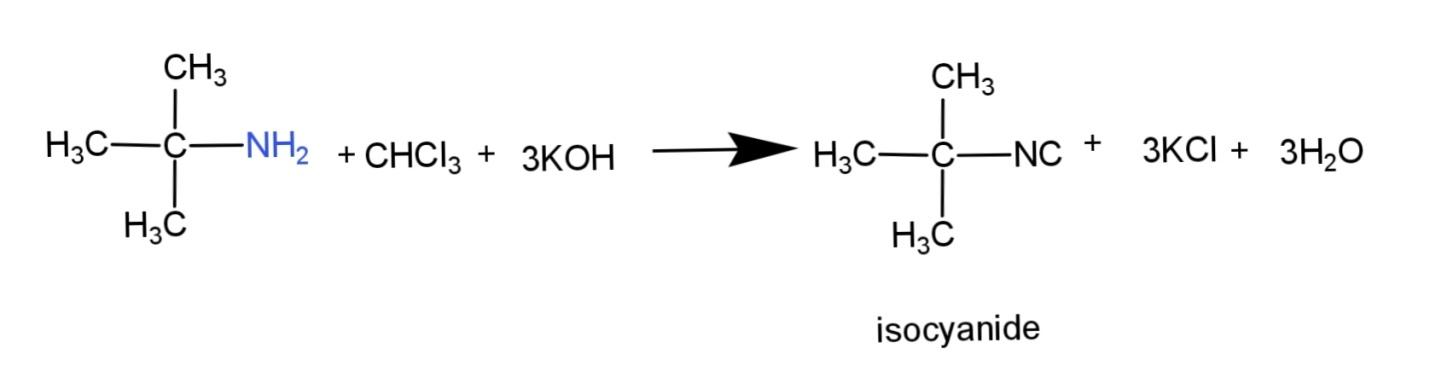
Hence, (A) will undergo carbylamine test, so this option is correct.
Note:
Amines $\left( -RN{{H}_{2}} \right)$ act as Lewis bases as they have a lone pair of electrons on nitrogen atoms, but aromatic amines are less basic. Isocyanide ion $C{{N}^{-}}$ is an ambident nucleophile, which means it has the ability to attach on the carbon chain either as $\left( N\equiv C \right)$called as isocyanide or as$\left( C\equiv N \right)$called as cyanide.
Complete answer:
When aliphatic or aromatic primary $1{}^\circ $amines $\left( -RN{{H}_{2}} \right)$react with chloroform in the presence of a strong alkali then a foul smelling compound called as isocyanide is formed. This reaction is known as carbylamine reaction or carbylamine test and also isocyanide test. This test distinguishes between primary amine from secondary and tertiary amines.
Among the given amines, the amine that is primary, which has an amine group attached with only one carbon atom will undergo a carbylamine test.
As the given compounds has (A) having a primary amine $\left( -RN{{H}_{2}} \right)$as amine group is attached with only one carbon atom, so it will give the carbylamine test and form a foul smelling isocyanide compound. The reaction is as follows:
Hence, (A) will undergo carbylamine test, so this option is correct.
Note:
Amines $\left( -RN{{H}_{2}} \right)$ act as Lewis bases as they have a lone pair of electrons on nitrogen atoms, but aromatic amines are less basic. Isocyanide ion $C{{N}^{-}}$ is an ambident nucleophile, which means it has the ability to attach on the carbon chain either as $\left( N\equiv C \right)$called as isocyanide or as$\left( C\equiv N \right)$called as cyanide.
Recently Updated Pages
Master Class 12 Economics: Engaging Questions & Answers for Success

Master Class 12 Physics: Engaging Questions & Answers for Success
Master Class 12 English: Engaging Questions & Answers for Success
Master Class 12 Social Science: Engaging Questions & Answers for Success
Master Class 12 Maths: Engaging Questions & Answers for Success
Master Class 12 Business Studies: Engaging Questions & Answers for Success
Trending doubts
Which are the Top 10 Largest Countries of the World?
What are the major means of transport Explain each class 12 social science CBSE
Draw a labelled sketch of the human eye class 12 physics CBSE
Why cannot DNA pass through cell membranes class 12 biology CBSE
Differentiate between insitu conservation and exsitu class 12 biology CBSE
Draw a neat and well labeled diagram of TS of ovary class 12 biology CBSE