




Write an essay on the structure of the heart of a rabbit. Draw a neat labelled diagram of L.S. of heart.
Answer
 Verified
582.9k+ views
Hint: Rabbits are warm- blooded mammals and a four-chamber heart is present.
Step by step answer:
The heart of a rabbit (Oryctolagus cuniculus) is four-chambered as in humans. There are two atria (auricles) and two ventricles. Ventricular chambers are larger in volume when compared to the auricles. The auricles are thin-walled when compared to the ventricles (thick wall to aid the increased intraventricular pressure). The right and the left atrium are separated by the interauricular septum. The pulmonary veins are four in number, they open into the left auricle through an oblique aperture. The two auricles are separated from the ventricles by the atrioventricular septum
The right and left auricle open into their respective ventricles through the atrioventricular aperture. The atrioventricular aperture is guarded by atrioventricular valves. The atrioventricular valve on the right side has 3 flaps and is called the tricuspid valve. The valve on the left side is known as the bicuspid/ mitral valve. These valves are made of cusps that are attached to the walls of the respective ventricles by chorda tendinea. Truncus arteriosus is a small bulging on the anterior and ventral part of the ventricle
There are three semilunar valves at the proximal end of the truncus arteriosus. The basal and thick-walled portion of the truncus arteriosus is known as the conus arteriosus. The anterior and the thin-walled portion of the truncus arteriosus is known as the ventral aorta.
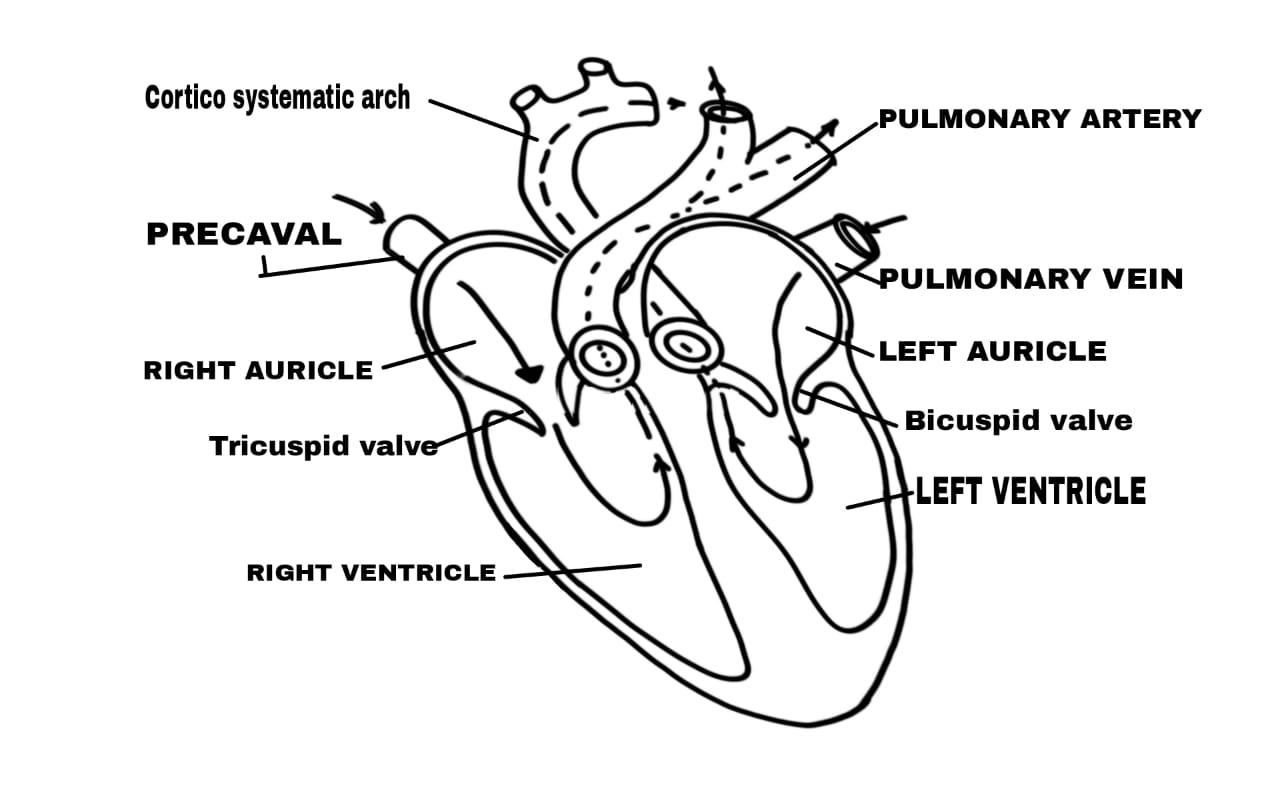
Note: The walls of the ventricles have many specialized structures known as the trabeculae carneae. This consists of the papillary muscles and muscular bridges. The conducting system of the heart is embedded in the muscular wall of the heart, this includes the SAN, AVN, bundle of His, and the Purkinje fibers.
Step by step answer:
The heart of a rabbit (Oryctolagus cuniculus) is four-chambered as in humans. There are two atria (auricles) and two ventricles. Ventricular chambers are larger in volume when compared to the auricles. The auricles are thin-walled when compared to the ventricles (thick wall to aid the increased intraventricular pressure). The right and the left atrium are separated by the interauricular septum. The pulmonary veins are four in number, they open into the left auricle through an oblique aperture. The two auricles are separated from the ventricles by the atrioventricular septum
The right and left auricle open into their respective ventricles through the atrioventricular aperture. The atrioventricular aperture is guarded by atrioventricular valves. The atrioventricular valve on the right side has 3 flaps and is called the tricuspid valve. The valve on the left side is known as the bicuspid/ mitral valve. These valves are made of cusps that are attached to the walls of the respective ventricles by chorda tendinea. Truncus arteriosus is a small bulging on the anterior and ventral part of the ventricle
There are three semilunar valves at the proximal end of the truncus arteriosus. The basal and thick-walled portion of the truncus arteriosus is known as the conus arteriosus. The anterior and the thin-walled portion of the truncus arteriosus is known as the ventral aorta.
Note: The walls of the ventricles have many specialized structures known as the trabeculae carneae. This consists of the papillary muscles and muscular bridges. The conducting system of the heart is embedded in the muscular wall of the heart, this includes the SAN, AVN, bundle of His, and the Purkinje fibers.
Recently Updated Pages
Master Class 11 Computer Science: Engaging Questions & Answers for Success

Master Class 11 Business Studies: Engaging Questions & Answers for Success
Master Class 11 Economics: Engaging Questions & Answers for Success
Master Class 11 English: Engaging Questions & Answers for Success
Master Class 11 Maths: Engaging Questions & Answers for Success
Master Class 11 Biology: Engaging Questions & Answers for Success
Trending doubts
One Metric ton is equal to kg A 10000 B 1000 C 100 class 11 physics CBSE
There are 720 permutations of the digits 1 2 3 4 5 class 11 maths CBSE
Discuss the various forms of bacteria class 11 biology CBSE
Draw a diagram of a plant cell and label at least eight class 11 biology CBSE
State the laws of reflection of light
Explain zero factorial class 11 maths CBSE