




The acceleration of the light pulley is
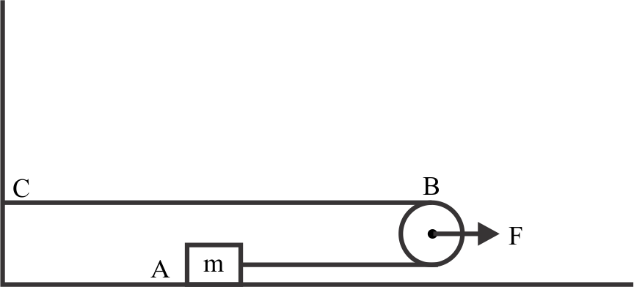
$\left( A \right)$ $\dfrac{F}{m}$
$\left( B \right)$ $\dfrac{F}{{2m}}$
$\left( C \right)$ $\dfrac{F}{{4m}}$
$\left( D \right)$ $\dfrac{F}{{8m}}$
Answer
 Verified
233.1k+ views
Hint: Acceleration is the name we tend to provide to any method wherever the speed changes. Since velocity may be speed and a direction so there are only two ways in which it can accelerate: the first one will be by the modification of speed or by the modification of direction—or by modifying each.
Formula used
Tension will be,
$ \Rightarrow T = ma$
Where, $T$ is the tension, $m$ is the mass, and $a$ is the acceleration.
The force applied on the block,
$ \Rightarrow F = 2T$
Here, $F$ is the force exerted on the block.
Solution
So this question is the problem of pulley and string and for solving such a type of question we should know the concept of applying it. Let’s see how we will solve this problem. One keynote for solving such a type of problem is we should know how to make the free body diagram because this will always help while solving this type of problem.
Let us consider the acceleration of the pulley be $a$
So from the relation of constraint, the acceleration of the block will be $2a$.
Now we will consider the forces acting on the block,
$ \Rightarrow T = m\left( {2a} \right)$
And also the forces acting on the pulley will be considered, which is
$ \Rightarrow F = 2T$
So by comparing from the above two equations, we will get
$ \Rightarrow a = \dfrac{T}{{2m}}$
And,
$ \Rightarrow \dfrac{{F/2}}{{2m}}$
On further solving the above equation, we get
$ \Rightarrow \dfrac{F}{{4m}}$
Therefore the acceleration of the light pulley will be $F/4m$.
Notes Problems involving two objects, connecting strings and pulleys are characterized by objects that are moving (or even accelerating) in numerous directions. They move or accelerate at a similar rate however in numerous directions. As such, it becomes necessary in approaching such issues to pick a different arrangement and axes system for every object. Attention ought to lean to choosing an axes system such that each object is accelerating on an axis within a positive direction. With the axes properly outlined for every individual object, a free-body diagram is created. Then Newton's laws are applied to every diagram to develop a system of two equations for the determination of the two unknowns.
Formula used
Tension will be,
$ \Rightarrow T = ma$
Where, $T$ is the tension, $m$ is the mass, and $a$ is the acceleration.
The force applied on the block,
$ \Rightarrow F = 2T$
Here, $F$ is the force exerted on the block.
Solution
So this question is the problem of pulley and string and for solving such a type of question we should know the concept of applying it. Let’s see how we will solve this problem. One keynote for solving such a type of problem is we should know how to make the free body diagram because this will always help while solving this type of problem.
Let us consider the acceleration of the pulley be $a$
So from the relation of constraint, the acceleration of the block will be $2a$.
Now we will consider the forces acting on the block,
$ \Rightarrow T = m\left( {2a} \right)$
And also the forces acting on the pulley will be considered, which is
$ \Rightarrow F = 2T$
So by comparing from the above two equations, we will get
$ \Rightarrow a = \dfrac{T}{{2m}}$
And,
$ \Rightarrow \dfrac{{F/2}}{{2m}}$
On further solving the above equation, we get
$ \Rightarrow \dfrac{F}{{4m}}$
Therefore the acceleration of the light pulley will be $F/4m$.
Notes Problems involving two objects, connecting strings and pulleys are characterized by objects that are moving (or even accelerating) in numerous directions. They move or accelerate at a similar rate however in numerous directions. As such, it becomes necessary in approaching such issues to pick a different arrangement and axes system for every object. Attention ought to lean to choosing an axes system such that each object is accelerating on an axis within a positive direction. With the axes properly outlined for every individual object, a free-body diagram is created. Then Newton's laws are applied to every diagram to develop a system of two equations for the determination of the two unknowns.
Recently Updated Pages
JEE Main 2023 April 6 Shift 1 Question Paper with Answer Key

JEE Main 2023 April 6 Shift 2 Question Paper with Answer Key
JEE Main 2023 (January 31 Evening Shift) Question Paper with Solutions [PDF]
JEE Main 2023 January 30 Shift 2 Question Paper with Answer Key
JEE Main 2023 January 25 Shift 1 Question Paper with Answer Key
JEE Main 2023 January 24 Shift 2 Question Paper with Answer Key
Trending doubts
JEE Main 2026: Session 2 Registration Open, City Intimation Slip, Exam Dates, Syllabus & Eligibility
JEE Main 2026 Application Login: Direct Link, Registration, Form Fill, and Steps
Understanding the Angle of Deviation in a Prism
Hybridisation in Chemistry – Concept, Types & Applications
How to Convert a Galvanometer into an Ammeter or Voltmeter
Understanding Uniform Acceleration in Physics
Other Pages
JEE Advanced Marks vs Ranks 2025: Understanding Category-wise Qualifying Marks and Previous Year Cut-offs
Laws of Motion Class 11 Physics Chapter 4 CBSE Notes - 2025-26
Waves Class 11 Physics Chapter 14 CBSE Notes - 2025-26
Mechanical Properties of Fluids Class 11 Physics Chapter 9 CBSE Notes - 2025-26
Thermodynamics Class 11 Physics Chapter 11 CBSE Notes - 2025-26
Units And Measurements Class 11 Physics Chapter 1 CBSE Notes - 2025-26