




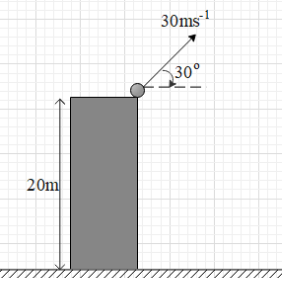
A ball is projected from a 20m high tower. Find the time taken and horizontal range to reach the ground.
Answer
 Verified
556.5k+ views
Hint: First calculate the initial vertical and initial horizontal velocities of the projectile. Then use suitable kinematic equations and calculate the time taken for the projectile to reach the ground and the horizontal range of the projectile.
Formula used:
${{u}_{x}}=u\cos \theta $
${{u}_{y}}=u\sin \theta $
where ${{u}_{x}}$ is the initial horizontal velocity and ${{u}_{y}}$ is the initial vertical velocity of the projectile. u is the net initial velocity and $\theta $ is the angle of projection of the projectile.
$s={{u}_{y}}t-\dfrac{1}{2}g{{t}^{2}}$
where s is the displacement of the projectile at time t and g is acceleration due to gravity.
$R={{u}_{x}}T$
where R is the horizontal range of the projectile and T is the time taken to reach the ground.
Complete step by step answer:
In the given figure, we can see that $u=30m{{s}^{-1}}$ and $\theta ={{30}^{\circ }}$.
Then this means that the initial horizontal velocity of the projectile is ${{u}_{x}}=u\cos \theta =30\cos {{30}^{\circ }}=15\sqrt{3}m{{s}^{-1}}$
And the initial vertical velocity of the projectile is ${{u}_{y}}=u\sin \theta =30\sin {{30}^{\circ }}=15m{{s}^{-1}}$.
When the projectile comes down and strikes the ground, the vertical displacement of the projectile is $s=-20m$ (as the height of the tower is 20m).
Now, let us use the kinematic equation $s={{u}_{y}}t-\dfrac{1}{2}g{{t}^{2}}$.
In this case, ${{u}_{y}}=15m{{s}^{-1}}$, $s=-20m$ and $g=10m{{s}^{-2}}$.
Then,
$\Rightarrow -20=15t-\dfrac{1}{2}(10){{t}^{2}}$
$\Rightarrow 5{{t}^{2}}-15t-20=0$
$\Rightarrow {{t}^{2}}-3t-4=0$
$\Rightarrow (t-4)(t+1)=0$
$\therefore (t-4)=0$ or $(t-1)=0$
Then means that either $t=4s$ or $t=-1s$.
But we know that time cannot be a negative value.
Therefore, we consider $t=4s$
Then this means that $T=t=4s$.
Therefore, the time taken by the projectile to reach the ground is 4s.
With this, we get that $R={{u}_{x}}T=15\sqrt{3}\times 4=60\sqrt{3}m$.
Therefore, the horizontal range of the projectile is equal to $60\sqrt{3}m$.
Note: In a projectile motion, the gravity pulls the projectile in the downward direction. As a result, the projectile only accelerates in the downward direction and its acceleration in the horizontal direction is zero.Hence, we can find the horizontal range just be using the distance formula, which $d=vt$, where d is distance travelled in a direction, v is its velocity in that direction and t is time.
Formula used:
${{u}_{x}}=u\cos \theta $
${{u}_{y}}=u\sin \theta $
where ${{u}_{x}}$ is the initial horizontal velocity and ${{u}_{y}}$ is the initial vertical velocity of the projectile. u is the net initial velocity and $\theta $ is the angle of projection of the projectile.
$s={{u}_{y}}t-\dfrac{1}{2}g{{t}^{2}}$
where s is the displacement of the projectile at time t and g is acceleration due to gravity.
$R={{u}_{x}}T$
where R is the horizontal range of the projectile and T is the time taken to reach the ground.
Complete step by step answer:
In the given figure, we can see that $u=30m{{s}^{-1}}$ and $\theta ={{30}^{\circ }}$.
Then this means that the initial horizontal velocity of the projectile is ${{u}_{x}}=u\cos \theta =30\cos {{30}^{\circ }}=15\sqrt{3}m{{s}^{-1}}$
And the initial vertical velocity of the projectile is ${{u}_{y}}=u\sin \theta =30\sin {{30}^{\circ }}=15m{{s}^{-1}}$.
When the projectile comes down and strikes the ground, the vertical displacement of the projectile is $s=-20m$ (as the height of the tower is 20m).
Now, let us use the kinematic equation $s={{u}_{y}}t-\dfrac{1}{2}g{{t}^{2}}$.
In this case, ${{u}_{y}}=15m{{s}^{-1}}$, $s=-20m$ and $g=10m{{s}^{-2}}$.
Then,
$\Rightarrow -20=15t-\dfrac{1}{2}(10){{t}^{2}}$
$\Rightarrow 5{{t}^{2}}-15t-20=0$
$\Rightarrow {{t}^{2}}-3t-4=0$
$\Rightarrow (t-4)(t+1)=0$
$\therefore (t-4)=0$ or $(t-1)=0$
Then means that either $t=4s$ or $t=-1s$.
But we know that time cannot be a negative value.
Therefore, we consider $t=4s$
Then this means that $T=t=4s$.
Therefore, the time taken by the projectile to reach the ground is 4s.
With this, we get that $R={{u}_{x}}T=15\sqrt{3}\times 4=60\sqrt{3}m$.
Therefore, the horizontal range of the projectile is equal to $60\sqrt{3}m$.
Note: In a projectile motion, the gravity pulls the projectile in the downward direction. As a result, the projectile only accelerates in the downward direction and its acceleration in the horizontal direction is zero.Hence, we can find the horizontal range just be using the distance formula, which $d=vt$, where d is distance travelled in a direction, v is its velocity in that direction and t is time.
Recently Updated Pages
Master Class 11 Computer Science: Engaging Questions & Answers for Success

Master Class 11 Business Studies: Engaging Questions & Answers for Success
Master Class 11 Economics: Engaging Questions & Answers for Success
Master Class 11 English: Engaging Questions & Answers for Success
Master Class 11 Maths: Engaging Questions & Answers for Success
Master Class 11 Biology: Engaging Questions & Answers for Success
Trending doubts
One Metric ton is equal to kg A 10000 B 1000 C 100 class 11 physics CBSE
There are 720 permutations of the digits 1 2 3 4 5 class 11 maths CBSE
Discuss the various forms of bacteria class 11 biology CBSE
Draw a diagram of a plant cell and label at least eight class 11 biology CBSE
State the laws of reflection of light
Explain zero factorial class 11 maths CBSE