




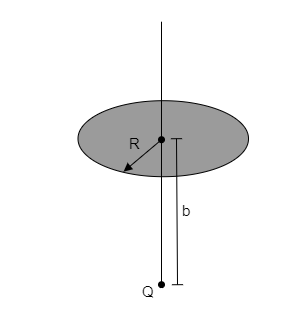
A point charge $Q$ is located on the axis of a disc of a radius $R$ at a distance $b$ from the plane of the disc (figure). Show that if one-fourth of the electric flux from the charge passes through the disc, then $R = \sqrt 3 b$
Answer
 Verified
584.4k+ views
Hint: Electric flux can be described as the strength of the electric field in a given surface. Gauss’ law gives the electric flux through a given surface as $\dfrac{1}{{{\varepsilon _0}}}$ times that of the charge enclosed by that surface. However, the given disc is said to enclose only one-fourth of this charge.
Formulas used:
->The electric flux through a surface element is given by, $d\phi = E \cdot ds$ where $E$ is the electric field and ${\text{ds}}$ is the elemental area.
->The electric field at a distance $r$ from a charge $q$ is given by, $E = \dfrac{q}{{4\pi {\varepsilon _0}{r^2}}}$ where ${\varepsilon _0}$ is the permittivity of the free space
Complete step-by-step solution:
->Step 1: Sketch the charge located at the axis of the disc and consider an elemental area of the disc.
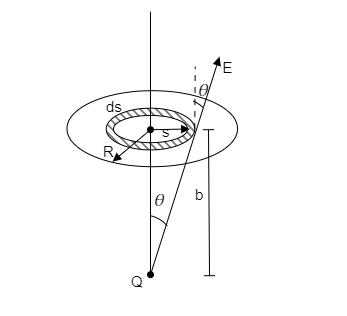
In the above figure, we consider an elemental area of the disc to be an annual ring of radius $s$ and width $ds$. Let $dA = 2\pi sds$ be the area of this element.
We see that the electric field is directed at an angle $\theta $ with the normal of the ring. However, it has the same magnitude at every point on the ring and it is given by, ${E_{ring}} = \dfrac{Q}{{4\pi {\varepsilon _0}\left( {{s^2} + {b^2}} \right)}}$
It is given that the electric flux passing through the disc is ${\phi _{disc}} = \dfrac{Q}{{4{\varepsilon _0}}}$
->Step 2: Obtain an expression for the electric flux through the ring.
The electric flux through the elemental area will be $d{\phi _{ring}} = {E_{ring}}dA\cos \theta $ ----- (1)
From the figure we have $\cos \theta = \dfrac{b}{{\sqrt {{s^2} + {b^2}} }}$
Substituting for ${E_{ring}} = \dfrac{Q}{{4\pi {\varepsilon _0}\left( {{s^2} + {b^2}} \right)}}$ , $dA = 2\pi sds$ and $\cos \theta = \dfrac{b}{{\sqrt {{s^2} + {b^2}} }}$ in equation (1) we get, $d{\phi _{ring}} = \dfrac{{Qb2\pi sds}}{{4\pi {\varepsilon _0}{{\left( {{s^2} + {b^2}} \right)}^{3/2}}}}$ ------- (2)
Step 3: Integrate equation (2) to obtain the electric flux through the disc.
The electric flux through the disc is expressed as ${\phi _{disc}} = \int\limits_0^R {d{\phi _{ring}}} $ --------- (3)
Substituting equation (2) in (3) we get, ${\phi _{disc}} = \int\limits_0^R {\dfrac{{Qb2\pi sds}}{{4\pi {\varepsilon _0}{{\left( {{s^2} + {b^2}} \right)}^{3/2}}}}} = \dfrac{{Qb}}{{2{\varepsilon _0}}}\int\limits_0^R {\dfrac{{sds}}{{{{\left( {{s^2} + {b^2}} \right)}^{3/2}}}}} = \dfrac{{Qb}}{{2{\varepsilon _0}}}\left[ {\dfrac{1}{{\sqrt {{s^2} + {b^2}} }}} \right]_0^R$
On applying the limits we have ${\phi _{disc}} = \dfrac{{Qb}}{{2{\varepsilon _0}}}\left[ {\dfrac{1}{b} - \dfrac{1}{{\sqrt {{R^2} + {b^2}} }}} \right]$
We thus have ${\phi _{disc}} = \dfrac{Q}{{2{\varepsilon _0}}}\left[ {1 - \dfrac{b}{{\sqrt {{R^2} + {b^2}} }}} \right] = \dfrac{Q}{{4{\varepsilon _0}}}$
Cancelling out the similar terms on both sides and simplifying the above equation we get, $\dfrac{b}{{\sqrt {{R^2} + {b^2}} }} = \dfrac{1}{2}$
On squaring we get, $\dfrac{{{b^2}}}{{{R^2} + {b^2}}} = \dfrac{1}{4}$
$ \Rightarrow 3{b^2} = {R^2}$ or $R = \sqrt 3 b$ .
Hence proved.
Note:- The electric flux refers to the amount of electric field lines passing through a surface. The annual ring represents an elemental area of the disc and not the gaussian surface. The Gaussian surface of the above disc will be a sphere with the charge located at its centre. The integration limits are taken from $0$ to $R$ because the flux has to be determined for the entire area of the disc.
Formulas used:
->The electric flux through a surface element is given by, $d\phi = E \cdot ds$ where $E$ is the electric field and ${\text{ds}}$ is the elemental area.
->The electric field at a distance $r$ from a charge $q$ is given by, $E = \dfrac{q}{{4\pi {\varepsilon _0}{r^2}}}$ where ${\varepsilon _0}$ is the permittivity of the free space
Complete step-by-step solution:
->Step 1: Sketch the charge located at the axis of the disc and consider an elemental area of the disc.
In the above figure, we consider an elemental area of the disc to be an annual ring of radius $s$ and width $ds$. Let $dA = 2\pi sds$ be the area of this element.
We see that the electric field is directed at an angle $\theta $ with the normal of the ring. However, it has the same magnitude at every point on the ring and it is given by, ${E_{ring}} = \dfrac{Q}{{4\pi {\varepsilon _0}\left( {{s^2} + {b^2}} \right)}}$
It is given that the electric flux passing through the disc is ${\phi _{disc}} = \dfrac{Q}{{4{\varepsilon _0}}}$
->Step 2: Obtain an expression for the electric flux through the ring.
The electric flux through the elemental area will be $d{\phi _{ring}} = {E_{ring}}dA\cos \theta $ ----- (1)
From the figure we have $\cos \theta = \dfrac{b}{{\sqrt {{s^2} + {b^2}} }}$
Substituting for ${E_{ring}} = \dfrac{Q}{{4\pi {\varepsilon _0}\left( {{s^2} + {b^2}} \right)}}$ , $dA = 2\pi sds$ and $\cos \theta = \dfrac{b}{{\sqrt {{s^2} + {b^2}} }}$ in equation (1) we get, $d{\phi _{ring}} = \dfrac{{Qb2\pi sds}}{{4\pi {\varepsilon _0}{{\left( {{s^2} + {b^2}} \right)}^{3/2}}}}$ ------- (2)
Step 3: Integrate equation (2) to obtain the electric flux through the disc.
The electric flux through the disc is expressed as ${\phi _{disc}} = \int\limits_0^R {d{\phi _{ring}}} $ --------- (3)
Substituting equation (2) in (3) we get, ${\phi _{disc}} = \int\limits_0^R {\dfrac{{Qb2\pi sds}}{{4\pi {\varepsilon _0}{{\left( {{s^2} + {b^2}} \right)}^{3/2}}}}} = \dfrac{{Qb}}{{2{\varepsilon _0}}}\int\limits_0^R {\dfrac{{sds}}{{{{\left( {{s^2} + {b^2}} \right)}^{3/2}}}}} = \dfrac{{Qb}}{{2{\varepsilon _0}}}\left[ {\dfrac{1}{{\sqrt {{s^2} + {b^2}} }}} \right]_0^R$
On applying the limits we have ${\phi _{disc}} = \dfrac{{Qb}}{{2{\varepsilon _0}}}\left[ {\dfrac{1}{b} - \dfrac{1}{{\sqrt {{R^2} + {b^2}} }}} \right]$
We thus have ${\phi _{disc}} = \dfrac{Q}{{2{\varepsilon _0}}}\left[ {1 - \dfrac{b}{{\sqrt {{R^2} + {b^2}} }}} \right] = \dfrac{Q}{{4{\varepsilon _0}}}$
Cancelling out the similar terms on both sides and simplifying the above equation we get, $\dfrac{b}{{\sqrt {{R^2} + {b^2}} }} = \dfrac{1}{2}$
On squaring we get, $\dfrac{{{b^2}}}{{{R^2} + {b^2}}} = \dfrac{1}{4}$
$ \Rightarrow 3{b^2} = {R^2}$ or $R = \sqrt 3 b$ .
Hence proved.
Note:- The electric flux refers to the amount of electric field lines passing through a surface. The annual ring represents an elemental area of the disc and not the gaussian surface. The Gaussian surface of the above disc will be a sphere with the charge located at its centre. The integration limits are taken from $0$ to $R$ because the flux has to be determined for the entire area of the disc.
Recently Updated Pages
Complete reduction of benzene diazonium chloride with class 12 chemistry CBSE

How can you identify optical isomers class 12 chemistry CBSE
The coating formed on the metals such as iron silver class 12 chemistry CBSE
Metals are refined by using different methods Which class 12 chemistry CBSE
What do you understand by denaturation of proteins class 12 chemistry CBSE
Assertion Nitrobenzene is used as a solvent in FriedelCrafts class 12 chemistry CBSE
Trending doubts
Which are the Top 10 Largest Countries of the World?
What are the major means of transport Explain each class 12 social science CBSE
Draw a labelled sketch of the human eye class 12 physics CBSE
Differentiate between insitu conservation and exsitu class 12 biology CBSE
Draw a neat and well labeled diagram of TS of ovary class 12 biology CBSE
RNA and DNA are chiral molecules their chirality is class 12 chemistry CBSE