




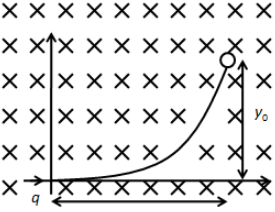
A positively charged particle of charge ‘q’ enters in a uniform magnetic field ‘B’ directed inwards and it is deflected a distance \[{y_0}\] after travelling a distance \[{x_0}\]as shown in the figure. Then the magnitude of linear momentum of the particle is
A. \[\dfrac{{qB{x_0}}}{2}\]
B. \[\dfrac{{qB}}{2}\left( {\dfrac{{x_0^2}}{{{y_0}}} + {x_0}} \right)\]
C. \[\dfrac{{qB}}{{2{y_0}}}\left( {x_0^2 + y_0^2} \right)\]
D. \[\dfrac{{qB}}{2}\left( {{y_0} + \dfrac{{x_0^2}}{{{y_0}}}} \right)\]
Answer
 Verified
561.6k+ views
Hint: Find the radius of the circular path using Pythagoras theorem. The necessary centripetal force required for the circular motion of the particle is provided by the magnetic force. The linear momentum of the particle is the product of its mass and velocity.
Formula used:
Magnetic force, \[{F_B} = qvB\],
where, q is the charge, B is the magnetic field and v is the velocity.
Centripetal force, \[{F_C} = \dfrac{{m{v^2}}}{r}\],
where, m is the mass and r is the radius of the circular motion.
Complete step by step answer:
We know that when the charge particle enters a magnetic field, it is deflected due to the magnetic force acting on it to change its direction. In the uniform magnetic field, the particle will deflect at each point so that the particle will follow a circular path.Let us find the radius of the circular path using the following figure.
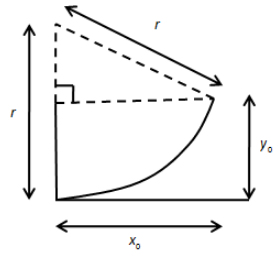
Using the Pythagoras theorem in the above triangle, we get,
\[{r^2} = {\left( {r - {y_0}} \right)^2} + x_0^2\]
\[ \Rightarrow {r^2} = {r^2} - 2r{y_0} + y_0^2 + x_0^2\]
\[ \Rightarrow 2r{y_0} = y_0^2 + x_0^2\]
\[ \Rightarrow r = \dfrac{{y_0^2 + x_0^2}}{{2{y_0}}}\]
\[ \Rightarrow r = \dfrac{1}{2}\left( {{y_0} + \dfrac{{x_0^2}}{{{y_0}}}} \right)\] …… (1)
The necessary centripetal force required for the circular motion of the particle is provided by the magnetic force. Therefore, we can write,
\[\dfrac{{m{v^2}}}{r} = qvB\]
\[ \Rightarrow \dfrac{{mv}}{r} = qB\]
\[ \Rightarrow mv = qBr\] …… (2)
Here, m is the mass, v is the velocity, r is the radius of the circular motion, q is the charge and B is the magnetic field.
We know that the linear momentum of the particle is given as,
\[p = mv\]
From equation (2), we can write the linear momentum of the particle as,
\[p = qBr\]
Using equation (1) in the above equation, we get,
\[p = qB\left( {\dfrac{1}{2}\left( {{y_0} + \dfrac{{x_0^2}}{{{y_0}}}} \right)} \right)\]
\[ \Rightarrow p = \dfrac{{qB}}{2}\left( {{y_0} + \dfrac{{x_0^2}}{{{y_0}}}} \right)\]
So, the correct answer is option D.
Note: When the distance \[{y_0}\] becomes equal to radius r, the distance \[{x_0}\] also equals the radius r and therefore, the linear momentum at this position is equal to \[p = qBr\]. We have given that the particle enters in only uniform magnetic field and electric field is not applied in this region. In the case of an electric field, the force on the particle will be the contribution from both electric field and magnetic field.
Formula used:
Magnetic force, \[{F_B} = qvB\],
where, q is the charge, B is the magnetic field and v is the velocity.
Centripetal force, \[{F_C} = \dfrac{{m{v^2}}}{r}\],
where, m is the mass and r is the radius of the circular motion.
Complete step by step answer:
We know that when the charge particle enters a magnetic field, it is deflected due to the magnetic force acting on it to change its direction. In the uniform magnetic field, the particle will deflect at each point so that the particle will follow a circular path.Let us find the radius of the circular path using the following figure.
Using the Pythagoras theorem in the above triangle, we get,
\[{r^2} = {\left( {r - {y_0}} \right)^2} + x_0^2\]
\[ \Rightarrow {r^2} = {r^2} - 2r{y_0} + y_0^2 + x_0^2\]
\[ \Rightarrow 2r{y_0} = y_0^2 + x_0^2\]
\[ \Rightarrow r = \dfrac{{y_0^2 + x_0^2}}{{2{y_0}}}\]
\[ \Rightarrow r = \dfrac{1}{2}\left( {{y_0} + \dfrac{{x_0^2}}{{{y_0}}}} \right)\] …… (1)
The necessary centripetal force required for the circular motion of the particle is provided by the magnetic force. Therefore, we can write,
\[\dfrac{{m{v^2}}}{r} = qvB\]
\[ \Rightarrow \dfrac{{mv}}{r} = qB\]
\[ \Rightarrow mv = qBr\] …… (2)
Here, m is the mass, v is the velocity, r is the radius of the circular motion, q is the charge and B is the magnetic field.
We know that the linear momentum of the particle is given as,
\[p = mv\]
From equation (2), we can write the linear momentum of the particle as,
\[p = qBr\]
Using equation (1) in the above equation, we get,
\[p = qB\left( {\dfrac{1}{2}\left( {{y_0} + \dfrac{{x_0^2}}{{{y_0}}}} \right)} \right)\]
\[ \Rightarrow p = \dfrac{{qB}}{2}\left( {{y_0} + \dfrac{{x_0^2}}{{{y_0}}}} \right)\]
So, the correct answer is option D.
Note: When the distance \[{y_0}\] becomes equal to radius r, the distance \[{x_0}\] also equals the radius r and therefore, the linear momentum at this position is equal to \[p = qBr\]. We have given that the particle enters in only uniform magnetic field and electric field is not applied in this region. In the case of an electric field, the force on the particle will be the contribution from both electric field and magnetic field.
Recently Updated Pages
Master Class 12 Economics: Engaging Questions & Answers for Success

Master Class 12 Physics: Engaging Questions & Answers for Success
Master Class 12 English: Engaging Questions & Answers for Success
Master Class 12 Social Science: Engaging Questions & Answers for Success
Master Class 12 Maths: Engaging Questions & Answers for Success
Master Class 12 Business Studies: Engaging Questions & Answers for Success
Trending doubts
Which are the Top 10 Largest Countries of the World?
What are the major means of transport Explain each class 12 social science CBSE
Draw a labelled sketch of the human eye class 12 physics CBSE
What is a transformer Explain the principle construction class 12 physics CBSE
Why cannot DNA pass through cell membranes class 12 biology CBSE
Differentiate between insitu conservation and exsitu class 12 biology CBSE