




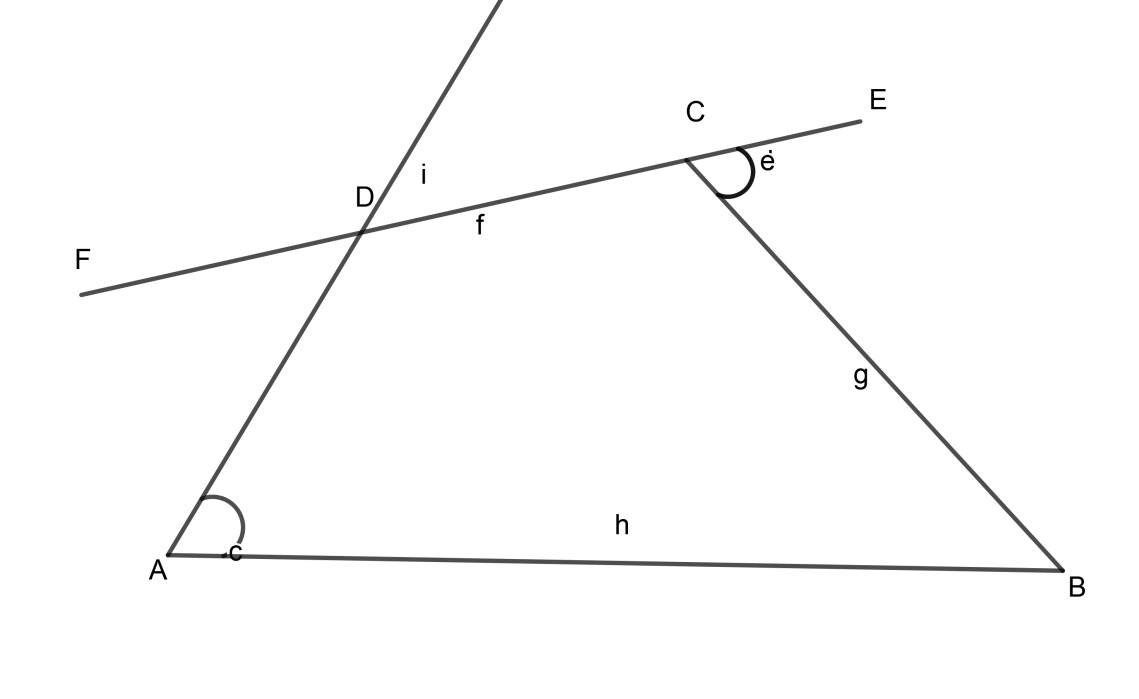
ABCD is a quadrilateral. If \[\angle A=\angle BCE\], is the quadrilateral a cyclic quadrilateral ? Give reasons.
Answer
 Verified
613.5k+ views
Hint: To prove the above statement use the property of cyclic quadrilateral i. e. opposite angles of a cyclic quadrilateral are always Supplementary i.e. their summation is $180{}^\circ $.
Complete step-by-step answer:
To prove that quadrilateral ABCD is a cyclic quadrilateral, we should know the necessary and sufficient condition for a quadrilateral to be cyclic which is given below,
Concept: Opposite angles of a cyclic quadrilateral are always Supplementary i.e. their summation is $180{}^\circ $.
Which means we have to prove,
\[\angle A+\angle DCB=180{}^\circ and \angle ADC+\angle B=180{}^\circ \]
Let,
\[\angle A=\angle BCE=\theta \]……………………………….. (1)
From figure we can easily see that \[\angle DCE\] is a straight angle,
\[\therefore \angle DCE=180{}^\circ \]
But, from figure we can also write,
\[\angle DCE=\angle DCB+\angle ECB\]
Therefore from above two equations we can write,
\[\angle DCB+\angle ECB=180{}^\circ \]
Put the value of equation (1),
\[\therefore \angle DCB+\theta =180{}^\circ \]
\[\therefore \angle DCB=180{}^\circ -\theta \]…………………………………… (2)
Now we will add \[\angle Aand\angle DCB\] to see if they are supplementary.
\[\angle A+\angle DCB=\theta +\left( 180{}^\circ -\theta \right)\] [From (1) and (2)]
By giving separate signs in bracket we can write,
\[\therefore \angle A+\angle DCB=\theta +180{}^\circ -\theta \]
\[\therefore \angle A+\angle DCB=180{}^\circ \]……………………………………… (3)
Now, as we all know summation of all angles of a square is always \[360{}^\circ \],
\[\therefore \angle A+\angle B+\angle DCB+\angle ADC=360{}^\circ \]
By rearranging above equation,
\[\therefore \angle A+\angle DCB+\angle B+\angle ADC=360{}^\circ \]
Put the value of Equation (3) in above equation,
\[\therefore 180{}^\circ +\angle B+\angle ADC=360{}^\circ \]
\[\therefore \angle B+\angle ADC=360{}^\circ -180{}^\circ \]
\[\therefore \angle B+\angle ADC=180{}^\circ \]……………………………………….. (4)
From equations (3) and (4),
We can conclude that \[\angle A,\angle DCB\] and \[\angle ADC,\angle B\] are pairs of supplementary angles and from the concept we have discussed earlier we can conclude that \[\square ABCD\] is a cyclic quadrilateral.
Hence Proved.
Note:
1) The concept given by “opposite angles of a cyclic quadrilateral are always Supplementary” is very much essential to prove any quadrilateral as a cyclic quadrilateral.
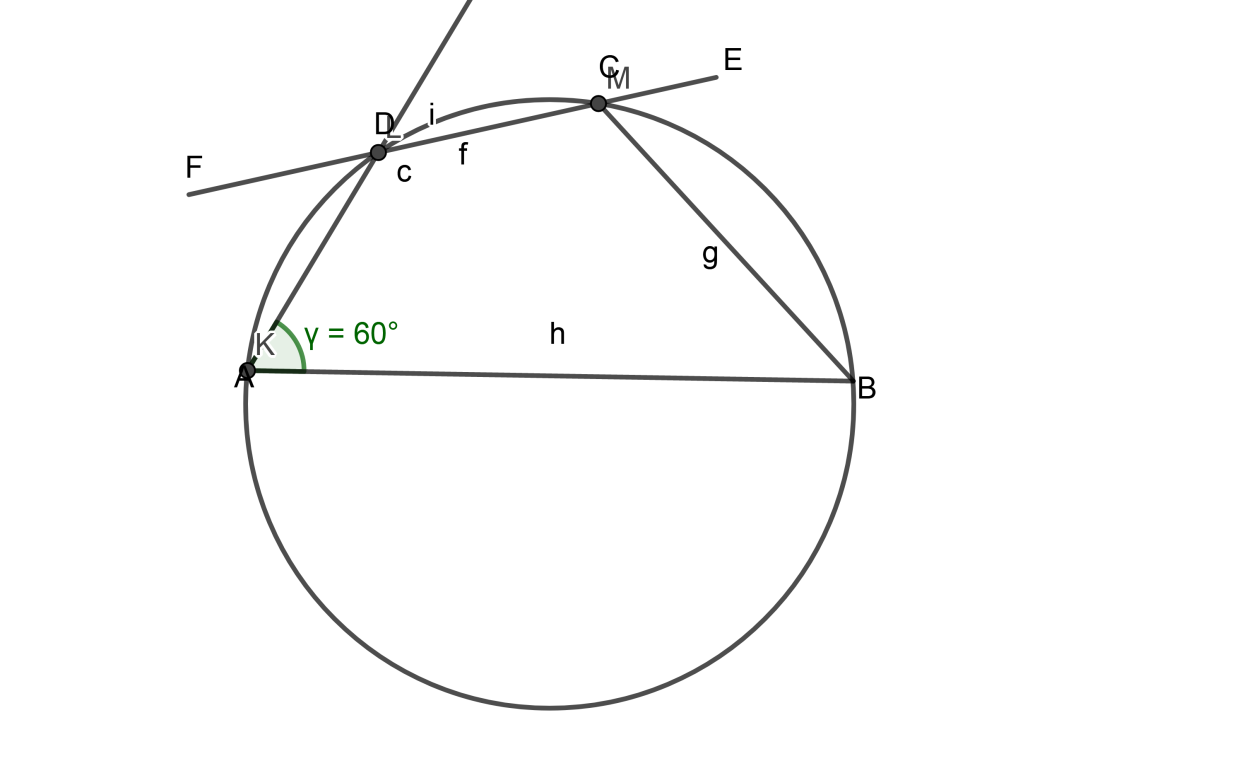
2) I have inscribed above the quadrilateral in a circle geometrically therefore it is proved experimentally also. I have taken the mentioned angle as \[60{}^\circ \].
Complete step-by-step answer:
To prove that quadrilateral ABCD is a cyclic quadrilateral, we should know the necessary and sufficient condition for a quadrilateral to be cyclic which is given below,
Concept: Opposite angles of a cyclic quadrilateral are always Supplementary i.e. their summation is $180{}^\circ $.
Which means we have to prove,
\[\angle A+\angle DCB=180{}^\circ and \angle ADC+\angle B=180{}^\circ \]
Let,
\[\angle A=\angle BCE=\theta \]……………………………….. (1)
From figure we can easily see that \[\angle DCE\] is a straight angle,
\[\therefore \angle DCE=180{}^\circ \]
But, from figure we can also write,
\[\angle DCE=\angle DCB+\angle ECB\]
Therefore from above two equations we can write,
\[\angle DCB+\angle ECB=180{}^\circ \]
Put the value of equation (1),
\[\therefore \angle DCB+\theta =180{}^\circ \]
\[\therefore \angle DCB=180{}^\circ -\theta \]…………………………………… (2)
Now we will add \[\angle Aand\angle DCB\] to see if they are supplementary.
\[\angle A+\angle DCB=\theta +\left( 180{}^\circ -\theta \right)\] [From (1) and (2)]
By giving separate signs in bracket we can write,
\[\therefore \angle A+\angle DCB=\theta +180{}^\circ -\theta \]
\[\therefore \angle A+\angle DCB=180{}^\circ \]……………………………………… (3)
Now, as we all know summation of all angles of a square is always \[360{}^\circ \],
\[\therefore \angle A+\angle B+\angle DCB+\angle ADC=360{}^\circ \]
By rearranging above equation,
\[\therefore \angle A+\angle DCB+\angle B+\angle ADC=360{}^\circ \]
Put the value of Equation (3) in above equation,
\[\therefore 180{}^\circ +\angle B+\angle ADC=360{}^\circ \]
\[\therefore \angle B+\angle ADC=360{}^\circ -180{}^\circ \]
\[\therefore \angle B+\angle ADC=180{}^\circ \]……………………………………….. (4)
From equations (3) and (4),
We can conclude that \[\angle A,\angle DCB\] and \[\angle ADC,\angle B\] are pairs of supplementary angles and from the concept we have discussed earlier we can conclude that \[\square ABCD\] is a cyclic quadrilateral.
Hence Proved.
Note:
1) The concept given by “opposite angles of a cyclic quadrilateral are always Supplementary” is very much essential to prove any quadrilateral as a cyclic quadrilateral.
2) I have inscribed above the quadrilateral in a circle geometrically therefore it is proved experimentally also. I have taken the mentioned angle as \[60{}^\circ \].
Recently Updated Pages
Master Class 10 Computer Science: Engaging Questions & Answers for Success

Master Class 10 General Knowledge: Engaging Questions & Answers for Success
Master Class 10 English: Engaging Questions & Answers for Success
Master Class 10 Social Science: Engaging Questions & Answers for Success
Master Class 10 Maths: Engaging Questions & Answers for Success
Master Class 10 Science: Engaging Questions & Answers for Success
Trending doubts
What is the median of the first 10 natural numbers class 10 maths CBSE
Which women's tennis player has 24 Grand Slam singles titles?
Who is the Brand Ambassador of Incredible India?
Why is there a time difference of about 5 hours between class 10 social science CBSE
Write a letter to the principal requesting him to grant class 10 english CBSE
A moving boat is observed from the top of a 150 m high class 10 maths CBSE