



After completion of the reaction (I and II), the organic compound (s) in the reaction mixture is (are):
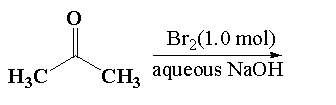
Reaction 1:
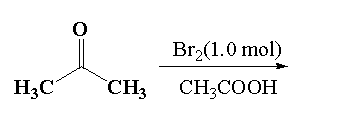
Reaction 2:
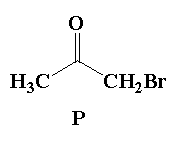
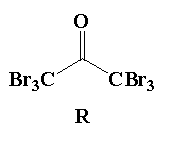
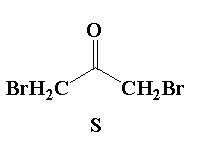
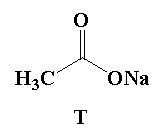
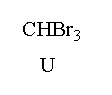
A. Reaction I: P and Reaction II: P
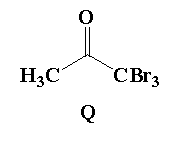
B. Reaction I: U, acetone and Reaction II: Q, acetone
C. Reaction I: T, U, acetone and reaction II:P
D. Reaction I: R, acetone and reaction II: S, acetone
Answer
 Verified
552.9k+ views
Hint: In the given reaction, two reactions are taking place first the acetone is reacting with bromine in the basic medium and in the second reaction the acetone is reacting with bromine in the acidic medium. In basic medium haloform reaction is taking place and in the acidic medium replacement of alpha hydrogen is taking place.
Complete step by step answer:
It is given that in reaction 1, acetone reacts with 1.0 mol of bromine in presence of an alkaline medium using an alkaline solution of sodium hydroxide. This reaction is called a haloform reaction. In haloform reaction. Methyl ketone is reacted with bromine, chlorine or iodine in presence of an alkaline medium containing hydroxide ions $O{H^ - }$to give carboxylate ions and haloform reactions.
Here, in this question acetone reacts with 1.0 mole of bromine in presence of sodium hydroxide to give sodium salt of acetic acid and a bromoform.
The reaction is shown below.
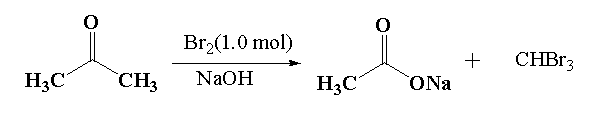
In the given mixture T is the sodium acetate and U is the bromoform.
It is given that in reaction 2, acetone reacts with 1.0 mol of bromine in presence of acetone (acidic medium). In this reaction the alpha hydrogen of acetone is replaced by the bromine atom to form alpha bromoacetone.
The reaction is shown below.
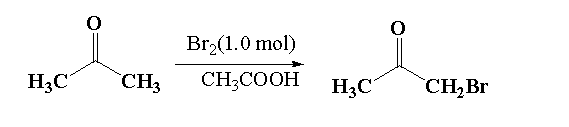
In the given mixture, alpha bromo acetone is P.
Therefore, the correct option is C.
Note:
Aldehyde does not give any haloform reaction but there is an exception in aldehydes. The only aldehyde which gives haloform reaction is acetaldehyde.
Complete step by step answer:
It is given that in reaction 1, acetone reacts with 1.0 mol of bromine in presence of an alkaline medium using an alkaline solution of sodium hydroxide. This reaction is called a haloform reaction. In haloform reaction. Methyl ketone is reacted with bromine, chlorine or iodine in presence of an alkaline medium containing hydroxide ions $O{H^ - }$to give carboxylate ions and haloform reactions.
Here, in this question acetone reacts with 1.0 mole of bromine in presence of sodium hydroxide to give sodium salt of acetic acid and a bromoform.
The reaction is shown below.
In the given mixture T is the sodium acetate and U is the bromoform.
It is given that in reaction 2, acetone reacts with 1.0 mol of bromine in presence of acetone (acidic medium). In this reaction the alpha hydrogen of acetone is replaced by the bromine atom to form alpha bromoacetone.
The reaction is shown below.
In the given mixture, alpha bromo acetone is P.
Therefore, the correct option is C.
Note:
Aldehyde does not give any haloform reaction but there is an exception in aldehydes. The only aldehyde which gives haloform reaction is acetaldehyde.
Recently Updated Pages
Master Class 12 Economics: Engaging Questions & Answers for Success

Master Class 12 Physics: Engaging Questions & Answers for Success
Master Class 12 English: Engaging Questions & Answers for Success
Master Class 12 Social Science: Engaging Questions & Answers for Success
Master Class 12 Maths: Engaging Questions & Answers for Success
Master Class 12 Business Studies: Engaging Questions & Answers for Success
Trending doubts
Which are the Top 10 Largest Countries of the World?
What are the major means of transport Explain each class 12 social science CBSE
Draw a labelled sketch of the human eye class 12 physics CBSE
What is a transformer Explain the principle construction class 12 physics CBSE
Why cannot DNA pass through cell membranes class 12 biology CBSE
Differentiate between insitu conservation and exsitu class 12 biology CBSE