




After refraction of light through a glass slab, incident ray and emergent ray are:
(A). Perpendicular
(B). Parallel
(C). In a straight line
(A) and (C)
Answer
 Verified
611.7k+ views
- Hint- In this question first we will make a clear ray diagram, and then we will proceed further by finding the angle between incident ray and emergent ray. By the help of diagram and the relation between the incident and refracted angle we will observe the relation between the incident and emergent ray.
Complete step-by-step solution -
We will use the following figure to solve this problem.
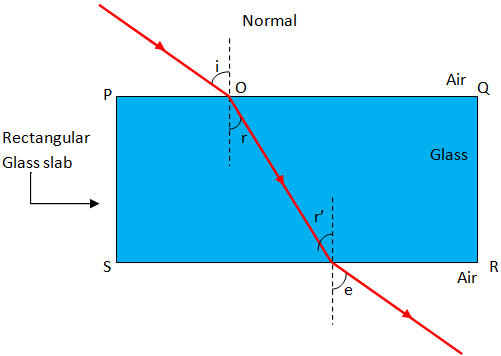
In the given figure:
“i” is the angle of incidence, “r” is the angle of refraction and “e” is the angle of emergence.
As we know that when light ray enters from rarer medium to denser medium it bends towards the normal and when the light ray enters from denser medium to rarer medium it bends away from the normal.
As we know, the density of air is lower than the density of glass.
So,
On entering into the glass medium light ray bends towards the normal that is light ray and gets refracted on entering the glass medium. After getting refracted this ray now travels through the glass slab and comes out of the glass slab by refraction from the other interface boundary. Since ray goes from glass medium to air it again gets refracted and bends away from normal.
The angle “r” and r’ are equal as they are adjacent interior angles to two parallel lines or normal.
Therefore, angle of incidence and angle of emergence are equal as emergent ray and incident ray are making the same angle after and before refraction on the same medium.
Hence, the incident ray and the emergent ray are parallel to each other.
So, option B is the correct option.
Note- Refraction is the change in direction of a wave passing from one medium to another or from a gradual change in the medium. Refraction of light is the most commonly observed phenomenon, but other waves such as sound waves and water waves also experience refraction. Students must remember the nature of light when it moves from rarer to denser medium and vice-versa.
Complete step-by-step solution -
We will use the following figure to solve this problem.
In the given figure:
“i” is the angle of incidence, “r” is the angle of refraction and “e” is the angle of emergence.
As we know that when light ray enters from rarer medium to denser medium it bends towards the normal and when the light ray enters from denser medium to rarer medium it bends away from the normal.
As we know, the density of air is lower than the density of glass.
So,
On entering into the glass medium light ray bends towards the normal that is light ray and gets refracted on entering the glass medium. After getting refracted this ray now travels through the glass slab and comes out of the glass slab by refraction from the other interface boundary. Since ray goes from glass medium to air it again gets refracted and bends away from normal.
The angle “r” and r’ are equal as they are adjacent interior angles to two parallel lines or normal.
Therefore, angle of incidence and angle of emergence are equal as emergent ray and incident ray are making the same angle after and before refraction on the same medium.
Hence, the incident ray and the emergent ray are parallel to each other.
So, option B is the correct option.
Note- Refraction is the change in direction of a wave passing from one medium to another or from a gradual change in the medium. Refraction of light is the most commonly observed phenomenon, but other waves such as sound waves and water waves also experience refraction. Students must remember the nature of light when it moves from rarer to denser medium and vice-versa.
Recently Updated Pages
Master Class 12 Economics: Engaging Questions & Answers for Success

Master Class 12 Physics: Engaging Questions & Answers for Success
Master Class 12 English: Engaging Questions & Answers for Success
Master Class 12 Social Science: Engaging Questions & Answers for Success
Master Class 12 Maths: Engaging Questions & Answers for Success
Master Class 12 Business Studies: Engaging Questions & Answers for Success
Trending doubts
Which are the Top 10 Largest Countries of the World?
What are the major means of transport Explain each class 12 social science CBSE
Draw a labelled sketch of the human eye class 12 physics CBSE
What is a transformer Explain the principle construction class 12 physics CBSE
Why cannot DNA pass through cell membranes class 12 biology CBSE
Differentiate between insitu conservation and exsitu class 12 biology CBSE