




Can you pull DNA from urine?
Answer
 Verified
478.5k+ views
Hint: DNA or deoxyribonucleic acid is the hereditary material in almost all organisms. Every cell in an individual’s body possesses the same DNA. While most DNA is located inside the nucleus of the cell (nuclear DNA), a lesser amount of DNA can be found in mitochondria (mitochondrial DNA). DNA is made up of four chemical bases, namely adenine, guanine, cytosine, and thymine.
Complete answer:
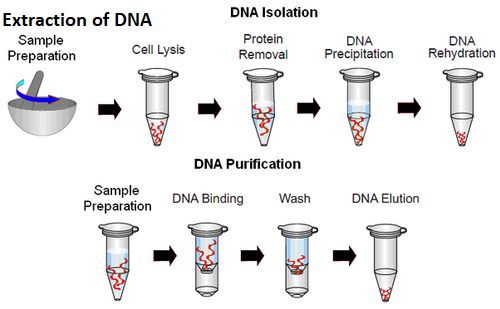
Fig: Steps in the Extraction of DNA
In humans, blood is an excellent source of the extraction of DNA. While white blood cells are rich sources of DNA, red blood cells lack nuclei.
There is DNA present in the urine excreted by humans. Urine possesses skin cells, semen and prostate discharges, and trace amounts of blood. Hence, a minute quantity of DNA can be extracted from human samples.
Saliva and blood are better sources of DNA. In addition, urine and human waste products can also be used for extraction. Urine is not considered as a potential source of DNA, due to the lower concentration of nucleated cells, present in human urine. Typically nucleated cells like white blood cells and epithelial cells are present in low amounts in urine. Female urine possesses a large amount of epithelial cells due to the vagina as a source.
DNA from urine can be used for the identification of a crime or placing a victim at a particular site. In a toxicology laboratory, DNA analysis is used to identify a person as a submitter of a specific urine sample, in the case of a contested positive sample.
For clinical testing, blood and saliva (containing skin cells) are primarily used for genetic testing. When other samples are not enough, urine is used. Urine itself does not consist of DNA, but it’s the skin cells in the urine that has the DNA.
Note:
In some diseases, nucleated cells are present in the urine, which contain DNA. But the DNA is a fragmented one. Pus cells present in small numbers contain DNA. Besides, most healthy individuals do not excrete epithelial cells in urine. Before testing, the DNA obtained may be amplified for getting handsome amounts and the same can be used for testing. Hence, DNA is a poor source of DNA.
Complete answer:
Fig: Steps in the Extraction of DNA
In humans, blood is an excellent source of the extraction of DNA. While white blood cells are rich sources of DNA, red blood cells lack nuclei.
There is DNA present in the urine excreted by humans. Urine possesses skin cells, semen and prostate discharges, and trace amounts of blood. Hence, a minute quantity of DNA can be extracted from human samples.
Saliva and blood are better sources of DNA. In addition, urine and human waste products can also be used for extraction. Urine is not considered as a potential source of DNA, due to the lower concentration of nucleated cells, present in human urine. Typically nucleated cells like white blood cells and epithelial cells are present in low amounts in urine. Female urine possesses a large amount of epithelial cells due to the vagina as a source.
DNA from urine can be used for the identification of a crime or placing a victim at a particular site. In a toxicology laboratory, DNA analysis is used to identify a person as a submitter of a specific urine sample, in the case of a contested positive sample.
For clinical testing, blood and saliva (containing skin cells) are primarily used for genetic testing. When other samples are not enough, urine is used. Urine itself does not consist of DNA, but it’s the skin cells in the urine that has the DNA.
Note:
In some diseases, nucleated cells are present in the urine, which contain DNA. But the DNA is a fragmented one. Pus cells present in small numbers contain DNA. Besides, most healthy individuals do not excrete epithelial cells in urine. Before testing, the DNA obtained may be amplified for getting handsome amounts and the same can be used for testing. Hence, DNA is a poor source of DNA.
Recently Updated Pages
Master Class 12 Economics: Engaging Questions & Answers for Success

Master Class 12 Physics: Engaging Questions & Answers for Success
Master Class 12 English: Engaging Questions & Answers for Success
Master Class 12 Social Science: Engaging Questions & Answers for Success
Master Class 12 Maths: Engaging Questions & Answers for Success
Master Class 12 Business Studies: Engaging Questions & Answers for Success
Trending doubts
Which are the Top 10 Largest Countries of the World?
What are the major means of transport Explain each class 12 social science CBSE
Draw a labelled sketch of the human eye class 12 physics CBSE
Why cannot DNA pass through cell membranes class 12 biology CBSE
Differentiate between insitu conservation and exsitu class 12 biology CBSE
Draw a neat and well labeled diagram of TS of ovary class 12 biology CBSE