




Find the area of the region bounded by the curve $ y = {x^2} $ and the line $ y = 4 $
Answer
 Verified
565.8k+ views
Hint: First of all we will draw a diagram with the given conditions and data. Then will find the coordinate and then place it in the integral function and then will place a limit in it and then will simplify for the required answer.
Complete step-by-step answer:
Draw the curve with the given data where \[y = 4\] and let line AB represents \[y = 4\].
Also, $ y = {x^2} $
It can be re-written as –
Let the curve AOB represents $ {x^2} = y $
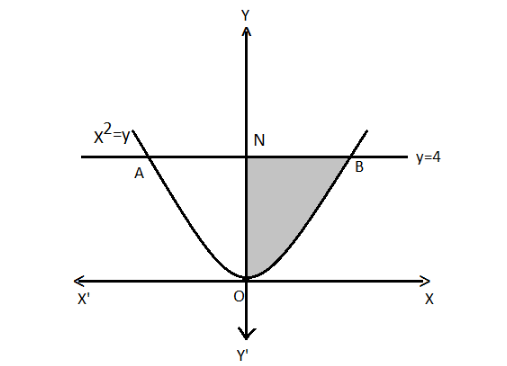
Now, the area of AOBA $ = 2 \times $ Area BONB
Place the values in the above expression –
Area $ = 2\int_0^4 x dy $ ..... (A)
We are given that –
$ {x^2} = y $
Take square-root on both the sides of the equation –
$ \sqrt {{x^2}} = \sqrt y $
Square and square-root cancel each other on the left hand side of the equation. Also, the square of positive and the negative term gives the positive term.
$ \therefore x = \pm \sqrt y $
Since BONB lies in first quadrant, we have $ x = + \sqrt y $
Place the above value in the equation (A)
Area of AOBA $ = 2\int_0^4 {xdy} $
Place value for “x”
Area of AOBA $ = 2\int_0^4 {\sqrt y dy} $
It can be written as using the law of exponent.
Area of AOBA $ = 2\int_0^4 {{y^{\dfrac{1}{2}}}dy} $
Use the identity: $ \int {{x^n}dx = \dfrac{{{x^{n + 1}}}}{{n + 1}}} $ in the above equation.
$ \Rightarrow A = 2\left[ {\dfrac{{{y^{\dfrac{1}{2} + 1}}}}{{\dfrac{1}{2} + 1}}} \right]_0^4 $
Simplify the above equation.
$ \Rightarrow A = 2\left[ {\dfrac{{{y^{\dfrac{3}{2}}}}}{{\dfrac{3}{2}}}} \right]_0^4 $
Place the limit in the above equation. Lower limit is subtracted from the upper limit.
$ \Rightarrow A = 2 \times \dfrac{2}{3}\left[ {{4^{\dfrac{3}{2}}} - 0} \right] $
Simplify the above equation.
$ \Rightarrow A = \dfrac{4}{3}\left[ {{{(2)}^{2 \times }}^{\dfrac{3}{2}}} \right] $
Common factors from the numerator and the denominator cancels each other. Therefore remove from the numerator and the denominator.
$ \Rightarrow A = \dfrac{4}{3}\left[ {{{(2)}^3}} \right] $
Simplify the above equation –
$ \Rightarrow A = \dfrac{{32}}{3} $
This is the required solution.
So, the correct answer is “ $ A = \dfrac{{32}}{3} $ Sq units ”.
Note: Remember the integration identity and be careful in placing the limits. Lower limit is always subtracted from the upper limit. Refer to different laws of power and exponent to simplify the expressions.
Complete step-by-step answer:
Draw the curve with the given data where \[y = 4\] and let line AB represents \[y = 4\].
Also, $ y = {x^2} $
It can be re-written as –
Let the curve AOB represents $ {x^2} = y $
Now, the area of AOBA $ = 2 \times $ Area BONB
Place the values in the above expression –
Area $ = 2\int_0^4 x dy $ ..... (A)
We are given that –
$ {x^2} = y $
Take square-root on both the sides of the equation –
$ \sqrt {{x^2}} = \sqrt y $
Square and square-root cancel each other on the left hand side of the equation. Also, the square of positive and the negative term gives the positive term.
$ \therefore x = \pm \sqrt y $
Since BONB lies in first quadrant, we have $ x = + \sqrt y $
Place the above value in the equation (A)
Area of AOBA $ = 2\int_0^4 {xdy} $
Place value for “x”
Area of AOBA $ = 2\int_0^4 {\sqrt y dy} $
It can be written as using the law of exponent.
Area of AOBA $ = 2\int_0^4 {{y^{\dfrac{1}{2}}}dy} $
Use the identity: $ \int {{x^n}dx = \dfrac{{{x^{n + 1}}}}{{n + 1}}} $ in the above equation.
$ \Rightarrow A = 2\left[ {\dfrac{{{y^{\dfrac{1}{2} + 1}}}}{{\dfrac{1}{2} + 1}}} \right]_0^4 $
Simplify the above equation.
$ \Rightarrow A = 2\left[ {\dfrac{{{y^{\dfrac{3}{2}}}}}{{\dfrac{3}{2}}}} \right]_0^4 $
Place the limit in the above equation. Lower limit is subtracted from the upper limit.
$ \Rightarrow A = 2 \times \dfrac{2}{3}\left[ {{4^{\dfrac{3}{2}}} - 0} \right] $
Simplify the above equation.
$ \Rightarrow A = \dfrac{4}{3}\left[ {{{(2)}^{2 \times }}^{\dfrac{3}{2}}} \right] $
Common factors from the numerator and the denominator cancels each other. Therefore remove from the numerator and the denominator.
$ \Rightarrow A = \dfrac{4}{3}\left[ {{{(2)}^3}} \right] $
Simplify the above equation –
$ \Rightarrow A = \dfrac{{32}}{3} $
This is the required solution.
So, the correct answer is “ $ A = \dfrac{{32}}{3} $ Sq units ”.
Note: Remember the integration identity and be careful in placing the limits. Lower limit is always subtracted from the upper limit. Refer to different laws of power and exponent to simplify the expressions.
Recently Updated Pages
Master Class 12 Economics: Engaging Questions & Answers for Success

Master Class 12 Physics: Engaging Questions & Answers for Success
Master Class 12 English: Engaging Questions & Answers for Success
Master Class 12 Social Science: Engaging Questions & Answers for Success
Master Class 12 Maths: Engaging Questions & Answers for Success
Master Class 12 Business Studies: Engaging Questions & Answers for Success
Trending doubts
Which are the Top 10 Largest Countries of the World?
What are the major means of transport Explain each class 12 social science CBSE
Draw a labelled sketch of the human eye class 12 physics CBSE
Why cannot DNA pass through cell membranes class 12 biology CBSE
Differentiate between insitu conservation and exsitu class 12 biology CBSE
Draw a neat and well labeled diagram of TS of ovary class 12 biology CBSE