




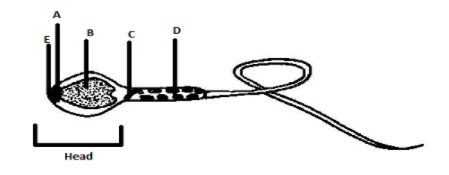
Identify the labelled parts A-E the given figure of sperm.
Answer
 Verified
570k+ views
Hint: A sperm is the male gamete that is responsible for the reproduction in humans, if the sperm gets defected the fertilisation process will not occur. Sperm is a motile gamete which have ‘n’ number of chromosomes via meiosis, it remains in a rest position or stored in the scrotum of the male gender. Sertoli cells give rise to the development of sperm.
Complete answer:
The labelled parts are:
A- Acrosome
B- Nucleus
C- Centriole
D- Mitochondria
E- Cell membrane
The cell membrane protects the structure and provides a covering which helps in making the surface very smooth. Acrosomes consist of digestive enzymes which help in eradicating the ovum cell wall by chemical reaction and making it easy to penetrate.
Head: Contains the nucleus with densely coiled chromatin fibres, surrounded anteriorly by using a skinny, flattened sac called the acrosome, which incorporates enzymes used for penetrating the lady egg. It also incorporates vacuoles.
Sperm centrioles help in the development of tail or flagellum, and also help in the development of embryos after fertilization.
Tail: Additionally known as the flagellum, is the longest element and capable of wave-like motion that propels sperm for swimming and aids in the penetration of the egg.
For energy and metabolism of sperm, mitochondria is useful.
The tail turned into the former notion to transport symmetrically in a helical shape.
The tail moves in a greater complicated manner, combining asymmetrical standing and travelling waves in addition to rotating the complete frame to attain a perceived symmetry.
Note: The midpiece has a central filamentous core with many mitochondria spiraled around it, used for ATP production for the journey via the female cervix, uterus, and uterine tubes.
During fertilization, the sperm gives three crucial parts to the oocyte:
- A signaling or activating element, which causes the metabolically dormant oocyte to activate.
- The haploid paternal genome.
- The centriole, that is liable for forming the centrosome and microtubule device.
Complete answer:
The labelled parts are:
A- Acrosome
B- Nucleus
C- Centriole
D- Mitochondria
E- Cell membrane
The cell membrane protects the structure and provides a covering which helps in making the surface very smooth. Acrosomes consist of digestive enzymes which help in eradicating the ovum cell wall by chemical reaction and making it easy to penetrate.
Head: Contains the nucleus with densely coiled chromatin fibres, surrounded anteriorly by using a skinny, flattened sac called the acrosome, which incorporates enzymes used for penetrating the lady egg. It also incorporates vacuoles.
Sperm centrioles help in the development of tail or flagellum, and also help in the development of embryos after fertilization.
Tail: Additionally known as the flagellum, is the longest element and capable of wave-like motion that propels sperm for swimming and aids in the penetration of the egg.
For energy and metabolism of sperm, mitochondria is useful.
The tail turned into the former notion to transport symmetrically in a helical shape.
The tail moves in a greater complicated manner, combining asymmetrical standing and travelling waves in addition to rotating the complete frame to attain a perceived symmetry.
Note: The midpiece has a central filamentous core with many mitochondria spiraled around it, used for ATP production for the journey via the female cervix, uterus, and uterine tubes.
During fertilization, the sperm gives three crucial parts to the oocyte:
- A signaling or activating element, which causes the metabolically dormant oocyte to activate.
- The haploid paternal genome.
- The centriole, that is liable for forming the centrosome and microtubule device.
Recently Updated Pages
Master Class 12 Economics: Engaging Questions & Answers for Success

Master Class 12 Physics: Engaging Questions & Answers for Success
Master Class 12 English: Engaging Questions & Answers for Success
Master Class 12 Social Science: Engaging Questions & Answers for Success
Master Class 12 Maths: Engaging Questions & Answers for Success
Master Class 12 Business Studies: Engaging Questions & Answers for Success
Trending doubts
Which are the Top 10 Largest Countries of the World?
What are the major means of transport Explain each class 12 social science CBSE
Draw a labelled sketch of the human eye class 12 physics CBSE
Why cannot DNA pass through cell membranes class 12 biology CBSE
Differentiate between insitu conservation and exsitu class 12 biology CBSE
Draw a neat and well labeled diagram of TS of ovary class 12 biology CBSE