



If \[OA\] and \[OB\] are two perpendicular chords of the circle \[r = a\cos \theta + b\sin \theta \] passing through origin, then the locus of the mid point of \[AB\] is:
A. \[{x^2} + {y^2} = \dfrac{{ax}}{2} + \dfrac{{by}}{2}\]
B. \[x = \dfrac{a}{2}\]
C. \[{x^2} - {y^2} = {a^2} + {b^2}\]
D. \[y = \dfrac{b}{2}\]
Answer
 Verified
552.6k+ views
Hint: Here, we have to find the locus of the midpoint of \[AB\]. We will use the equation of the line and the chord to solve the question. A chord of a circle is a straight line segment whose endpoints both lie on the circle.
Formula used:
We will use the following formulas:
1. The equation of the chord of the circle \[{x^2} + {y^2} + 2gx + 2fy + c = 0\]bisected at the point \[({x_1},{y_1})\] is given by \[T = {S_1}\]
2. If two lines are perpendicular to each other, we have \[{m_1}{m_2} = \dfrac{a}{b} = - 1\].
Complete Step by Step Solution:
We will first draw a circle with two perpendicular chords.
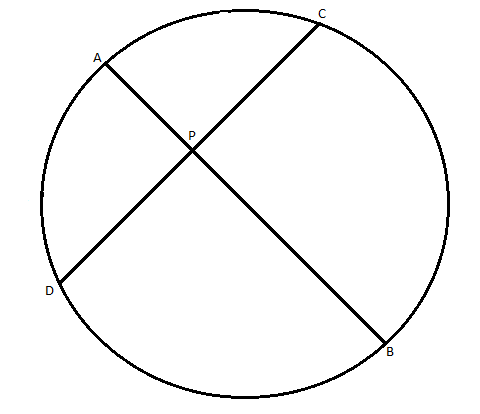
Here, AB and CD are two perpendicular chords of a circle.
We are given that two perpendicular chords of the circle \[r = a\cos \theta + b\sin \theta \] passing through origin
\[r = acos\theta + bsin\theta \] ……………………………… (1)
Multiplying equation (1) by \[r\] on both sides, we get
\[ \Rightarrow {r^2} = arcos\theta + brsin\theta \]…………………… (2)
The Cartesian equation of a circle is written as \[{r^2} = {x^2} + {y^2}\].
Polar coordinates of a circle are written as \[rcos\theta = x\] and \[rsin\theta = y\].
By substituting the Cartesian equation and rewriting the polar coordinates in equation (2), we have
\[ \Rightarrow {x^2} + {y^2} = ax + by\]
Rewriting the equation , we have
\[ \Rightarrow {x^2} + {y^2} - ax - by = 0\]
Thus the equation of the circle \[{x^2} + {y^2} - ax - by = 0\]
Now, we have to find the locus of the midpoint of the chord\[AB\].
Let the midpoint of chord \[AB\]be\[\left( {h,k} \right)\]
Since we have to find the locus at Midpoint of the chord AB at \[\left( {h,k} \right)\].
\[hx + ky - \dfrac{{a\left( {x + h} \right)}}{2} - \dfrac{{b\left( {y + k} \right)}}{2} = {h^2} + {k^2} - ah - bk\]
\[ \Rightarrow hx + ky - \dfrac{{ax}}{2} - \dfrac{{by}}{2} - {h^2} + {k^2} - \dfrac{{ah}}{2} - \dfrac{{bk}}{2} = 0\].
Homogenizing the equation, we get
\[ \Rightarrow {x^2} + {y^2} - \left( {ax + by} \right)\dfrac{{(hx + ky - \dfrac{{ax}}{2} - \dfrac{{by}}{2})}}{{({h^2} + {k^2} - \dfrac{{ah}}{2} - \dfrac{{bk}}{2})}} = 0\]
Rewriting the equation, we get
\[ \Rightarrow {x^2}\left( {{h^2} + {k^2} - \dfrac{{ah}}{2} - \dfrac{{bk}}{2}} \right) + {y^2}\left( {{h^2} + {k^2} - \dfrac{{ah}}{2} - \dfrac{{bk}}{2}} \right) - \left( {ah{x^2} - \dfrac{{{a^2}{x^2}}}{2} + bk{y^2} - \dfrac{{{b^2}{y^2}}}{2} + xy\left( p \right)} \right) = 0\]
Here \[p\] is the coefficient of \[xy\].
Since the two chords are perpendicular to each other, we have
\[ \Rightarrow {m_1}{m_2} = \dfrac{a}{b} = - 1\]
\[ \Rightarrow {h^2} + {k^2} - \dfrac{{ah}}{2} - \dfrac{{bk}}{2} = - {h^2} - {k^2} + \dfrac{{ah}}{2} + \dfrac{{bk}}{2}\]
\[ \Rightarrow 2\left( {{h^2} + {k^2} - \dfrac{{ah}}{2} - \dfrac{{bk}}{2}} \right) = 0\]
Rewriting the equation, we get
\[ \Rightarrow {h^2} + {k^2} - \dfrac{{ah}}{2} - \dfrac{{bk}}{2} = 0\]
Re-substituting \[(h,k)\] as \[(x,y)\], we get
Locus of the Midpoint is \[{x^2} + {y^2} - \dfrac{{ax}}{2} - \dfrac{{by}}{2} = 0\]
Therefore, the locus of the midpoint is \[{x^2} + {y^2} = \dfrac{{ax}}{2} + \dfrac{{by}}{2}\].
Hence option A is the correct answer.
Note:
Homogenization is the process of making it homogenous. That is, we should make the degree of every term the same. We have to be clear that the locus should be found out for the midpoint of the chord. When a point moves in a plane according to some given conditions the path along which it moves is called a locus. We should notice whether the points lie inside or outside or on the circle.
Formula used:
We will use the following formulas:
1. The equation of the chord of the circle \[{x^2} + {y^2} + 2gx + 2fy + c = 0\]bisected at the point \[({x_1},{y_1})\] is given by \[T = {S_1}\]
2. If two lines are perpendicular to each other, we have \[{m_1}{m_2} = \dfrac{a}{b} = - 1\].
Complete Step by Step Solution:
We will first draw a circle with two perpendicular chords.
Here, AB and CD are two perpendicular chords of a circle.
We are given that two perpendicular chords of the circle \[r = a\cos \theta + b\sin \theta \] passing through origin
\[r = acos\theta + bsin\theta \] ……………………………… (1)
Multiplying equation (1) by \[r\] on both sides, we get
\[ \Rightarrow {r^2} = arcos\theta + brsin\theta \]…………………… (2)
The Cartesian equation of a circle is written as \[{r^2} = {x^2} + {y^2}\].
Polar coordinates of a circle are written as \[rcos\theta = x\] and \[rsin\theta = y\].
By substituting the Cartesian equation and rewriting the polar coordinates in equation (2), we have
\[ \Rightarrow {x^2} + {y^2} = ax + by\]
Rewriting the equation , we have
\[ \Rightarrow {x^2} + {y^2} - ax - by = 0\]
Thus the equation of the circle \[{x^2} + {y^2} - ax - by = 0\]
Now, we have to find the locus of the midpoint of the chord\[AB\].
Let the midpoint of chord \[AB\]be\[\left( {h,k} \right)\]
Since we have to find the locus at Midpoint of the chord AB at \[\left( {h,k} \right)\].
\[hx + ky - \dfrac{{a\left( {x + h} \right)}}{2} - \dfrac{{b\left( {y + k} \right)}}{2} = {h^2} + {k^2} - ah - bk\]
\[ \Rightarrow hx + ky - \dfrac{{ax}}{2} - \dfrac{{by}}{2} - {h^2} + {k^2} - \dfrac{{ah}}{2} - \dfrac{{bk}}{2} = 0\].
Homogenizing the equation, we get
\[ \Rightarrow {x^2} + {y^2} - \left( {ax + by} \right)\dfrac{{(hx + ky - \dfrac{{ax}}{2} - \dfrac{{by}}{2})}}{{({h^2} + {k^2} - \dfrac{{ah}}{2} - \dfrac{{bk}}{2})}} = 0\]
Rewriting the equation, we get
\[ \Rightarrow {x^2}\left( {{h^2} + {k^2} - \dfrac{{ah}}{2} - \dfrac{{bk}}{2}} \right) + {y^2}\left( {{h^2} + {k^2} - \dfrac{{ah}}{2} - \dfrac{{bk}}{2}} \right) - \left( {ah{x^2} - \dfrac{{{a^2}{x^2}}}{2} + bk{y^2} - \dfrac{{{b^2}{y^2}}}{2} + xy\left( p \right)} \right) = 0\]
Here \[p\] is the coefficient of \[xy\].
Since the two chords are perpendicular to each other, we have
\[ \Rightarrow {m_1}{m_2} = \dfrac{a}{b} = - 1\]
\[ \Rightarrow {h^2} + {k^2} - \dfrac{{ah}}{2} - \dfrac{{bk}}{2} = - {h^2} - {k^2} + \dfrac{{ah}}{2} + \dfrac{{bk}}{2}\]
\[ \Rightarrow 2\left( {{h^2} + {k^2} - \dfrac{{ah}}{2} - \dfrac{{bk}}{2}} \right) = 0\]
Rewriting the equation, we get
\[ \Rightarrow {h^2} + {k^2} - \dfrac{{ah}}{2} - \dfrac{{bk}}{2} = 0\]
Re-substituting \[(h,k)\] as \[(x,y)\], we get
Locus of the Midpoint is \[{x^2} + {y^2} - \dfrac{{ax}}{2} - \dfrac{{by}}{2} = 0\]
Therefore, the locus of the midpoint is \[{x^2} + {y^2} = \dfrac{{ax}}{2} + \dfrac{{by}}{2}\].
Hence option A is the correct answer.
Note:
Homogenization is the process of making it homogenous. That is, we should make the degree of every term the same. We have to be clear that the locus should be found out for the midpoint of the chord. When a point moves in a plane according to some given conditions the path along which it moves is called a locus. We should notice whether the points lie inside or outside or on the circle.
Recently Updated Pages
Master Class 12 Economics: Engaging Questions & Answers for Success

Master Class 12 Physics: Engaging Questions & Answers for Success
Master Class 12 English: Engaging Questions & Answers for Success
Master Class 12 Social Science: Engaging Questions & Answers for Success
Master Class 12 Maths: Engaging Questions & Answers for Success
Master Class 12 Business Studies: Engaging Questions & Answers for Success
Trending doubts
Which are the Top 10 Largest Countries of the World?
What are the major means of transport Explain each class 12 social science CBSE
Draw a labelled sketch of the human eye class 12 physics CBSE
Why cannot DNA pass through cell membranes class 12 biology CBSE
Differentiate between insitu conservation and exsitu class 12 biology CBSE
Draw a neat and well labeled diagram of TS of ovary class 12 biology CBSE