




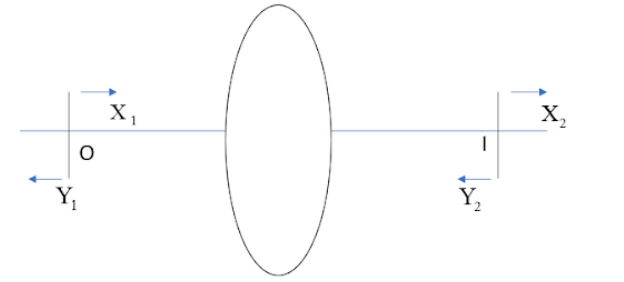
In a converging lens of focal length f and the distance between the real object and its real image if 4f. If the object moves \[{x_1}\] distance towards the lens its image moves \[{x_2}\] distance away from them and when the object moves \[{y_1}\] distance away from the lens its image moves \[{y_2}\] distance towards the lens, then choose the correct option:
A) ${x_1} > {x_2}$And ${y_1} > {y_2}$
B) ${x_1} < {x_2}$ And ${y_1} < {y_2}$
C) ${x_1} < {x_2}$And ${y_1} > {y_2}$
D) ${x_1} > {x_2}$And ${y_2} > {y_1}$
Answer
 Verified
586.2k+ views
Hint: Lens is a molded glass material that either converges or diverges the parallel incident rays coming to a principal axis. There are two types of lenses, converging and a diverging lens. The converging lens converges the incident rays coming parallel to the principal axis. The converging lens is thin at the upper and lower edges and thick in the middle. The converging lens is a double convex lens.
Complete step by step solution:
(i) Focal length$f$: Distance between the mirror and the principal focus. To find the Focal length, \[\dfrac{1}{f} = \dfrac{1}{{{d_o}}} + \dfrac{1}{{{d_i}}}\].
Where, ${d_o}$=distance between the object from the mirror, ${d_i}$= distance between the image and the mirror.
(ii) ${d_o}$ is always positive, ${d_i}$ is positive for the image which is the same as the object but negative if the image is opposite to the side of the object.
(iii) From the diagram, the object O and the image I are opposite to each other.
(iv) The distance of the images \[{x_2}\] and \[{y_2}\] are negative and the distance of the objects \[{x_1}\] and \[{y_1}\] is positive.
(iv) Hence the distance of the objects is greater than the images. Therefore, ${x_1} > {x_2}$ and ${y_1} > {y_2}$.
Therefore the correct option is A.
Note:
The focal length is positive for the converging lens. Hence the value of object distance is higher and the value of the image distance should be lower if in the case of the image opposite to the object. The image distance is maximum when in the case of the real image which means the object and image are on the same side.
Complete step by step solution:
(i) Focal length$f$: Distance between the mirror and the principal focus. To find the Focal length, \[\dfrac{1}{f} = \dfrac{1}{{{d_o}}} + \dfrac{1}{{{d_i}}}\].
Where, ${d_o}$=distance between the object from the mirror, ${d_i}$= distance between the image and the mirror.
(ii) ${d_o}$ is always positive, ${d_i}$ is positive for the image which is the same as the object but negative if the image is opposite to the side of the object.
(iii) From the diagram, the object O and the image I are opposite to each other.
(iv) The distance of the images \[{x_2}\] and \[{y_2}\] are negative and the distance of the objects \[{x_1}\] and \[{y_1}\] is positive.
(iv) Hence the distance of the objects is greater than the images. Therefore, ${x_1} > {x_2}$ and ${y_1} > {y_2}$.
Therefore the correct option is A.
Note:
The focal length is positive for the converging lens. Hence the value of object distance is higher and the value of the image distance should be lower if in the case of the image opposite to the object. The image distance is maximum when in the case of the real image which means the object and image are on the same side.
Recently Updated Pages
Master Class 12 Economics: Engaging Questions & Answers for Success

Master Class 12 Physics: Engaging Questions & Answers for Success
Master Class 12 English: Engaging Questions & Answers for Success
Master Class 12 Social Science: Engaging Questions & Answers for Success
Master Class 12 Maths: Engaging Questions & Answers for Success
Master Class 12 Business Studies: Engaging Questions & Answers for Success
Trending doubts
Which are the Top 10 Largest Countries of the World?
What are the major means of transport Explain each class 12 social science CBSE
Draw a labelled sketch of the human eye class 12 physics CBSE
What is a transformer Explain the principle construction class 12 physics CBSE
Why cannot DNA pass through cell membranes class 12 biology CBSE
Differentiate between insitu conservation and exsitu class 12 biology CBSE