




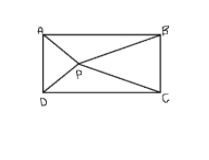
In given fig P is a point in the interior of a rectangle ABCD. Show that:
(1) $ar\left( {APB} \right) + ar\left( {CPD} \right) = \dfrac{1}{2}ar\left( {ABCD} \right)$
(2) $ar\left( {APD} \right) + ar\left( {BPC} \right) = ar\left( {APB} \right) + ar\left( {CPD} \right)$
Answer
 Verified
582.6k+ views
Hint: Draw a line passing through $P$ and parallel to side $AD$ cutting the sides $AB$ and $CD$ at $E$ and $F$ respectively.
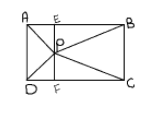
Then, find the area of Triangles $APB$ and $CPD$ by using the formula $area = \dfrac{1}{2} \times B \times H$ where $B$ is the base and $H$ is the height of the triangle. Then, add the area of both triangles. And compare it with the area of the rectangle.
Complete step by step answer:
Given, ABCD is a rectangle and area of rectangle $ABCD = AB \times AD$
($\because $ area of rectangle $ = $ length $ \times $ breadth)
Now, In triangle $APB$, $AB$ is the base of the triangle and $EP$ is the height of the triangle because $EP$ is perpendicular to $AB$.
So, area of triangle $APB = \dfrac{1}{2} \times AB \times EP$
Similarly, In triangle $CPD$, $CD$ is the base of the triangle and $FP$ is the height of the triangle.
So, area of triangle $CPD = \dfrac{1}{2} \times CD \times FP$
Now, adding the area of both triangles we get,
$\Rightarrow ar\left( {APB} \right) + ar\left( {CPD} \right) = \left( {\dfrac{1}{2} \times AB \times EP} \right) + \left( {\dfrac{1}{2} \times CD \times FP} \right)$
Taking $\dfrac{1}{2}$ common from both in right hand side we get,
$\Rightarrow ar\left( {APB} \right) + ar\left( {CPD} \right) = \dfrac{1}{2} \times \left( {\left( {AB \times EP} \right) + \left( {CD \times FP} \right)} \right)$
Since $ABCD$ is a rectangle so opposite sides are equal.
$\therefore AB = CD$
$\Rightarrow ar\left( {APB} \right) + ar\left( {CPD} \right) = \dfrac{1}{2} \times \left( {\left( {AB \times EP} \right) + \left( {AB \times FP} \right)} \right)$
Taking $AB$ common from both we get,
$\Rightarrow ar\left( {APB} \right) + ar\left( {CPD} \right) = \dfrac{1}{2} \times AB \times \left( {EP + FP} \right)$
From figure it is obvious that $EF = EP + FP$
$\therefore ar\left( {APB} \right) + ar\left( {CPD} \right) = \dfrac{1}{2} \times AB \times EF$
Now in rectangle $ABCD$, $AD = EF = BC$ because opposite sides are equal and parallel.
Thus, we can write
$\Rightarrow ar\left( {APB} \right) + ar\left( {CPD} \right) = \dfrac{1}{2} \times AB \times AD$
Since $ar\left( {ABCD} \right) = AB \times AD$ proved above.
We can finally write $ar\left( {APB} \right) + ar\left( {CPD} \right) = ar\left( {ABCD} \right)$
Hence, (1) is proved.
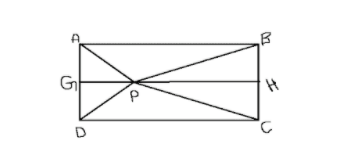
(2) Draw a line passing through $P$ and parallel to $AB$ then find the area of triangles $APD$ and $BPC$ using formula $area = \dfrac{1}{2} \times B \times H$ where $B$ is the base and $H$ is the height of the triangle. Then, add the area of both triangles.
Given, ABCD is a rectangle and area of rectangle $ABCD = AB \times AD$
($\because $ area of rectangle $ = $ length $ \times $ breadth)
Now, In triangle $APD$, $AD$ is the base of triangle and $GP$ is the height of triangle because $GP$ is perpendicular to $AD$.
So, area of triangle $APD = \dfrac{1}{2} \times AD \times GP$
Similarly, In triangle $BPC$, $BC$ is the base of the triangle and $HP$ is the height of the triangle.
So, area of triangle $BPC = \dfrac{1}{2} \times BC \times HP$
Now, adding the area of both triangles we get,
$\Rightarrow ar\left( {APD} \right) + ar\left( {BPC} \right) = \left( {\dfrac{1}{2} \times AD \times GP} \right) + \left( {\dfrac{1}{2} \times BC \times HP} \right)$
Taking $\dfrac{1}{2}$ common from both in right hand side we get,
$\Rightarrow ar\left( {APD} \right) + ar\left( {BPC} \right) = \dfrac{1}{2} \times \left( {\left( {AD \times GP} \right) + \left( {BC \times HP} \right)} \right)$
Since,$ABCD$ is a rectangle so opposite sides are equal.
$\therefore AD = {\rm B}C$
$\Rightarrow ar\left( {APD} \right) + ar\left( {BPC} \right) = \dfrac{1}{2} \times \left( {\left( {AD \times GP} \right) + \left( {AD \times HP} \right)} \right)$
Taking $AD$ common from both we get,
$\Rightarrow ar\left( {APD} \right) + ar\left( {BPC} \right) = \dfrac{1}{2} \times AD \times \left( {GP + {\rm H}P} \right)$
From figure it is obvious that $GH = GP + HP$
$\therefore ar\left( {APD} \right) + ar\left( {BPC} \right) = \dfrac{1}{2} \times AD \times GH$
Now in rectangle $ABCD$, $AB = CD = GH$ because opposite sides are equal and parallel.
Thus, we can write
$\Rightarrow ar\left( {APD} \right) + ar\left( {BPC} \right) = \dfrac{1}{2} \times AD \times AB$
Since $ar\left( {ABCD} \right) = AB \times AD$ proved above.
We can finally write $ar\left( {APD} \right) + ar\left( {BPC} \right) = ar\left( {ABCD} \right)$
Since the right side of the result of (1) and of this are equal so, we can equate the left-hand side then,
$\Rightarrow ar\left( {APB} \right) + ar\left( {CPD} \right) = ar\left( {APD} \right) + ar\left( {BPC} \right) = \dfrac{1}{2}ar\left( {ABCD} \right)$
Hence, (2) is proved.
Note:
- In this type of problem make suitable construction which converts the given figure into a known figure whose area and perimeter can be written easily
- If the right-hand side of two equations is equal then we can say that the left-hand side must be equal.
- This relation is also valid in the case of a square.
Then, find the area of Triangles $APB$ and $CPD$ by using the formula $area = \dfrac{1}{2} \times B \times H$ where $B$ is the base and $H$ is the height of the triangle. Then, add the area of both triangles. And compare it with the area of the rectangle.
Complete step by step answer:
Given, ABCD is a rectangle and area of rectangle $ABCD = AB \times AD$
($\because $ area of rectangle $ = $ length $ \times $ breadth)
Now, In triangle $APB$, $AB$ is the base of the triangle and $EP$ is the height of the triangle because $EP$ is perpendicular to $AB$.
So, area of triangle $APB = \dfrac{1}{2} \times AB \times EP$
Similarly, In triangle $CPD$, $CD$ is the base of the triangle and $FP$ is the height of the triangle.
So, area of triangle $CPD = \dfrac{1}{2} \times CD \times FP$
Now, adding the area of both triangles we get,
$\Rightarrow ar\left( {APB} \right) + ar\left( {CPD} \right) = \left( {\dfrac{1}{2} \times AB \times EP} \right) + \left( {\dfrac{1}{2} \times CD \times FP} \right)$
Taking $\dfrac{1}{2}$ common from both in right hand side we get,
$\Rightarrow ar\left( {APB} \right) + ar\left( {CPD} \right) = \dfrac{1}{2} \times \left( {\left( {AB \times EP} \right) + \left( {CD \times FP} \right)} \right)$
Since $ABCD$ is a rectangle so opposite sides are equal.
$\therefore AB = CD$
$\Rightarrow ar\left( {APB} \right) + ar\left( {CPD} \right) = \dfrac{1}{2} \times \left( {\left( {AB \times EP} \right) + \left( {AB \times FP} \right)} \right)$
Taking $AB$ common from both we get,
$\Rightarrow ar\left( {APB} \right) + ar\left( {CPD} \right) = \dfrac{1}{2} \times AB \times \left( {EP + FP} \right)$
From figure it is obvious that $EF = EP + FP$
$\therefore ar\left( {APB} \right) + ar\left( {CPD} \right) = \dfrac{1}{2} \times AB \times EF$
Now in rectangle $ABCD$, $AD = EF = BC$ because opposite sides are equal and parallel.
Thus, we can write
$\Rightarrow ar\left( {APB} \right) + ar\left( {CPD} \right) = \dfrac{1}{2} \times AB \times AD$
Since $ar\left( {ABCD} \right) = AB \times AD$ proved above.
We can finally write $ar\left( {APB} \right) + ar\left( {CPD} \right) = ar\left( {ABCD} \right)$
Hence, (1) is proved.
(2) Draw a line passing through $P$ and parallel to $AB$ then find the area of triangles $APD$ and $BPC$ using formula $area = \dfrac{1}{2} \times B \times H$ where $B$ is the base and $H$ is the height of the triangle. Then, add the area of both triangles.
Given, ABCD is a rectangle and area of rectangle $ABCD = AB \times AD$
($\because $ area of rectangle $ = $ length $ \times $ breadth)
Now, In triangle $APD$, $AD$ is the base of triangle and $GP$ is the height of triangle because $GP$ is perpendicular to $AD$.
So, area of triangle $APD = \dfrac{1}{2} \times AD \times GP$
Similarly, In triangle $BPC$, $BC$ is the base of the triangle and $HP$ is the height of the triangle.
So, area of triangle $BPC = \dfrac{1}{2} \times BC \times HP$
Now, adding the area of both triangles we get,
$\Rightarrow ar\left( {APD} \right) + ar\left( {BPC} \right) = \left( {\dfrac{1}{2} \times AD \times GP} \right) + \left( {\dfrac{1}{2} \times BC \times HP} \right)$
Taking $\dfrac{1}{2}$ common from both in right hand side we get,
$\Rightarrow ar\left( {APD} \right) + ar\left( {BPC} \right) = \dfrac{1}{2} \times \left( {\left( {AD \times GP} \right) + \left( {BC \times HP} \right)} \right)$
Since,$ABCD$ is a rectangle so opposite sides are equal.
$\therefore AD = {\rm B}C$
$\Rightarrow ar\left( {APD} \right) + ar\left( {BPC} \right) = \dfrac{1}{2} \times \left( {\left( {AD \times GP} \right) + \left( {AD \times HP} \right)} \right)$
Taking $AD$ common from both we get,
$\Rightarrow ar\left( {APD} \right) + ar\left( {BPC} \right) = \dfrac{1}{2} \times AD \times \left( {GP + {\rm H}P} \right)$
From figure it is obvious that $GH = GP + HP$
$\therefore ar\left( {APD} \right) + ar\left( {BPC} \right) = \dfrac{1}{2} \times AD \times GH$
Now in rectangle $ABCD$, $AB = CD = GH$ because opposite sides are equal and parallel.
Thus, we can write
$\Rightarrow ar\left( {APD} \right) + ar\left( {BPC} \right) = \dfrac{1}{2} \times AD \times AB$
Since $ar\left( {ABCD} \right) = AB \times AD$ proved above.
We can finally write $ar\left( {APD} \right) + ar\left( {BPC} \right) = ar\left( {ABCD} \right)$
Since the right side of the result of (1) and of this are equal so, we can equate the left-hand side then,
$\Rightarrow ar\left( {APB} \right) + ar\left( {CPD} \right) = ar\left( {APD} \right) + ar\left( {BPC} \right) = \dfrac{1}{2}ar\left( {ABCD} \right)$
Hence, (2) is proved.
Note:
- In this type of problem make suitable construction which converts the given figure into a known figure whose area and perimeter can be written easily
- If the right-hand side of two equations is equal then we can say that the left-hand side must be equal.
- This relation is also valid in the case of a square.
Recently Updated Pages
Master Class 10 Computer Science: Engaging Questions & Answers for Success

Master Class 10 General Knowledge: Engaging Questions & Answers for Success
Master Class 10 English: Engaging Questions & Answers for Success
Master Class 10 Social Science: Engaging Questions & Answers for Success
Master Class 10 Maths: Engaging Questions & Answers for Success
Master Class 10 Science: Engaging Questions & Answers for Success
Trending doubts
What is the median of the first 10 natural numbers class 10 maths CBSE
Which women's tennis player has 24 Grand Slam singles titles?
Who is the Brand Ambassador of Incredible India?
Why is there a time difference of about 5 hours between class 10 social science CBSE
Write a letter to the principal requesting him to grant class 10 english CBSE
State and prove converse of BPT Basic Proportionality class 10 maths CBSE