




Magnetic field outside the solenoid is:
A) Zero
B) Strong
C) Infinite
D) Negligible
Answer
 Verified
528.6k+ views
Hint: Magnetic field lines are closed loops, it cannot converge or diverge from a point like an electric field. The solenoid is a helical structure formed by a coil.
Complete step by step answer:
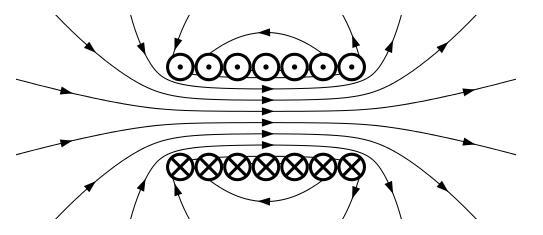
If the solenoid is carrying current in its coil, the current flowing will produce a magnetic field along the axis of the solenoid. Given above is the diagram of a cross section of a solenoid, imagine the cross section is obtained by cutting the solenoid in half and we are looking at the part where the coils have been cut.
The upper part of the section is the section in which we can consider that the current is coming out, so the direction of the magnetic field which can be determined from the right hand thumb rule is out of the paper or screen.
The lower part of the section is the section in which we can consider that the current is going in, so the direction of the magnetic field which can be determined from the right hand thumb rule is into the paper or screen.
So these separate sections provide magnetic fields in opposite directions, one into the paper/screen while on outside the paper/screen. The magnetic field lines of these sections will be in the same direction inside the loop, you can see that in the figure. So this will create a strong magnetic field in the inside of the coil, especially at the center.
But, as you can see from the figure, the magnetic fields are in opposite directions outside the loop. So the magnetic field of the upper section will try to reduce the magnetic field produced in the lower section, outside the loop. So the magnetic field outside the solenoid will be really low and almost negligible.
So the answer to the question is option (D)-Negligible
Note: For a very long solenoid the magnetic field outside will be zero and magnetic will be present only inside the solenoid.
The right hand thumb rule states that, ‘When the current carrying conductor is held in the right hand while the thumb points towards the direction of current, the direction of the fingers curled around the conductor, gives the direction of magnetic field lines along the conductor.’
Complete step by step answer:
If the solenoid is carrying current in its coil, the current flowing will produce a magnetic field along the axis of the solenoid. Given above is the diagram of a cross section of a solenoid, imagine the cross section is obtained by cutting the solenoid in half and we are looking at the part where the coils have been cut.
The upper part of the section is the section in which we can consider that the current is coming out, so the direction of the magnetic field which can be determined from the right hand thumb rule is out of the paper or screen.
The lower part of the section is the section in which we can consider that the current is going in, so the direction of the magnetic field which can be determined from the right hand thumb rule is into the paper or screen.
So these separate sections provide magnetic fields in opposite directions, one into the paper/screen while on outside the paper/screen. The magnetic field lines of these sections will be in the same direction inside the loop, you can see that in the figure. So this will create a strong magnetic field in the inside of the coil, especially at the center.
But, as you can see from the figure, the magnetic fields are in opposite directions outside the loop. So the magnetic field of the upper section will try to reduce the magnetic field produced in the lower section, outside the loop. So the magnetic field outside the solenoid will be really low and almost negligible.
So the answer to the question is option (D)-Negligible
Note: For a very long solenoid the magnetic field outside will be zero and magnetic will be present only inside the solenoid.
The right hand thumb rule states that, ‘When the current carrying conductor is held in the right hand while the thumb points towards the direction of current, the direction of the fingers curled around the conductor, gives the direction of magnetic field lines along the conductor.’
Recently Updated Pages
Master Class 12 Economics: Engaging Questions & Answers for Success

Master Class 12 Physics: Engaging Questions & Answers for Success
Master Class 12 English: Engaging Questions & Answers for Success
Master Class 12 Social Science: Engaging Questions & Answers for Success
Master Class 12 Maths: Engaging Questions & Answers for Success
Master Class 12 Business Studies: Engaging Questions & Answers for Success
Trending doubts
Which are the Top 10 Largest Countries of the World?
What are the major means of transport Explain each class 12 social science CBSE
Draw a labelled sketch of the human eye class 12 physics CBSE
Why cannot DNA pass through cell membranes class 12 biology CBSE
Differentiate between insitu conservation and exsitu class 12 biology CBSE
Draw a neat and well labeled diagram of TS of ovary class 12 biology CBSE