



How many sides do a polygon have whose sum of the interior angles is \[1980^\circ \]?
A) 10
B) 13
C) 11
D) None of the above
Answer
 Verified
492.9k+ views
Hint: A polygon is a closed figure. It can have both regular and irregular sides. There is a formula that can be used to calculate the sum of interior angles using the sides of the polygon. So, in this case, the sum of interior angles is given, and we have to reverse the calculation to get the sides of the polygon.
Complete step by step answer:
The sum of interior angles of a polygon formula is based on the sum of interior angles of a triangle, which is \[180^\circ \]. So, we know that,
\[S = (n - 2) \times 180^\circ \]
Where n is the number of sides of the polygon and S is the sum of interior angles. Now, by putting the value of S as \[1980^\circ \] , we can derive the number of sides.
\[ \Rightarrow 1980^\circ = (n - 2) \times 180^\circ \]
By taking \[180^\circ \] on the other side, we get
\[ \Rightarrow \dfrac{{1980^\circ }}{{180^\circ }} = (n - 2)\]
\[ \Rightarrow 11 = (n - 2)\]
And finally, by taking 2 on the other side
\[ \Rightarrow 11 + 2 = n\]
\[ \Rightarrow n = 13\]
Hence, the number of sides in a polygon, having the sum of interior angles \[1980^\circ \], is 13.
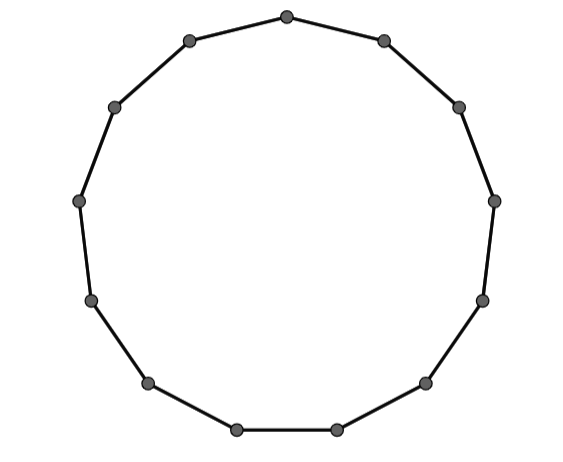
So, the correct answer is “Option B”.
Note:
Remember that we reversed the formula because the sum of interior angles was given. However, if the sides are specified in the question, we will put the value in n's place and calculate the total of internal angles. Also, there is a huge difference between the sum of interior angles and the sum of exterior angles, so don’t get confused between the two.
Complete step by step answer:
The sum of interior angles of a polygon formula is based on the sum of interior angles of a triangle, which is \[180^\circ \]. So, we know that,
\[S = (n - 2) \times 180^\circ \]
Where n is the number of sides of the polygon and S is the sum of interior angles. Now, by putting the value of S as \[1980^\circ \] , we can derive the number of sides.
\[ \Rightarrow 1980^\circ = (n - 2) \times 180^\circ \]
By taking \[180^\circ \] on the other side, we get
\[ \Rightarrow \dfrac{{1980^\circ }}{{180^\circ }} = (n - 2)\]
\[ \Rightarrow 11 = (n - 2)\]
And finally, by taking 2 on the other side
\[ \Rightarrow 11 + 2 = n\]
\[ \Rightarrow n = 13\]
Hence, the number of sides in a polygon, having the sum of interior angles \[1980^\circ \], is 13.
So, the correct answer is “Option B”.
Note:
Remember that we reversed the formula because the sum of interior angles was given. However, if the sides are specified in the question, we will put the value in n's place and calculate the total of internal angles. Also, there is a huge difference between the sum of interior angles and the sum of exterior angles, so don’t get confused between the two.
Recently Updated Pages
Master Class 8 Social Science: Engaging Questions & Answers for Success

Master Class 8 English: Engaging Questions & Answers for Success
Class 8 Question and Answer - Your Ultimate Solutions Guide
Master Class 8 Maths: Engaging Questions & Answers for Success
Master Class 8 Science: Engaging Questions & Answers for Success
Master Class 9 General Knowledge: Engaging Questions & Answers for Success
Trending doubts
What is BLO What is the full form of BLO class 8 social science CBSE
Citizens of India can vote at the age of A 18 years class 8 social science CBSE
Full form of STD, ISD and PCO
Advantages and disadvantages of science
Right to vote is a AFundamental Right BFundamental class 8 social science CBSE
What are the 12 elements of nature class 8 chemistry CBSE