




How do you solve the equation \[{x^2} - 2x - 24 = 0\] by graphing?
Answer
 Verified
555.3k+ views
Hint: Here, we will first find the \[x\] and \[y\] intercepts and the vertex to plot the graph of this equation. As this is a quadratic equation, its graph will be U-shaped. After plotting the graph, we will observe what are the possible values of \[x\] when \[y = 0\] to find the required solution using the graph.
Complete step-by-step answer:
The given quadratic equation is: \[{x^2} - 2x - 24 = 0\]
Now, in order to plot a graph of this equation, we will, first of all, determine the \[y\] intercept.
Hence, we will substitute \[x = 0\]
Hence, \[y = f\left( 0 \right) = {\left( 0 \right)^2} - 2\left( 0 \right) - 24 = - 24\]
Thus, the \[y\] intercept is \[\left( {0, - 24} \right)\]
Now, we will determine the \[x\] intercept, by substituting \[y = f\left( x \right) = 0\]
\[{x^2} - 2x - 24 = 0\]
Doing middle term split, we get
\[ \Rightarrow {x^2} - 6x + 4x - 24 = 0\]
\[ \Rightarrow x\left( {x - 6} \right) + 4\left( {x - 6} \right) = 0\]
Factoring out common terms, we get
\[ \Rightarrow \left( {x + 4} \right)\left( {x - 6} \right) = 0\]
By using zero product property, we get
\[\begin{array}{l} \Rightarrow \left( {x + 4} \right) = 0\\ \Rightarrow x = - 4\end{array}\]
Or
\[\begin{array}{l} \Rightarrow \left( {x - 6} \right) = 0\\ \Rightarrow x = 6\end{array}\]
Therefore, for \[y = 0\], we get two \[x\] intercepts, i.e. \[\left( { - 4,0} \right)\] and \[\left( {6,0} \right)\]
Now, we will determine the vertex by using the formula \[x = \dfrac{{ - b}}{{2a}}\] to find the \[x\]-value of the vertex and then, we will substitute this value in the function to find the corresponding value of \[y\].
In the given equation, \[{x^2} - 2x - 24 = 0\] by comparing it to \[a{x^2} + bx + c = 0\], we get,
\[a = 1\], \[b = - 2\] and \[c = - 24\]
Thus, substituting these values in \[x = \dfrac{{ - b}}{{2a}}\], we get,
\[x = \dfrac{{ - \left( { - 2} \right)}}{{2\left( 1 \right)}} = \dfrac{2}{2} = 1\]
Substituting this is the equation \[y = {x^2} - 2x - 24\], we get,
\[y = {1^2} - 2\left( 1 \right) - 24\]
Simplifying the expression, we get
\[ \Rightarrow y = 1 - 2 - 24 = - 25\]
Therefore, the vertex is: \[\left( {1, - 25} \right)\]
Also, let us substitute \[x = 2\] in the \[y = {x^2} - 2x - 24\] thus, we get,
\[y = {2^2} - 2\left( 2 \right) - 24\]
Simplifying the expression, we get
\[ \Rightarrow y = 4 - 4 - 24 = - 24\]
Therefore, the other point is \[\left( {2, - 24} \right)\]
Hence, we will plot the graph having:
\[y\] intercept as \[\left( {0, - 24} \right)\]
\[x\] intercepts as \[\left( { - 4,0} \right)\] and \[\left( {6,0} \right)\]
Vertex: \[\left( {1, - 25} \right)\]
Extra point: \[\left( {2, - 24} \right)\]
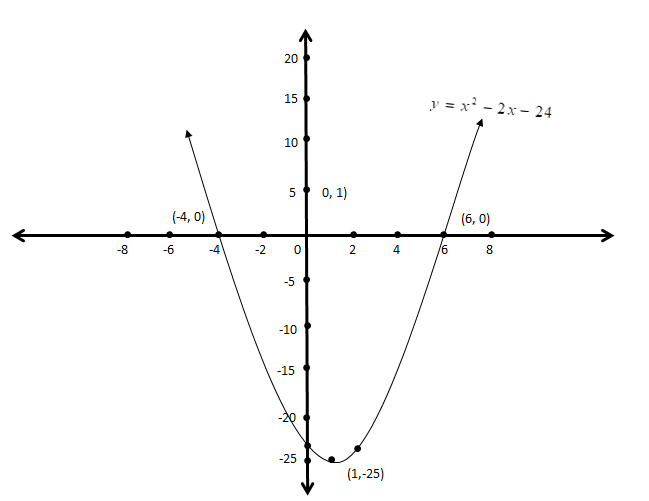
Hence, from this graph, we can clearly observe that the values \[x = - 4\]and \[x = 6\] when \[y = 0\]
Therefore, this is the required solution of the given equation \[{x^2} - 2x - 24 = 0\] by graphing.
Hence, this is the required answer.
Note:
An equation is called a quadratic equation if it can be written in the form of \[a{x^2} + bx + c = 0\] where \[a,b,c\] are real numbers and \[a \ne 0\] , as it is the coefficient of \[{x^2}\] and it determines that this is a quadratic equation. Also, the power of a quadratic equation will be 2 as it is a ‘quadratic equation’. Also, a quadratic equation will give us two roots and its graph is U-shaped as we can observe from this question.
Complete step-by-step answer:
The given quadratic equation is: \[{x^2} - 2x - 24 = 0\]
Now, in order to plot a graph of this equation, we will, first of all, determine the \[y\] intercept.
Hence, we will substitute \[x = 0\]
Hence, \[y = f\left( 0 \right) = {\left( 0 \right)^2} - 2\left( 0 \right) - 24 = - 24\]
Thus, the \[y\] intercept is \[\left( {0, - 24} \right)\]
Now, we will determine the \[x\] intercept, by substituting \[y = f\left( x \right) = 0\]
\[{x^2} - 2x - 24 = 0\]
Doing middle term split, we get
\[ \Rightarrow {x^2} - 6x + 4x - 24 = 0\]
\[ \Rightarrow x\left( {x - 6} \right) + 4\left( {x - 6} \right) = 0\]
Factoring out common terms, we get
\[ \Rightarrow \left( {x + 4} \right)\left( {x - 6} \right) = 0\]
By using zero product property, we get
\[\begin{array}{l} \Rightarrow \left( {x + 4} \right) = 0\\ \Rightarrow x = - 4\end{array}\]
Or
\[\begin{array}{l} \Rightarrow \left( {x - 6} \right) = 0\\ \Rightarrow x = 6\end{array}\]
Therefore, for \[y = 0\], we get two \[x\] intercepts, i.e. \[\left( { - 4,0} \right)\] and \[\left( {6,0} \right)\]
Now, we will determine the vertex by using the formula \[x = \dfrac{{ - b}}{{2a}}\] to find the \[x\]-value of the vertex and then, we will substitute this value in the function to find the corresponding value of \[y\].
In the given equation, \[{x^2} - 2x - 24 = 0\] by comparing it to \[a{x^2} + bx + c = 0\], we get,
\[a = 1\], \[b = - 2\] and \[c = - 24\]
Thus, substituting these values in \[x = \dfrac{{ - b}}{{2a}}\], we get,
\[x = \dfrac{{ - \left( { - 2} \right)}}{{2\left( 1 \right)}} = \dfrac{2}{2} = 1\]
Substituting this is the equation \[y = {x^2} - 2x - 24\], we get,
\[y = {1^2} - 2\left( 1 \right) - 24\]
Simplifying the expression, we get
\[ \Rightarrow y = 1 - 2 - 24 = - 25\]
Therefore, the vertex is: \[\left( {1, - 25} \right)\]
Also, let us substitute \[x = 2\] in the \[y = {x^2} - 2x - 24\] thus, we get,
\[y = {2^2} - 2\left( 2 \right) - 24\]
Simplifying the expression, we get
\[ \Rightarrow y = 4 - 4 - 24 = - 24\]
Therefore, the other point is \[\left( {2, - 24} \right)\]
Hence, we will plot the graph having:
\[y\] intercept as \[\left( {0, - 24} \right)\]
\[x\] intercepts as \[\left( { - 4,0} \right)\] and \[\left( {6,0} \right)\]
Vertex: \[\left( {1, - 25} \right)\]
Extra point: \[\left( {2, - 24} \right)\]
Hence, from this graph, we can clearly observe that the values \[x = - 4\]and \[x = 6\] when \[y = 0\]
Therefore, this is the required solution of the given equation \[{x^2} - 2x - 24 = 0\] by graphing.
Hence, this is the required answer.
Note:
An equation is called a quadratic equation if it can be written in the form of \[a{x^2} + bx + c = 0\] where \[a,b,c\] are real numbers and \[a \ne 0\] , as it is the coefficient of \[{x^2}\] and it determines that this is a quadratic equation. Also, the power of a quadratic equation will be 2 as it is a ‘quadratic equation’. Also, a quadratic equation will give us two roots and its graph is U-shaped as we can observe from this question.
Recently Updated Pages
Master Class 10 Computer Science: Engaging Questions & Answers for Success

Master Class 10 General Knowledge: Engaging Questions & Answers for Success
Master Class 10 English: Engaging Questions & Answers for Success
Master Class 10 Social Science: Engaging Questions & Answers for Success
Master Class 10 Maths: Engaging Questions & Answers for Success
Master Class 10 Science: Engaging Questions & Answers for Success
Trending doubts
What is the median of the first 10 natural numbers class 10 maths CBSE
Which women's tennis player has 24 Grand Slam singles titles?
Who is the Brand Ambassador of Incredible India?
Why is there a time difference of about 5 hours between class 10 social science CBSE
Write a letter to the principal requesting him to grant class 10 english CBSE
A moving boat is observed from the top of a 150 m high class 10 maths CBSE